Jul
14
2026
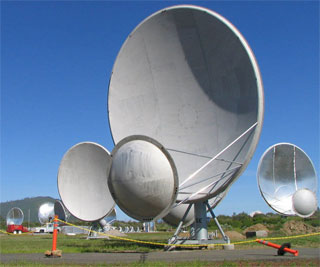 I have been a supporter of the Search for Extraterrestrial Intelligence (SETI) since I learned of its existence. Essentially, SETI is a search for technosignatures of alien origin, specifically using radio astronomy. However, I occasionally encounter skepticism toward SETI, and I love to engage with fellow skeptics on topic about which we disagree. I recently received an e-mail with a fairly typical skeptical perspective:
“I am sure we will eventually find signs or evidence of life outside our solar system but the likelihood of finding a life form that can communicate on a level that we can understand seems so unlikely as to be not worth pursuing from an economic point of view.”
His basic argument is that, in order for us to communicate with an alien technological species they would have to be very similar to us. This would require a degree of “parallel evolution” that is fantastically unlikely. Even given the vastness of the universe, he feels the probably is simply too close to zero to justify any investment. I disagree, however, with his core premise.
First let me say that we simply have no idea how common life, intelligent life, and technological civilizations are in the universe. That is one of the questions SETI is attempting to answer. We suffer from the so-called “N of 1” problem – we have only one example of life and a technological species. He agrees life is likely common, which I think is likely, but feels technological species are exceedingly rare, but we simply have no basis for this conclusion. The evolution of greater intelligence occurred in many clades on Earth. Many, of course, like insects, will never achieve technological status, but that doesn’t matter. Greater intelligence is a massive evolutionary advantage, and is likely to occur in many lines.
Continue Reading »
Jul
13
2026

When I was a child I would love looking up at the night sky. I became quite familiar with the northern sky, and how it changed from summer to winter. I could clearly see the Milky Way, which was always stunning. I took it for granted.
Today I rarely see the Milky Way. I live in the burbs and can still see a lot of stars at night, but it is nothing like 50 years ago. Even in small cities, you can only see the brightest stars. In order to get an experience like I had regularly in my youth you have to go to a dark sky location – the nearest one to me is a six hour drive. The first two times I visited the southern hemisphere I didn’t see the night sky once. On my third trip I had to make a dedicated trip to a semi-dark sky location to get my first view of the southern sky, which was magnificent.
If all of the currently proposed satellites are eventually launched, there may be no dark skies left anywhere. Ground-based astronomy might also become extremely difficult, to practically impossible. Right now there are over 16,000 satellites in orbit, about two-thirds of which are Starlink. There are current proposals for 1.7 million new satellites. You read that right – over a million. Space X did alter their satellites to make them less bright, which helps, but they are still a problem. Now they plan to launch a million more satellites for orbital data centers. Europe and China have other proposals that would add hundreds of thousands more.
Reflect Orbital is a company that wants to launch giant mirrors into orbit to reflect sunlight down to dark parts of the planet. They hope to launch 50,000 such satellites – each one would be 4 times brighter than the moon if you are within its reflected light, and as bright as the planet Venus if you are outside that area.
A recent study concludes that if there are over 100,000 satellites in orbit ground based astronomy essentially becomes impossible. Imagine dozens of objects, much brighter than the distant objects you are trying to observe, crisscrossing every image. Essentially, satellites reduce the observing time that observatories have. The more satellites, the less time (as they wait for satellites to clear their view). With 1.7 million satellites (especially the Reflect Orbital ones) ground base astronomy is doomed. Continue Reading »
Jul
06
2026
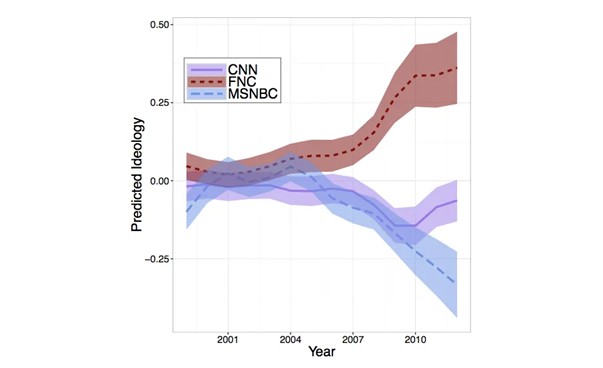 It is now an accepted narrative within the media that the US has become increasingly polarized. We just had our 250th celebration, and it seems to have further polarized our nation rather than bring it together. It is important, however, to put this polarization into perspective. We discuss this topic on my (relatively) new podcast, Political Reality, which I host with political scientist, Andres Jones Rooy.
First, we have to define what we mean by political polarization – mainly a divergence of ideology and policy preferences. How similar or far apart are Americans on average in terms of their political beliefs and preferences? It certainly feels as if such polarization is increasing, but political scientists have been confronted with a dilemma – they cannot find this polarization in the data. Left and right (Democrat and Republican) do differ in many policy preference, but those differences are a lot less than most people think, and they are not increasing over time. It turns out, most people favor common sense policies that are somewhere in the middle on most issue, with Democrats skewing a little left and Republican skewing a little right. Further, people’s core concerns are all just about the same. We all want relative safety, fair prices, and good job opportunities.
There are a few exceptions to this lack of increasing polarization, including two policy issues – abortion and global warming. Over the last 20 years there has been a little increase in the policy differences on these issues. But that’s it. Another exception is a demographic one. There has been increasing polarization within our elected officials. Senators and Representatives are becoming more polarized, even while their constituents are not.
Continue Reading »
Jul
03
2026
 I often get questions like the one below:
“I live part time in Japan. Everyone sees hydrogen powered generators, trains, trucks, etc regularly. High density population means it’s easy to get enough synergy to justify the infrastructure. So sad we aren’t doing more to utilize this great tech. Hydrogen combustion engines emerge as cheap alternative to fuel cells.”
https://asia.nikkei.com/business/energy/hydrogen-combustion-engines-emerge-as-cheap-alternative-to-fuel-cells
This is often how news about advances in hydrogen tech are framed. The problem is – the limitations with hydrogen technology have nothing to do with the tech itself, so tech advances are mostly irrelevant. Also, hydrogen combustion is not a better solution for most use cases then hydrogen fuel cells. Fuel cells use an electrochemical process to combine hydrogen and oxygen, producing electricity and water. They are about 60% efficient, produce no pollution, and have no moving parts. Hydrogen combustion operates more like a regular engine, but with hydrogen as the fuel. They are about 40% efficient, produce nitrogen oxides as pollution, and have moving parts that operate at high pressure and temperature. They can be, however, more powerful for heavy applications and are cheaper to build.
For cars hydrogen combustion is a terrible idea. Maybe there is a use case for large generators, trains, and heavy trucks. Even there, however, there are current limitations that the technology of hydrogen engines or fuel cells do not address.
Continue Reading »