Jul 13 2026
Proposed Satellites Would Ruin Astronomy
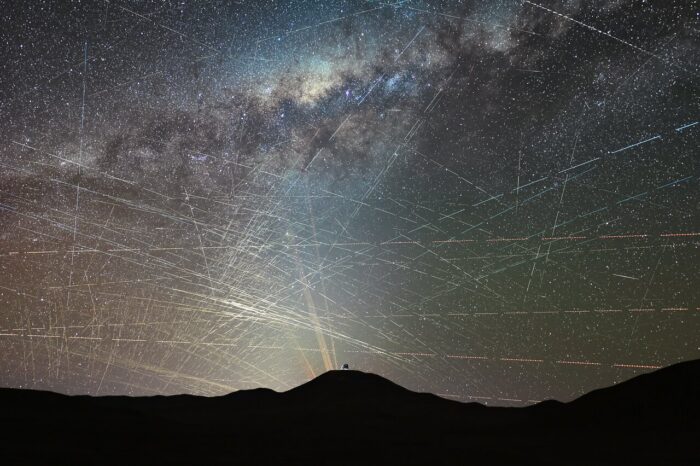
When I was a child I would love looking up at the night sky. I became quite familiar with the northern sky, and how it changed from summer to winter. I could clearly see the Milky Way, which was always stunning. I took it for granted.
Today I rarely see the Milky Way. I live in the burbs and can still see a lot of stars at night, but it is nothing like 50 years ago. Even in small cities, you can only see the brightest stars. In order to get an experience like I had regularly in my youth you have to go to a dark sky location – the nearest one to me is a six hour drive. The first two times I visited the southern hemisphere I didn’t see the night sky once. On my third trip I had to make a dedicated trip to a semi-dark sky location to get my first view of the southern sky, which was magnificent.
If all of the currently proposed satellites are eventually launched, there may be no dark skies left anywhere. Ground-based astronomy might also become extremely difficult, to practically impossible. Right now there are over 16,000 satellites in orbit, about two-thirds of which are Starlink. There are current proposals for 1.7 million new satellites. You read that right – over a million. Space X did alter their satellites to make them less bright, which helps, but they are still a problem. Now they plan to launch a million more satellites for orbital data centers. Europe and China have other proposals that would add hundreds of thousands more.
Reflect Orbital is a company that wants to launch giant mirrors into orbit to reflect sunlight down to dark parts of the planet. They hope to launch 50,000 such satellites – each one would be 4 times brighter than the moon if you are within its reflected light, and as bright as the planet Venus if you are outside that area.
A recent study concludes that if there are over 100,000 satellites in orbit ground based astronomy essentially becomes impossible. Imagine dozens of objects, much brighter than the distant objects you are trying to observe, crisscrossing every image. Essentially, satellites reduce the observing time that observatories have. The more satellites, the less time (as they wait for satellites to clear their view). With 1.7 million satellites (especially the Reflect Orbital ones) ground base astronomy is doomed.
The other problem is the overall brightness of the sky. The full suite of proposed satellites would increase the brightness of the sky by 3-4 times – everywhere. Good-bye dark skies. When you look up at the night sky, most of the points of light you would see would be satellites. And if a Reflect Orbital mirror is near, that might be all that you see.
All of this raises the question – who owns the sky? Right now the FCC has applications from Space X and Reflect Orbital to launch their satellites, and we await their decision. Does that one agency really have the power to make such a decision for the world? Do these companies have the right to pollute the sky to such an extent? While the FCC was open to public comments, I think such a decision requires a much greater public debate, and yet this issue does not rate much mainstream media attention.
Space X is planning orbital AI data centers to get around limitations of ground-based data centers. There are environmental, power, and NIMBY issues. Orbital data centers could be in orbits that give them constant sunlight to feed their solar panels, and passive radiative cooling. I get the advantages here – but while they are bypassing NIMBY issues, what about “Not in my sky!”
Having 1.7 million satellites in orbit also dramatically increases the risk of collision, even a cascading collision scenario which would be disastrous for low Earth orbit. That many satellites reentering and burning up in the atmosphere would have significant pollution issues. They could also cause considerable radio interference problems. Space agencies would have to map out complex pathway to get ships past LEO, and have increased shielding to fend off small debris. But there is a limit – and if a collision cascade occurs, it could likely close space to humanity for a very long time.
It is hard for me to see launching so many satellites into orbit as anything but fantastically irresponsible. The Reflect Orbital plan seem particularly absurd. The idea is sunlight on demand, but with LED light technology where it is, do we really need orbital mirrors to get light where we need it? They boast a (theoretical) 20% increase in capacity factor for solar farms that use their service, but this is only after they launch 50,000 satellites. Seems like it would be better to just build 20% more solar panels. Really, I just think this is dumb, right up there with solar roadways.
This also seems like an area where we need international cooperation and regulation. It is not right that one company in one country can ruin the sky for the entire world, and potentially ruin low Earth orbit. LEO should be seen as a limited resource that the world shares. This study suggests 100,000 satellites as a hard limit, but even that may be too generous. International regulations should include worldwide licensing if you want to launch more than a certain number of satellites. Satellites should require designs that minimize their brightness and interference with ground-based astronomy and dark skies. They should also be safe to deorbit, and should have planned deorbiting at the end of their lifetime.
In the US, I also think that such a decision is bigger than one regulatory agency, or one president. This should be the kind of decision that requires bipartisan support in both chambers to pass. The stakes are too high.
As if often the case, it seems like we cannot trust is a good outcome unless the public is aware of the situation and makes a stink. Otherwise in another decade people might look up (if they look up at all) and wonder what happened to the night sky.