Nov 09 2026
COVID-19 Vaccines Were Cost Effective
 One of my goals as a science communicator with a focus on healthcare is to increase the general understanding of how to think about clinical interventions. Just take a look at the many health-related videos on TikTok or other social media platform, contradicting standard medical advice. Many are based on false information, but they also almost uniformly do not think about public health measures or medical decisions properly. This disconnect between how experts think of intervention and how the public may perceive them was massively on display during the recent COVID pandemic.
Here is the quick primer. Think of interventions based upon their risk vs benefit. You cannot only consider risk, and you have to consider the risk vs benefit of all options, including doing nothing. On the diagnostic end, it is better to consider the predictive value of information, not just whether it is a sign or symptom. In the realm of public health there are more considerations, not just the risk vs benefit at the individual and the population level. Because we have limited resources, and often there are competing valid options, we also like to look at the return on investment (ROI) of interventions. A recent study does that for the COVID-19 vaccines – how much public and private money was spent for their development, manufacture, and distribution and what were the health and economic benefits?
The bottom line is that the COVID-19 vaccination programs had a massive ROI, they had a positive cost-benefit and cost effectiveness (in addition to a positive benefit to risk ratio). But the details are interesting, so let’s dive in.
There are many ways to slice and dice such data, and many ways to estimate the cost benefits of preventing illness. So the authors provided as much information as possible, without just choosing one analysis. I am going to present the data from the bottom up – from the most conservative estimates to the most complete estimates. First, the estimated cost of all stages of the vaccine programs (including the first year of delivery) was $79.4 billion worldwide. That is a high price tag, but what did we get in return? The most straightforward type of cost benefit from a healthcare intervention is avoided future healthcare costs. The authors estimated this by using estimates of hospitalizations avoided and the average cost of hospitalization in each country. That amounted to $222 billion. So based on that maximally conservative estimate the vaccine programs were very cost-effective.
This estimate, however, does not include all out-patient healthcare costs, or the costs of managing long COVID. This also only include the first year of vaccine delivery, so any later benefits are not included. The real figure is therefore likely significantly higher. Most healthcare cost-effectiveness analysis, however, also includes the value of lost productivity. That is pretty straightforward to estimate – how many days of work are missed due to illness, and what is the economic value of that day of work. They estimate saved lost productivity at $564 billion. If we combine the two we get $786 billion, a return of about $10 for each dollar spent on the vaccines. In the public health world that is considered a great ROI.
There are a few things not included in the analysis, including the lost productivity of the time taken out to get vaccinated. This is likely a relatively small figure, however. Most people can get vaccinated without having to miss work. They also did not include lost economic activity due to shutdowns or closed businesses or any decreased economic activity due to the pandemic.
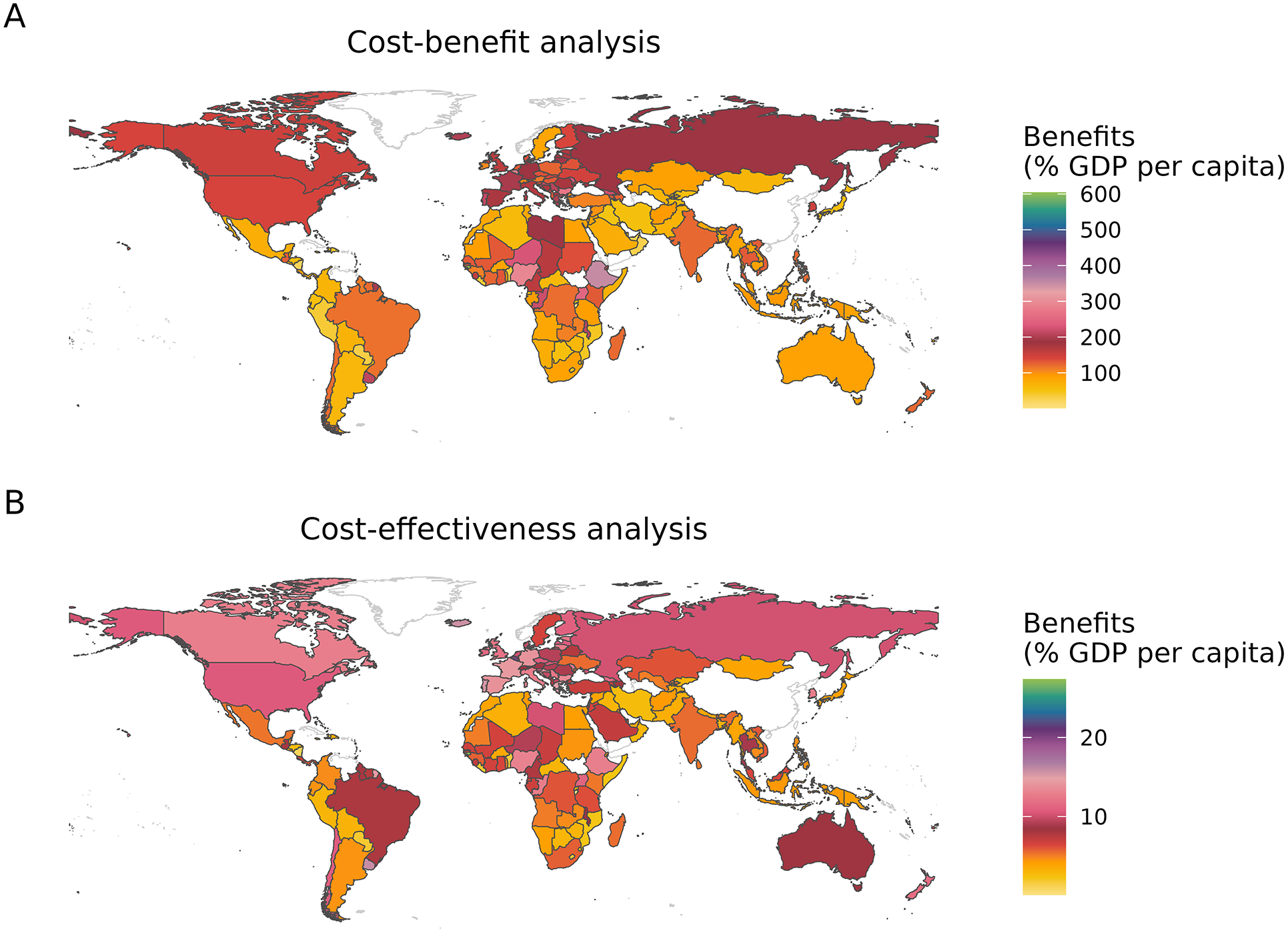
Now we get to the two main analyses that they did, total cost effectiveness and total cost efficiency. They used long established and widely used methods, but they do require value judgements. The cost effectiveness method used the “value of a statistical life” or VSL. This is an estimate of how much people are willing to pay, in each country, for a specific reduction in the risk of death (how much is their life worth). This value was then added to the avoided healthcare costs and lost productivity estimates. The cost efficiency method used the “quality adjusted life years” or QALY method. This estimates how may quality life years were saved by the intervention (by preventing death or disability). They converted QALYs into monetary values using country-specific healthcare opportunity-cost thresholds, based on GDP per capita and income group.
Because there is variability in the monetary value you might place on the lives and disability saved, this resulted in a range of estimates. Using these methods the authors estimated, “the health and economic benefits of vaccination were valued between $6.43 and $64.3 trillion.” Even at the low end, that is an ROI of almost $60 of value for each dollar spent, and at the high end more than $800. By any measure, the COVID-19 vaccines were cost effective – if you consider only the narrow economic benefits, and even more so if you consider the health benefits (which is, after all, the goal of public health interventions). Keep in mind, this is for the first year only, so the benefits would increase after that – the development costs are fixed, and only manufacturing and distribution costs continue. There are also likely to be significant downstream benefits which are not captured by this analysis.
The authors acknowledge some limitations to their data, including what I already pointed out. They also did not include estimates of the cost of side effects from the vaccines. However, serious side effects are extremely rare, on the order of 10-50 per million doses, and so this would likely have not affected the numbers much.
Taken together, what this study shows is that even massive investment in developing and distributing vaccines in the face of a serious epidemic or pandemic can be a highly cost effective investment for any country to make. Vaccines generally are a highly cost-effective healthcare intervention,