Nov 10 2026
The Definition of “Biological Sex” – A Lesson for Skeptics
 This article is the result of a rather long journey in science communication, and I think carries some important lessons for science communicators, skeptics, and anyone interested in this topic. What is the technical scientific definition of the term “biological sex”? I have to say I went into this discussion naively thinking that this question would be easy to resolve, and would serve as a good basis of common ground from which to discuss more complex related topics, specifically the trans phenomenon. This is a topic that divides popular skeptics and science communicators, and I am always fascinated and drawn to such controversies. They seem like fertile territory to deepen my understanding of complex topics, and hopefully to contribute to the conversation.
I soon learned that there were two fairly entrenched perspectives on this question. Jerry Coyne, Richard Dawkins and others were claiming that sex (whether an organism is male or female) is determined entirely by gamete size, with males having small gametes and females large gametes (a property known as anisogamy). I and others favor the multidimensional definition of biological sex – that it includes and is defined by the entire spectrum of biological sexual differences – chromosomes and genes, gonads, gametes, hormones, reproductive organs, genitals, and all secondary sexual characteristics. I admit and can see now that I assumed this was “the” scientific definition of sex. It was the definition I learned in medical school in the 1980s, and pretty much the only definition I encountered throughout my medical career. I was therefore somewhat surprised when I received push back from other science communicators that this was not “the” definition, even being accused of trying to change the definition to suit my needs, and of engaging in pseudoscience.
It seemed to me that these two schools of thought on sex were primarily determined by political ideology, and I still think that is playing a significant role. This is especially true among non-biologists, who mostly just accept the definition that fits their political opinions. This also allows for both sides to claim that science is on their side, and the other side is engaging in pseudoscience and allowing their politics to influence their scientific reasoning. This is pretty much where things sit – two entrenched sides largely talking past each other. This is not a good look for a group that identifies as skeptics and presumes to communicate science to the public.
The more I engaged in this topic, however, the more I realized that there is another dimension to these two camps. Jerry Coyne and Richard Dawkins are both evolutionary biologists, and their justification for the “gametes only” definition is explicitly on evolutionary grounds – it is the only feature that is universal across all taxa of sexually reproducing life. Meanwhile, I found a very receptive audience among other physicians for the multidimensional definition of biological sex (even if they disagreed on trans politics), but also very tellingly among developmental biologists, such as PZ Myers and Kevin Folta. Perhaps we are mostly seeing a simple difference of context-dependent definitions among different scientific disciplines, so I decided to do a deep dive on that specific question.
What I found is more interesting and informative than I expected. The topic of “how have scientists defined sex over historical time” is incredibly complex, really requiring a textbook-length discussion to do it justice (and to be clear not by me, but someone who is an actual expert on the topic), but I will give a reasonable overview. What you will find is that the definition of sex has evolved along with our understanding of biology and with the emergence of subdisciplines within biology. These various definitions are not mutually incompatible but merely represent different context-dependent frameworks that serve the purpose of the scientists who use them. Also, we have to make a distinction between the term “sex” and the term “biological sex”, which I will get to at the right point in the timeline.
If we start with the ancient pre-scientific world we find that people like Aristotle understood that there were two sexes and that they served a reproductive role. But understanding of biology was extremely limited, and therefore there is no mention of gametes or anatomy. The ancients took a very essentialist view of things, and so males and females had certain essential properties that were needed for reproduction.
As our knowledge of anatomy and physiology developed a more coherent definition of sex emerged, having to do largely with the reproductive organs. In the 1600s, for example, William Harvey defined the reproductive anatomy and function of the gonads and genitals of animals. Linnaeus was among the first to develop a sexual classification system for plants, explicitly relying upon plant reproductive organs (stamens and pistols). Naturalists focused on observable differences in males and females of species, so-called sexual dimorphism. We can call this pre-Darwinian view the “naturalist” approach to sex – based on reproductive roles and anatomy and sexually dimorphic observable characteristics. These are features that modern naturalists, such as ornithologists, still focus on.
Darwin, of course, was a turning point, as he was for all of biology. Darwin himself, however, was a transitional figure – he explicitly defined male and female according to reproductive anatomy: “With animals which have their sexes separated, the males necessarily differ from the females in their organs of reproduction; and these afford the primary sexual characters” (The Descent of Man, and Selection in Relation to Sex). Darwin’s contribution was to separate primary sexual characteristics involved directly in reproduction from secondary sexual characteristics that differ between male and female but are not directly related to reproduction.
It was later evolutionary biologists, trying to come up with a universal definition of sex, that hit upon gamete size as the key feature. Marcus Hartog in 1891 was probably the first to explicitly cite gamete size: he defined anisogamy as “the union of two gametes differing chiefly in size” where “the smaller (micro-) gamete is male, the larger (mega-) gamete, female.”
Keep in mind – this did not become “the” definition of sex, just the one used by evolutionary biologists. It did not replace so much as complement the naturalist definition focusing on anatomy and reproductive role.
The next major event was likely the advent of the field of genetics and the discovery of genes and chromosome. This lead Clarence Erwin McClung to propose that sex chromosomes are what determine sex in 1901, which was experimentally verified in 1905 by Nettie Stevens and Edmund Beecher Wilson, with Wilson introducing the term “sex chromosome” in 1906. Using sex chromosomes to determine sex became increasingly popular in the 1910s and 1920s. One big advantage is that you could use chromosomes to sex an individual somatic cell, something that nothing else could do.
However, to be fair “determining” sex and “defining” sex are not necessarily the same thing. And during this same time period there were two other scientific disciplines on the ascent – developmental biology and biomedicine. Developmental biologists are interested in how a single cell becomes an infant, and how an infant becomes an adult. This starts with the chromosomes, but eventually involves all aspects of biological sex. They, therefore, began using an increasingly multidimensional approach to sex. This approach also served the biomedical field as well, which is concerned with all aspects of biology and health.
By the first half of the 20th century, therefore, we have four different frameworks by which “sex” could be defined – the naturalist framework based on anatomy and reproductive roles, the evolutionary framework based on anisogamy, the genetics framework based on sex chromosomes, and the developmental biology/biomedical framework based on a multidimension understanding of sex. It is also at this time that we begin to see qualifiers attached to the word “sex”. For example, around 1950 Alfred Jost (a developmental physiologist) developed a framework that involved chromosomal sex which determines gonadal sex which leads to phenotypic sex. This trend continued. Specifically, a 1978 paper by W.C. Clark explicitly uses the term “gametic sex” – “gametic sex, determined by the kind of gamete produced”. There may be earlier instances, but that is the first I could find.
The mid 20th century also saw the introduction of another important qualifier on the term “sex” – “biological sex”. This is extremely important for contemporary discussions about the scientific definition of “biological sex”. This term comes out of yet another scientific discipline, needing a new framework in which to discuss sex – sociology and psychology, specifically the subdiscipline of sexology. It was within this field that the term “biological sex” first appears. It was popularized by sexologist John Money in a 1955 paper and later in a 1972 book, Man & Woman, Boy & Girl, he cowrote with Anke A. Ehrhardt. Money and his colleagues developed the term explicitly to refer to the multidimensional definition of sex (all aspects of biology related to sex), and specifically to distinguish these biological aspects of sex from the social and psychological aspects of sex, including gender.
To test whether or not the term “biological sex” was really introduced in the mid 20th century I did a search on “biological sex” in the Google Ngram Viewer and this is what I found.
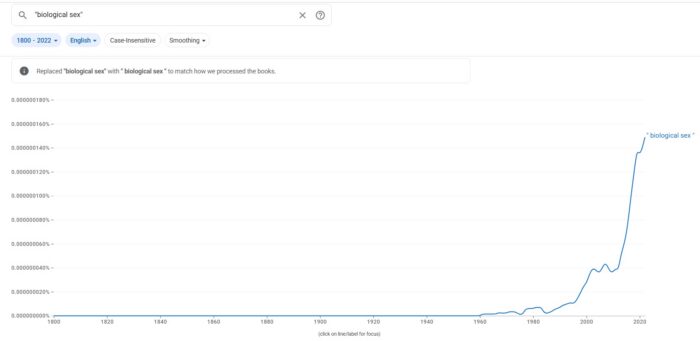
As you can see, use of the term prior to 1960 does not even register. It then takes off in the later 20th century to the present. The same is true of the multidimensional definition of sex. Evolutionary biologists continue to use the framework of anisogamy, because it serves their purposes, and in many contexts chromosomal sex is used because it is appropriate and convenient. But in pretty much all other aspects of biology and medicine the multidimensional concept is often used, and increasingly the term “biological sex” is used to refer to this multidimensional framework. This is reflected in this quote from a 2022 consensus statement by National Academies of Sciences, Engineering, and Medicine:
“Sex is a multidimensional construct based on a cluster of anatomical and physiological traits that include external genitalia, secondary sex characteristics, gonads, chromosomes, and hormones.”
Meanwhile evolutionary biologists have doubled-down on their definition. In the 2004 book Evolution’s Rainbow:Diversity, Gender, and Sexuality in Nature and People, evolutionary biologist Joan Roughgarden writes: “To a biologist, ‘male’ means making small gametes, and ‘female’ means making large gametes. Period!”
I would quality that statement – “To an evolutionary biologist,…”.
Both of these above quotes are from sources that exist within the sex, gender, and diversity issue. It is hard to find a modern reference about biological sex that does not address this context, but they exist. Within the medical literature the multidimensional framework of biological sex is implicit, even if it is not explicitly defined. Also, some references make a distinction between the technical definition of sex and all the relevant aspects of sex.
So – what do we make of all of this? I think we can say a few things (not that I expect universal agreement).
First, the concept of sex is a scientific framework that differs between different scientific disciplines. A universal definition is elusive, because there is no such thing. Different scientists approach the definition according to their own perspectives and needs.
Today, there persists four basic approaches to defining sex: the naturalist approach which focusses on observable anatomical details, the evolutionary biologist approach which focusses on gamete size, the genetics approach which focusses on sex chromosomes, and the developmental/biomedical approach which focusses on a multidimensional framework. None of these definitions is right or wrong, none is “the” scientific definition of sex, they are all correct as far as they go. They each have different strengths and weaknesses, different trade-offs that make sense within the context of each discipline. Evolutionary biologists sacrifice completeness for universality. Biomedical scientists sacrifice elegance and simplicity in favor of completeness that captures all the complexity that is relevant to their research and practice.
Rather than debating endlessly about what “the” definition of sex is, many scientists have already provided a reasonable solution – just use different terms for the different frameworks of sex. As I discovered, “biological sex” is one such term, specifically developed to refer to the multidimensional approach. Incidentally, this makes it very ironic when defenders of the gametic approach claim that “biological sex” has always referred to the gametic sex. That is one claim we can say is absolutely incorrect. But that aside – we can simply refer to gametic sex, hormonal sex, chromosomal sex, biological sex, and morphological sex without worrying about which one is better, or more problematic, “correct”. They all have their use and their proper context.
Which leads to my final point – what is important is not imposing one framework on another discipline where it is not appropriate. We should respect each other’s areas of expertise, and recognize that different scientific disciplines have their own perspective. If evolutionary biologists agree that gametic sex makes the most sense as a universal definition of sex that applies across taxa, then I have no reason to disagree with them. It makes sense, and I can see the logic and utility of that definition. It is a unifying concept, just as evolution itself is across all of biology.
But evolutionary biologists should understand that geneticists and developmental biologists, and sociologists, and medical specialists have their own perspectives. When addressing sex as a biological variable in medical issues, gametic sex simply does not cut it. It is only one tiny slice of a big picture. If the question is which medical interventions are most appropriate for a specific patient population, I think a medical perspective is most salient.
Let me also say that in my experience often much of the disagreement among otherwise good skeptical science communicators comes down to terminology and jargon. We are sometimes talking past each other because we are using words differently. Different scientific disciplines also develop their own language and they don’t always translate across other disciplines. Understanding the role of language is critical to bridging this gap in perspective, otherwise we end up just making straw men of other people’s positions.
I do not intend this to be my final word on the topic, but rather I sincerely hope this is the beginning of a more constructive conversation.