Aug 17 2026
Should We, and Can We, Terraform Mars?
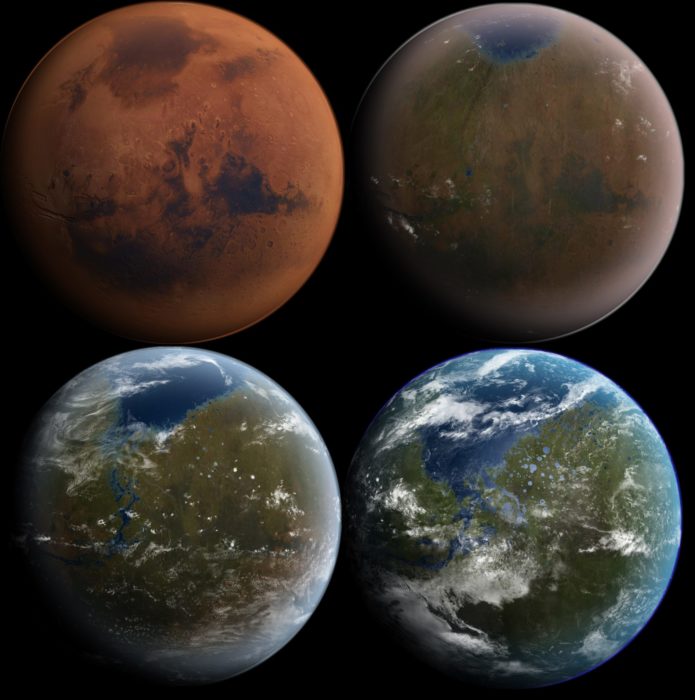 Terraforming, altering a planet’s atmosphere and surface to make it more Earth-like, has become a staple of science fiction. The benefit of successfully terraforming a planet are huge in that we now have an entire planet we can settle without the need for spacesuits and air-tight stations. We could also farm the surface for food, and would have access to liquid water. But how feasible is it? Is this something we could theoretically do with existing technology, and how long would it take?
The answer to these questions depends upon the planet in question. Right now the only planet for which it is even a discussion is Mars. Terraforming Venus is theoretically possible, at least on paper, but would likely be much more difficult, so let’s focus on Mars. What would it take to terraform Mars?
Mars is dry and cold with a wispy atmosphere – less than 1% the density of Earth’s atmosphere at sea level. We would therefore need to increase the thickness of the atmosphere, including greenhouse gases to help warm up Mars to a livable temperature. Average surface temperature is around -75 F / -65 C, but it can get quite balmy at the equator during the say, 70-80 F. But even there the temperature plummets to -100 F at night, because the lack of atmosphere cannot retain the heat.
Would the “Total Recall” approach work, simply melt the polar ice caps, which are mostly CO2 and water ice, to release a thick atmosphere? No. Melting the Martian icecaps would increase the atmosphere from 0.6% to 1.2% of an Earth atmosphere, which is negligible and would not result in runaway heating. But there is also CO2 and ice in the Martian regolith around the planet. What is we could melt all of the ice? https://www.nasa.gov/news-release/mars-terraforming-not-possible-using-present-day-technology/According to a NASA study, if we could release all that ice we would still only get up to 6.9% of an atmosphere. At that pressure the water in your body would boil and oxygen would leave your lungs. Humans require 20-25% atmosphere to survive without a pressure suit – not that it would be comfortable, but you would not quickly die.
The short answer is – there is simply not enough volatiles on Mars to create an atmosphere. Therefore we would need to import volatiles from somewhere else. Some have proposed that we could redirect comets from the outer solar system to crash into the surface of Mars, delivering water and CO2. This could theoretically work but would require literally millions of comets (according to NASA about 20 million Haley-sized comets). Crashing that many comets into the surface of Mars would create a molten hellscape for centuries. So such a project could achieve an atmosphere, but would likely take thousands of years.
However, there is another massive problem. In order to warm up Mars to a comfortable temperature, one that would not necessarily freeze every night, you would need about 1 bar (one atmosphere) of CO2. That amount of CO2 is deadly to humans. At the maximal tolerable CO2 level, about 4% (0.04 bar), Mars would heat up only a few degrees. So basically, we cannot have a Mars that is simultaneously breathable and warm. There is simply no scenario in which the surface of Mars becomes livable for humans without pressure suits and masks to provide O2 and limit CO2. Total Recall is a fantasy.
This means that for the foreseeable future, and possibly forever, settling Mars means living in pressurized habitats. The best bet is underground, such as in lava tubes, because the lack of an atmosphere and global magnetic field means that the surface of Mars is not protected from radiation. The final issue is the surface gravity, which is 38% Earths, which is fine except that it would be difficult to transition back to living on Earth. Someone born and raised on Mars would likely never be able to visit Earth, without some medical intervention.
Could there be any advantage to even partially terraforming Mars? Maybe. Let’s say we find a way to release most of the native volatiles and get up to 6% atmosphere (0.06 bar). This is not a help to humans, but are there any plants that could survive? For most plants the answer is no – they would freeze at night and the complete lack of oxygen is a problem because plants need to breath oxygen at night. But – there are some extremophile plants, like desert moss and some lichens, which could theoretically survive in such conditions, especially with some genetic tweaking. We could, therefore, seed the equatorial regions of Mars with adapted desert mosses. But again – while it could survive even at Mars’ current atmospheric pressure, it cannot thrive and grow. It needs liquid water and some oxygen. Also, it would remain dormant in response to the radiation on Mars.
So, the thin path to some sort of terraforming here is this. First, release as many native volatiles as possible. Then seed the equator with desert moss or a similar extremophile. That moss, however, would need to be covered with a transparent blanket to keep in moisture and oxygen and to block out UV radiation. It is then possible for the desert moss to survive and be active during the day to produce oxygen. It would then convert some of the CO2 into oxygen. This, however, would be far too little oxygen to create an ozone layer to protect from UV radiation. What, then, would this accomplish. Actually, not much. It may help improve the soil for later farming under a protective dome. That’s about it.
The bottom line is that there is no extrapolation of current technology that would allow for any significant terraforming of Mars. It would require advanced technology we don’t currently have, and even then there are some inherent dilemmas – like, we need more CO2 to keep it warm than we can survive. If we plan to ever have humans living on Mars, we will need to live in habitats that are protected from radiation and micrometeors.