Oct
11
2021
 A recent BBC article discusses the emergence of products designed for neurofeedback to aid in stress reduction. The headline asks, “Smart headbands claim to make people calmer. Do they work?” However, the article does not really answer the question, or even get to the heart of the issue. It mostly provide anecdotes and opinions without putting the technology into a clear context. The article focuses mainly on the use of such devices to allegedly improve sports performance.
There are a few premises on which the claims made for such devices are based, varying from well established to questionable. One premise is that we can measure “stress” in the brain using an electroencephalograph (EEG) to measure the electrical activity in the brain. This claim is mostly true, but there is some important background necessary to understand what this means. First, we need to define “stress”. Functionally when researchers are talking about mental stress they mean one of two things, either the stress that results from an immediate physical threat, or the mental stress that results from engaging in a challenging mental task (like doing math in your head while being distracted). For practical purposes the research on EEGs and mental stress use the challenging mental task model.
It his, however, a good representation of stress generally? It is a convenient research paradigm, but how generalizable it is to mental stress is questionable. It can result in objective measures of physiological stress, such as secretion of stress hormones, which is partly why it’s convenient for research and not unreasonable, but it is only a representation of mental stress and might not translate to all “stressful” situations (like sports).
Can EEGs measure this type of mental stress? Yes – a relaxed mind with eyes closed produces a lot of regular alpha waves. A more active mind (and one with eyes open) produces more theta waves and chaotic brainwave activity. EEGs can therefore tell the difference between relaxed and active. How about not just active but stressed? That is trickier, but there are studies which appear to show some statistical differences in the wave patterns regionally with mental stress. So the premise that EEGs can measure certain kinds of mental stress is reasonable, but not as simple as often implied. This also does not necessarily mean that commercial devices claiming to measure EEG markers of stress work.
Continue Reading »
Jul
06
2020
 The current world population is 7.8 billion people. We are expected to reach 10 billion by 2057, which, let’s face it, is right around the corner. That is a lot of people to feed. We don’t produce enough food now to feed that many people, and we are already using almost all the available arable land (this is a complex topic, but I go over it in detail here). What are the possible solutions?
Some argue for population control, and there is a reasonable argument to be made for leveling off and stabilizing human populations, even allowing them to drift down a bit. I don’t want to go into detail on this issue here, just to quickly say I reject arguments for radical population control, or things like allowing mass starvation to occur. But I support efforts such as lifting people out of poverty and affording more rights to women, both measures being shown to reduce population increase.
Another offered solution is to reduce food waste, and this is a noble effort. However, there is no magic wand we can wave to make this happen. Food waste is built into the system, and a major cause is the limited shelf life of food. It spoils. But there is unnecessary waste in the system, and we can do a better job of making sure as many calories end up consumed (by people or animals) as possible, and the rest is recycled as fertilizer. But this isn’t going to solve the problem.
This leaves us with food production – we need to produce more calories of food in order to meet growing demand. This is going to require a global effort, and the introduction of new technology. I have argued for the necessity of GMOs in order to meet growing demand for food while minimizing land use. But we have to produce not only more food, we need to produce food smarter – making sure that our resources (especially land) are being used optimally.
Continue Reading »
Mar
15
2018
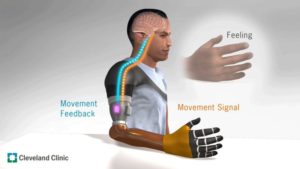 We continue to make incremental improvements in robotic artificial limbs, and now researchers report one more – kinesthetic feedback. This is a sense that your limb is moving under your control.
What the engineers did is include a mechanism to make the robotic arm vibrate when it moves. The vibration gives the user sensory feedback that mimics movement. This is similar to the haptic feedback that some video game controllers give, to enhance the illusion that you are wielding an actual item rather than just a plastic controller.
In the study this vibrational feedback was successful in creating the illusion of control, meaning that the users felt as if they controlled their robotic limb. However, they still did not feel as if they owned their robotic limb, like it was part of them, which is another hurdle engineers will have to solve.
I found it interesting that they referred to this effect as an illusion, which I think is accurate, but I want to emphasize that our normal sense of agency and ownership is an identical illusion. The same circuits in the brain that give you the subjective sense that you occupy, own, and control your various body parts are the same ones that would potentially create this sensation in a robotic limb.
This is precisely why a robotic limb can work and ultimately feel natural. All we need to do is close the loop on these brain circuits.
Continue Reading »
Sep
11
2014
 Often GMO critics will argue that the biotech industry is conducting a massive experiment with our food supply by introducing genetically modified organisms. The implication is that GMOs are not adequately studied, which is at best debatable, but in a way they are correct. We can look at what has happened in the 19 years of GMO use starting in 1996 to see if there have been any adverse effects. A newly published study, Prevalence and impacts of genetically engineered feedstuffs on livestock populations, does just that. (Full study, may be behind a paywall.)
The study authors, Van Eenennaam and Young, first review the existing literature on animal feeding studies. They then review available data on livestock outcomes to see what effect feeding them mostly GMO since 1996 has had, if any.
GMO Feeding Studies
The first regulatory hurdle for safety testing of GMOs is to establish “substantial equivalence.” Researchers must show that the genetically engineered crop is essentially the same as the parent variety in all ways except for the desired introduced genetic change. The authors report:
Over the past 20 yr, the U.S. FDA found all of the 148 GE transformation events that they evaluated to be substantially equivalent to their conventional counterparts, as have Japanese regulators for 189 submissions.
Continue Reading »
Jul
05
2013
There are many appealing aspects of the new media – its immediacy, the democratizing effect of lowering the bar on content production and distribution so that many people can participate, and the ability to customize the content you want. I especially love the interactive nature of blogging, tweeting, and even podcasting, the immediate feedback.
Having been on the giving and receiving end of such feedback for years now I wanted to share my thoughts on giving effective feedback. I am busy prepping for TAM, so this is also a good light topic to tackle.
The first thing to consider when giving feedback is – what is your goal? Why are you bothering? I find that feedback (meaning e-mails and comments not geared toward having a conversation about the topic at hand, but targeted toward the content provider) generally fall along a spectrum from simply expressing a feeling to wanting to change behavior.
I get many e-mails that can be summarized as either saying, “Love what you’re doing, thanks,” or “You’re a jerk, (although they don’t use the word “jerk”, if you know what I mean – btw, that’s a movie reference). That’s fine. People want to express their support or displeasure, and I get that. Just don’t expect the anonymous expression of raw displeasure to have any effect at all on my behavior.
Continue Reading »
Nov
20
2012
Anyone who has been blogging for a while and covers even remotely controversial topics is likely to get hostile comments and e-mail. I recently received the following comment on a prior blog entry about organic farming:
It suits well that this shill would say some ubsurd shit like conventional pesticide and herbicide drenched food isnt bad for you! lol why dont you drink some round up to show us it isnt harmful! you fucking lame http://www.cornucopia.org/2012/09/stanfords-spin-on-organics-allegedly-tainted-by-biotechnology-funding/
Its too late people are losing conventional foods like its a hot potato! So its only a matter of time before your out of business because the corporations that pay you will be out of business.
But theirs alot of things I want to say to a scum like you but I will keep my mouth shut. I hope you sleep well at night you sellout and enemy to humanity!
geeksquad100
There are some common themes in the comment and the linked article that are worth exploring. First, the tone of the comment is hostile and juvenile. I don’t mind the judicious use of profanity, but it’s clear when people are relying on profanity as a cheap way to lend emotional weight to their words because they cannot do so with their ideas or prose. This, unfortunately, has become common in the social space of the internet. Psychologists are beginning to look at the phenomenon sometimes referred to as “internet balls” – the lack of usual social cues and pressures allows for the shedding of normal polite behavior. People commenting anonymously into a virtual space are free to say things they would never have said in person.
Continue Reading »
Oct
17
2007
I am frequently asked to give my opinion as a neurologist about neurofeedback techniques – these are therapies based upon using real-time recording of brain waves (EEG) to help train the brain to have a more normal brain wave pattern. These techniques are still not generally accepted, and with good reason, but are none-the-less growing in popularity.
This recent news article is a good indication of why the popularity of this treatment is outstripping the evidence. The article itself is a great example of the standard template journalists use for reporting controversial science stories. Here is the template:
Continue Reading »
Sep
10
2026
 For many science fiction fans the computer voice on the Enterprise is iconic, and is, in fact, “the” voice of any computer. Majel Barrett deliberately gave the computer a stilted, monotone, mechanical voice to reflect the fact that it was a non-sentient machine. But also, it reflected the technology at the time. Voice synthesizers had been around since the VODER, first debuted at the 1939 World’s Fair. They produce an electronic-sounding definitely artificial voice. Many people are also familiar with this electronic voice through Stephen Hawking’s voice synthesizer.
But now we have the technology to create artificial speech that sounds convincingly human – the voice sounds natural and not electronic and contains all the inflection and nuance of natural speech. Sesame is one example, and you can try the demo for yourself. The app adds pauses, breaths, “ums”, and other fillers to sound more natural. Essentially it is now simply not possible to tell an AI generated voice from a human generated voice. I recently rewatched Star Trek TOS and paid close attention to the futurism in the series and was struck by how dated all concepts of AI were in the show. We can already produce natural-sounding human speech, so why is the Enterprise’s computer so mechanical 200 years in the future?
However – there is another explanation (this is obviously a retcon having nothing to do with the original intent of the creators). More recently it occurred to me that we might consider the mechanical nature of the computer voice a deliberate feature, not a bug of technological limitations. In the episode Tomorrow is Yesterday the ship’s computer had recently been overhauled on Cygnet XIV and was given a female personality with a more natural sounding (albeit humorously annoying) voice. We can therefore say that the technology existed and the mechanical voice was at least partly a deliberate choice. At this point you are probably thinking, “So what?”
Well, one of the features of LLM-based chatbots is that they are getting increasingly good at imitating human interactions through language, whether with text or speech. This creates the powerful illusion that they are sentient and feeling, when they clearly are not. I know this point can be debated – how can we be sure they are not sentient? I maintain they are simply not built to be sentient. As an example, the same technology can be used to make pictures, but no one argues that Midjourney is sentient. So for the sake of discussion let’s stipulate LLMs are not sentient. Continue Reading »
Aug
27
2026
 There is a lot of legitimate concern over the net effects of students using AI to do their school work. If you let AI do your writing, then you will not learn how to write, for example. Or worse – if you let AI think for you, then you will not learn how to think. I have spoken with many teachers at many levels about this and they range from those who take diligent steps to minimize AI “cheating”, to the other end where some throw up their arms and essentially say, “if students us AI to cheat, they are just cheating themselves out of an education.” For me the bigger question is – what happens to society if we raise a generation intellectually crippled by their dependence on AI?
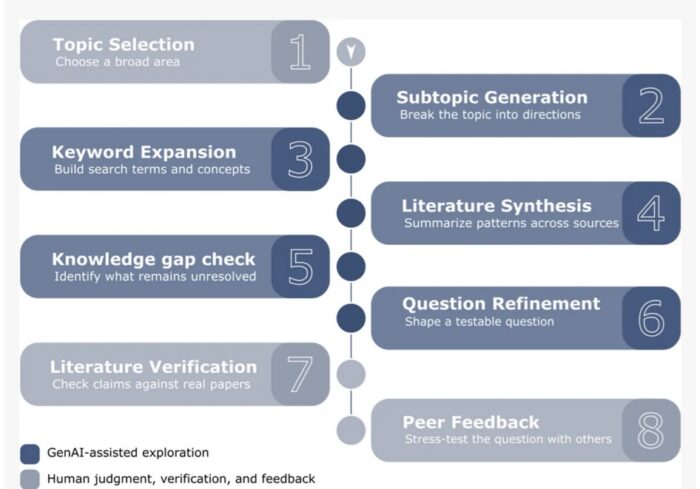
Certainly, the educational system at every level needs to deal with the reality of AI, and needs to protect the legitimacy of their methods for evaluating students. But also, schools need to face the reality of a world with AI and prepare their students for that world, which may require leveraging AI itself as a teaching tool. In fact, using AI as part of the teaching itself may secondarily solve (or at least mitigate) the AI-cheating problem. For example, if you develop a workflow that includes human and AI elements, then use of AI is already baked in and accounted for. Ideally, the outcome will be optimal when the human adds value to the process and uses AI effectively. The outcome should be better than AI alone, or human alone, could generate. And if you have to show your work throughout the workflow, it becomes hard to fake your contribution to the process.
I don’t think researchers were even thinking of the AI-cheating problem when they developed this AI assisted workflow to teach undergraduates how to develop proper research questions. They were trying to more effectively teach students how to develop research questions. But their model may provide a useful template in many other educational contexts, and also help the AI-cheating problem.
Here is the problem they were trying to address – undergraduate students often have a difficult time developing useful research questions. It’s a lot harder than you might think – “Students can usually name a topic they care about, but often lack strategies for turning that interest into a question that is grounded in evidence, scoped to what is feasible, and aligned with available methodologies.” This has long been identified as a bottleneck in undergraduate research education. Developing a solid research question is often the most critical step in any research, and is often the most challenging thing to do. Continue Reading »
Jul
13
2026

When I was a child I would love looking up at the night sky. I became quite familiar with the northern sky, and how it changed from summer to winter. I could clearly see the Milky Way, which was always stunning. I took it for granted.
Today I rarely see the Milky Way. I live in the burbs and can still see a lot of stars at night, but it is nothing like 50 years ago. Even in small cities, you can only see the brightest stars. In order to get an experience like I had regularly in my youth you have to go to a dark sky location – the nearest one to me is a six hour drive. The first two times I visited the southern hemisphere I didn’t see the night sky once. On my third trip I had to make a dedicated trip to a semi-dark sky location to get my first view of the southern sky, which was magnificent.
If all of the currently proposed satellites are eventually launched, there may be no dark skies left anywhere. Ground-based astronomy might also become extremely difficult, to practically impossible. Right now there are over 16,000 satellites in orbit, about two-thirds of which are Starlink. There are current proposals for 1.7 million new satellites. You read that right – over a million. Space X did alter their satellites to make them less bright, which helps, but they are still a problem. Now they plan to launch a million more satellites for orbital data centers. Europe and China have other proposals that would add hundreds of thousands more.
Reflect Orbital is a company that wants to launch giant mirrors into orbit to reflect sunlight down to dark parts of the planet. They hope to launch 50,000 such satellites – each one would be 4 times brighter than the moon if you are within its reflected light, and as bright as the planet Venus if you are outside that area.
A recent study concludes that if there are over 100,000 satellites in orbit ground based astronomy essentially becomes impossible. Imagine dozens of objects, much brighter than the distant objects you are trying to observe, crisscrossing every image. Essentially, satellites reduce the observing time that observatories have. The more satellites, the less time (as they wait for satellites to clear their view). With 1.7 million satellites (especially the Reflect Orbital ones) ground base astronomy is doomed. Continue Reading »