Jul 02 2008
Connectomics and Brain Cores
Connectomics is the effort to completely map the neuronal connections of the human brain. It is akin to genomics – the mapping of the human genome, or its successor, proteomics – the mapping of the human repertoire of proteins. Connectomic has taken a huge leap with a newly published study that uses MRI techniques to map brain connections.
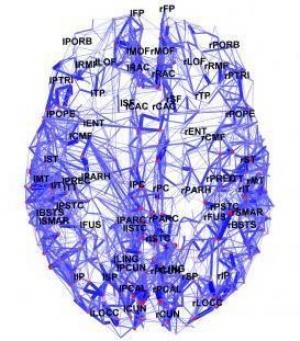
An international team of researchers used a recently developed magnetic resonance imaging (MRI) technique known as diffusion MRI to image the pathway that bundles of neural connections take through the brain. Essentially, MRI scans use a powerful magnet to align protons in water molecules in tissues like the brain. It then uses a perpendicular magnetic field to push some of the protons out of alignment and then measure the radio signal that is created when the second field is turned off and the protons flip back. Different tissues have different water content and other properties that cause them to generate different MRI signals. MRI scientists have found numerous clever ways of manipulating this basic technique, in addition to improving the computers and software used to analyze the resulting signals, producing not only better MRI images but new ways of imaging brain anatomy and function. Diffusion MRI is just one of these special MRI techniques.
What these researchers have done is use this technology to partially map major pathways and connections within the brain. One of the key findings is that there is a central hub within the brain containing the most connections – a brain core. Study co-author Olaf Sporns is quoted as saying:
“We found that the core, the most central part of the brain, is in the medial posterior portion of the cortex, and it straddles both hemispheres. This wasn’t known before. Researchers have been interested in this part of the brain for other reasons. For example, when you’re at rest, this area uses up a lot of metabolic energy, but until now it hasn’t been clear why.”
It has been known for a long time that the brain makes many internal connections with itself. It was also known that many of these connections were regional, while others were interhemispheric (between the right and left hemisphere). It was not known, however, that there is this central brain core. This will likely lead to some interesting research to discover the exact function of this central hub, or if it has a function beyond simply being a high traffic area.
This technique may also help efforts to reverse engineer the brain – to develop a computer model of an entire human brain, including all connections. We seem to be getting close to a perfect storm of science and technology – our understanding of brain function is playing off of our rapidly advancing computer technology, which is also playing into our increasing ability to map and model the brain, which is potentially feeding back into our computer technology. This is a technological feed-forward loop.
Hold on tight – it’s going to be quite a ride.

49 Responses to “Connectomics and Brain Cores”
Leave a Reply
You must be logged in to post a comment.


very exciting, indeed and a long way from the right/left brain handle that is hopefully is now covered with cobwebs.
Here’s Mind Hacks post on this research:
http://www.mindhacks.com/blog/2008/07/connected_to_the_hig.html
Fascinating
“This technique may also help efforts to reverse engineer the brain – to develop a computer model of an entire human brain, including all connections.”
Very funny.
Hmm, I have a question:
Considering this study finds a highly connected area – dubbed the brain core – and that the area is associated with ‘stimulus independent thought’, can this considered a good area to look for neuronal correlates of consciousness?
Damasio proposes that conscience might be a simple thing, just a mapping of other neuronal maps naturally produced by any animal that develops a nervous system. He also says emotions can affect it, but it’s quite difficult to contain emotions (he differentiates from sentiment). The location of the region is just above the “emotion centers”.
To me this seems to be a candidate, or at least a narrowing down, on where and how consciousness works in material terms. But what are your thoughts?
“conscience might be a simple thing, just a mapping of other neuronal maps naturally produced by any animal that develops a nervous system.”
Any idiotic theory will be considered, as long as it supports materialism.
Pardon my lack of sophistication in proposing a topic, pec, but I’m just an enthusiast in this area and not anyone with expertise in these kinds of studies. It doesn’t mean I’m completely ignorant of the topic, I’ve only read a couple of books on the subject, and a few articles online and in magazines. My background, though, is computer science, not neuroscience.
You would better have served the topic by actually explaining why you think it’s idiotic, rather the knee-jerk it as materialism. You could also consider that me being unexperienced in the area, even if I didn’t stated it upfront, I may have explained Damasio’s position poorly.
Still, I’ve given Damasio’s point of view to illustrate where my inquiry comes from, and to stimulate discussion on the topic.
Really good post — the third post I’ve read this evening across the Internet that I’m printing off. Not so good for the trees, of course, but I keep a variety of interesting bits in a now quite large folder and spend a fascinating Sunday afternoon re-reading when the moment catches me.
I also hope you don’t mind if I click one of your adverts every so often — the pseudo-science looks fascinating…
BrianTani,
Neuroscientists and computer scientists have been searching for that simple explanation of consciousness for decades. I think the search is idiotic because I am not a materialist and materialism just seems idiotic to me.
But to each his own favorite philosophy.
So you think it’s idiotic because you think it’s idiotic.
Well explained, and way to defend your position.
Could you offer, some thoughts in what this new find entails to the nature of thoughts, conscience, or if does help dualist notions in anyway? Maybe you think it’s irrelevant, fruitless and pointless? Why so?
As it stands your argument is an ad hominem fallacy.
BrianTani,
Don’t worry. Pec has her feet firmly planted in the clouds of non-materialism. Keep asking the questions. Maybe someone who knows more in this field will answer and we all will learn something. Except for pec, unlike the rest of us, she apparently has a direct line to knowledge and truth.
Brian, you made an initial error when you wrote “conscience” instead of consciousness. Pec, of course, never caught the typo, not being possessed of either quality to any conspicuous degree.
I saw the typo Roy Niles, but unlike you I am smart enough to know what he meant. No need to pick on every little typo.
I have many reasons for my belief that materialism is idiotic. Will probably write a book some day but don’t have time now while having to work.
Short statements are easily misunderstood, but ok I will try one:
Life and intelligence cannot arise out of non-living, non-intelligent, substances. At least we have no logical or evidence-based reasons for thinking they can.
Materialist philosophy is a fashion, not a scientifically valid perspective.
Oh, yes. Sorry for the mistake. Roy got it right, I meant Consciousness instead of Conscience.
Pec, thanks for explaining it further.
However, why is it that life and intelligence cannot arise out non-living non-intelligent, substances?
There are plenty of examples of self-organizing physical systems such as spin-glasses, cellular automata. Fractal patterns can be seen throughout nature and fractals only need simple rules to follow.
There is some sort of self-organizational properties in non-living things, and that’s one aspect of living things. Organization.
The fact that we didn’t discover the exact process by which life arose, or by which consciousness arose, doesn’t exclude the a materialistic approach, nor makes it idiotic. The fact that we do observe self-organization in non-living systems can be a clue that such process is theoretically possible. Isn’t it?
What positive argument, then a dualist have to explain life or intelligence?
Is there no positive argument?
I don’t mean to impose, but saying you have an explanation, and then simply asserting your position – since we obviously disagree on your assertion – is not valid argumentation.
If our premises differ we arrive at different conclusions, therefore, is important we address the premises first. Right?
Brian, pec is a resident troll. You’ll get back nothing substantive.
~*~
How does the complication level of mapping all neural connections compare to mapping the human genome? More or less complicated? By what factor? (I possess a canyon of ignorance in this area, which is why I come here instead of to blogs in my areas of expertise).
“Life” in fact describes a process wherein “material” substance was effectively organized as a calculative mechanism, for starters.
Some of which of course evolved to achieve more success with these calculations than others.
And pec, good luck with that book.
I am sure that “Materialism is Idiotic” is a perfect title as well as an excellent argument detailed by an enormous body of evidence.
The volume will act as a catalyst for a comprehensive paradigm shift in our understanding of reality, and will catapult us all into the wondrous world of woo-woo.
As someone said earlier: “Hold on tight – it’s going to be quite a ride.”
What a delightful irony that pec’s “ghost in the machine” philosophy (ie. bodies are just machines that house a separate and distinct soul) doesn’t allow for machines to have “ghosts”!
But the blurb that accompanied an advance copy of his book has explained all such contradictions thusly:
Introducing pec’s razor: “The simplest possible explanation trumps the more complicated, and thus becomes the probable in materialist philosophy, except that an even greater simplicity will trump the absolute barest of materialist possibilities, as nothing in fact or fiction is impossible.”
DevilsAdvocate
Total number of synapses in cerebral cortex = 60 trillion (from G.M. Shepherd, The Synaptic Organization of the Brain, 1998)
Thx, decius!
“How does the complication level of mapping all neural connections compare to mapping the human genome? More or less complicated?”
I’m going to hazard an answer here, though I’m only a lowly psych undergrad with neuroscience pretentions, so much of what I say might well be muddled, misguided, or just plain wrong :-p.
I’m hazarding a guess that brains between individuals differ more than DNA simply because DNA doesn’t change much during your lifespan, wheras the difference between your brain at birth and when you die will is vast. Furthermore, there are far, far more neurons than there are genes – the PLoS article gives a number of 10^10 – and each of these neurons synapses with hundreds if not thousands of its fellows. Looked at from this perspective, the task is daunting.
However, you need to balance utility and practicality. Knowing the details of individual neurons and synapses isn’t necessarily a very useful thing, especially considering how varied the specific details are going to be between even ‘typical’ individuals. What it more useful is to look at the big bundles of connections between various regions, and try to get an overall picture of how things are connected.
This is, however, an exact-inexact science. Everyone has a different brain, and what you see in many ‘brain scan’ (and, I assume, the computer-generated image above) is a summation of a number of scans on a number of participants. These scans are normalized through complicated mathematical techniques (gotta love the computers we’ve got these days!) to take into account different brain topography, and in doing so some resolution is unfortunately always lost. While the technology allowing us to peer inside people’s heads is astounding, it’s still a case of viewing through a scanner darkly (sorry, couldn’t resist!).
I think one of the really exciting things about this kind of research is that it opens up new questions, and possibilities of looking at old problems in new ways. Knowing more about how the brain is physically ‘wired up’ allows us to make more-educated guesses about how brains manage to do the wonderful variety of things they do. It feeds into scanning and neuropsychological studies to enable us to propose new theories and new, better tuned explanations – which then feeds back into research and questions about the connections within the brain.
Even if we were to assume that materialist and non-materialist hypothesis for life and intelligence are equally likely to be true, which should we be investigating? What can you do with a non-materialistic hypothesis? You can write about it, and you can argue with others who have different non-materialist hypothesis. But can you actually investigate it? Is there any way to evaluate two competing non-materialist theories except to argue about which seems more elegant? (Unless of course one of them claims that some effect is due to a non-material cause, and it’s proven that the effect has a material cause)
So it seems that we should be investigating materialist hypothesis if for no other reason that we have some hope of confirming or refuting them. Even if I were a dedicated dualist I would still want to investigate the functions that are in the brain. Something interesting is going on in there, and at least you can touch and measure the material bits.
anadamide: “I’m going to hazard an answer here, though I’m only a lowly psych undergrad with neuroscience pretentions..”
Heh. I’m a Masters clinical psych and I’m every bit as clueless, lol. Thanks for your input though, highly appreciated. Mind you, I wasn’t planning on conducting any mapping myself, I just wondered which was the tougher job, mapping the human genome or the human neural network. It’s a tough thing to google and I was hoping someone who frequents here might know.
Just so, Traveler. There must be 10,000,000 versions of dualist or non-material hypotheses, but only about 9,999,999 or so are unfalsifiable/untestable as described.
Are there ‘trinalist’ or ‘quadralist’ hypotheses out there? After all, the more complicated the ideer, the more fun it is to discuss it.
I am not a duelist and I believe that “matter” can be self-organizing. But materialists have no useful definition of “matter.”
It is irrational to think that someone who questions materialism must see the world as divided into matter vs. spirit. There are much more interesting and plausible ways of thinking about it.
One example is the “implicate order” idea of David Bohm:
http://www.amazon.com/Wholeness-Implicate-Order-Routledge-Classics/dp/0415289793
So you’re pinning this on a definition of matter? Is this some elbow room tactic of shifting matter to some other category?
If you’re have a problem with the name materialism, fine, I’m not going to fight over labels. My arguments should stand on their own, and the argument is that physical processes govern how the brain works, and that our minds is the functioning of the brain. Therefore how the brain is “wired” becomes important to understand how it functions. Which brings us to the question I asked, does this new find get us closer to understanding consciousness or not. I don’t feel qualified to assess that.
What we know of physical processes and physical properties is valid and tested across an immense array of disparate areas of knowledge, and the neuroscientists are not making an ad hoc definition of matter for this experiment, nor calling up new kind of physics. Those connections to other known phenomena give strength to the notions we hold of the world we experience.
So what in our understand would be invalid when considering life or intelligence that we need to call up a new definition of matter, or something of the sort.
P.S.: BTW, Thanks for the book suggestion.
“I’m not a duelist [sic]”
LOL. Naw, but yer wearin’ a Flawdian slip.
pec,
Are you saying you wouldn’t recognize matter if you found it in your soup?
Bohm? Implicate order?
Hrrrafffff.
I’m not sure there’s enough substance in that to debunk. The man’s career practically defines the descent from competence into woo. It is currently not known whether the Bohmian mechanics he proposed in the early 1950s to make sense out of quantum physics can usefully be reconciled with relativity; while physicists will disagree on what should be used in its place, most will agree with R. F. Streater in designating it a “lost cause”. That said, Bohmian mechanics was a solid attempt to find something intuitive and sensible underlying quantum oddity. In Alan Sokal’s words,
Anyway, after solid work like this and the Aharonov-Bohm Effect (1959), he drifted into philosophy, sophistry and quasi-New-Age vagueness. This later stage is beloved by pseudoscientific slackers, for as Sokal says,
Life and intelligence cannot arise out of non-living, non-intelligent, substances. At least we have no logical or evidence-based reasons for thinking they can.
You mean like carbon? carbon is pretty non-living but we seem to do ok out of it.
The definition of a conscious being is any creature that we say is conscious since we are the ones who define our language. I therefore see no impossibility with being able to create a conscious computer model that people believe is self-aware. It’s just going to be very, very hard.
“I therefore see no impossibility with being able to create a conscious computer model that people believe is self-aware. It’s just going to be very, very hard.”
The Turing test has been failed for decades now. You can always say “oh it’s so hard, it’s gonna take a long long time.” You could cling to your beloved materialist philosophy forever.
But we could also say it hasn’t been done because it’s impossible. The brain does not create consciousness.
pec,
machines have been failing the Turing test (so far) because the necessary computing power is simply not there yet, nor have the proper algorithms been written in its absence. AI experts never claimed otherwise.
This doesn’t warrant that we should throw our arms in the air and declare premature defeat, particularly when technological advancements and new discoveries keep on materialising and furthering our understanding of the mechanisms and architecture of consciousness.
With your attitude, complex problems that defied our comprehension for centuries (human flight and gravitation come to mind) would have never been solved.
decius – I suspect pec thinks that “materialist” EB solutions to the eternal human desire and subsequent attempts to fly are really just a weak substitute for the ancient magical “science” of astral travel that has been suppressed. Clearly evil “allopathic” people into technology and science have concocted a conspiracy to try to kill the astral travel trade since astral travel agents can get you there in mind (if not body) – of course, the “trip” only lasts as long as your appointment with the astral travel agent (can be done over the phone or via thinking good happy vacation thoughts remotely). Souvenirs may be purchased from all astral travel agents’ not-for-profit websites, super psychic Olympics special this week on made-in-China Buddhas, astral shipping not concluded.
Fifi,
thanks for pointing out my errors in judgement and exposing my myopic understanding of the history of human flight.
Your enlightening comment has prompted me to look for other similar technologies suppressed by insensible allopathic fundamentalists, and I found this wonderful account that proves beyond doubt that flight, aquaria, and a smooth epilation were readily available in X century Arabia. Peace be upon the prophet.
“Sulaiman (Peace be upon him) previously ordered a Sarh (a glass surface with water underneath in which there are various sorts of fish and other seacreatures) to be built. Afterwards, Bilqis was ordered to enter the Sarh while Sulaiman (Peace be upon him) was sitting on his throne, {But when she saw it, she thought it was a pool, and she (tucked up her clothes) uncovering her legs. (Sulaiman (Solomon)) said: “Verily, it is a Sarh (a glass surface with water underneath it or a palace).” She said: “My Lord! Verily, I have wronged myself, and I submit to the Lord of the” Alamin (mankind, jinn and all that exists)}.
It was said: That when Sulaiman (Peace be upon him) wanted to marry her he asked mankind about a way of removing the hair from her legs, and they mentioned the razor, but she feared thereof. Then, he (Peace be upon him) consulted the Jinn who made the bath for him. Thus, he was the first to enter the bath.
At-Tha`labi and others said: When Sulaiman married her he returned the kingdom of Yemen to her and he used to visit her there and stay for three days a month then comes back to Jerusalem on the flying carpet . In addition, he ordered the Jinn to build him three palaces in the Yemen: Ghamdan, Salhin and Bitun. And, Allah knows best!”
(No, I didn’t make this up.)
DevilsAdvocate: “How does the complication level of mapping all neural connections compare to mapping the human genome? More or less complicated?”
It depends on exactly what you mean by ‘mapping’, both with respect to the genome and the brain. Let’s start with the genome. The simplest step in mapping the human genome is to determine the DNA sequence of the typical human; this was completed in 2003. The next step is to determine the regions of the genome that vary between different humans. This is more complicated because it requires uniquely sequencing the genomes of many individuals. However, sequencing technology has become faster and cheaper such that recently several people have had their complete genomes sequenced. The individuals were the scientists James Watson and Craig Venter, and they’ve made their genomes publicly available here http://jimwatsonsequence.cshl.edu. However, knowing the genetic sequence, even of many individuals, only takes you so far. The most difficult work is determining how to read the genome; this will require defining when, where, and how each gene functions and interacts in networks with other genes.
Despite the complexity of mapping the function of each human gene, I believe the analogous project in the human brain is at least 1 or 2 orders of magnitude more difficult. First we need to define what is meant by ‘mapping all neural connections’. The human brain is composed of billions of neurons, and each neuron can make thousands of connections, which means there are trillions of connections to be mapped. Mapping all of these fine-scale connections is similar to sequencing the genome. But whereas it is feasible to sequence an individual’s genome, mapping the fine-scale human connectome is still in the realm of science fiction given our current technology. However, technology is evolving rapidly and there are currently projects underway to determine the fine-scale connectome of the entire mouse brain using the resolving power of an electron microscope. Read about it here
http://network.nature.com/boston/news/articles/2007/05/10/local-scientists-map-the-brain-one-connection-at-a-time
As was pointed out by anandamide, the problem of brain connectivity can be approached at different levels of resolution. The study that Dr. Novella describes concerns the large-scale and long-range fiber tracts that connect the various regions of the brain. This level of analysis is very important and is bound to provide insight into human brain function in health and disease. Ultimately, however, this scale of mapping is not detailed enough to adequately describe and model brain function. But the next question is whether we need to go all the way down to the level of knowing all trillion connections. Neuroscientists vary on their answer to this question, but my opinion is that there is some middle ground that is both experimentally tractable and very functionally informative. In-between the level of gross fiber tracts and exact synaptic connections is the realm of “local circuit connectivity” and “circuit motifs”. The human cortex (and mouse and monkey cortex for that matter) is composed largely of repeating circuit motifs that comprise hundreds of neurons. One attractive possibility is that these circuit motifs represent computational units and that understanding the rules of local connectivity and function within one circuit motif will permit generalization to similar circuits. Under this view, we don’t necessarily need to perform fine-scale mapping on the entire brain, rather we could get a lot of bang for our buck by performing fine-scale mapping on a few representative neural circuits.
My last point is that even after we know the basic connectivity pattern of the brain this will still only be analogous to knowing the human genome sequence. Moreover, there is reason to believe that dissecting the function of neural circuits will be more difficult than determining the function of genes. Of course, form and function will speak to and inform each other, so I wholly agree with Dr. Novella that we’re in for a wild ride.
I would hazard a guess that until one can construct a mechanism that is responsible for it’s own survival, the self-awareness aspect of consciousness just won’t be there. But I could be wrong.
However, pec’s maxim holds that anything is possible, so he has broken his own rule by stating that such a construct would be impossible.
And even though he is convinced the brain does not create consciousness, such consciousness therefor having been created elsewhere, he is also convinced he’s not a dualist (or much of a duelist either).
In his book, after discussing the nature of idiocy, he will then go on to explain the difference between foolish and wise consistency.
DevilsAdvocate: “Are there ‘trinalist’ or ‘quadralist’ hypotheses out there?”
Warner Brothers advocated a trinalist theory of mind when they put competing cartoon devils and angels on their characters’ shoulders.
Traveler,
I am humbled by your scholarship.
To put a few things in perspective on the connections in the brain, each neuron doesn’t make thousands of connections; there are tens of thousands of connections per neuron.
But those are the “actual” connections. When a neuron fires, on average only one downstream neuron fires in response (if more than one downstream neuron did fire there would be an exponential increase until the entire brain was seizing).
Which one of those 10,000+ connections is the one that fires this time or that time or the next time? How does the brain “decide” which downstream neuron is going to fire? An excellent question.
I suspect that a lot of that acute regulation of functional connectivity is regulated by NO. One of the techniques that is used is functional Magnetic Resonance Imaging Blood Oxygen Level Dependant, fMRI BOLD. What this technique does is look at the difference in magnetic susceptibility between oxy and deoxyhemoglobin. When a brain region is activated, there is an acute vasodilation which increases the ratio of oxyHb to deoxyHb and that is observable on fMRI in real time with sub-second time resolution.
What causes that vasodilation is NO. Neurogenically generated NO activates sGC and generates cGMP which causes vasodilation. What the fMRI BOLD signal is actually measuring is where NO is sufficiently high to activate sGC and cause vasodilation. In the brain that level is about 1 nM/L.
Exactly what is going on during that activation is not well understood. I suspect that NO is doing a lot more than just causing vasodilation. That NO may be changing the probability of firing of neuronal connections in the region that is activated, perhaps by changing the kinetics or voltage dependence of ion channel opening or something else. Modulating the probability of firing a little bit could be a mechanism for metaprogramming the brain. Release a puff of NO, increase local activity in region xyz. When the vasodilation occurs, it increases the level of oxyHb which is the sink for NO. The increased oxyHb then traps and convects away the NO, allowing for the NO background to stay very low, and allowing NO to be a very robust and crisp signaling mechanism. NO passes through everything, the BB barrier, vessels, myelin, so each part of the brain can be exposed to the “right” amount as modulated by the relative diffusion of NO through aqueous and lipid (~10x solubility difference between them).
A lot of the “diffusion” that is measured in the brain is anisotropic, it is confined to axons. Some of that “diffusion” isn’t passive; it is movement of water due to the entrainment of cytoplasm by cargo being moved in axons. All the important bits in neurons are manufactured in the cell body where the nuclear DNA is. Everything then has to be carried out to the tippy ends of the axons (which may approach a meter in length for motor neurons). That cargo includes mitochondria and other stuff carried by ATP powered motors.
A condition that is characteristic of reduced “diffusion” is what is called white matter hyperintensities. All the neurodegenerative diseases are characterized by this reduced diffusion. I suspect that this reduced diffusion is actually a “feature” to conserve ATP. Acute ischemia causes very prompt white matter hyperintensities in experimental animals. I suspect this is regulated in part by NO, which regulates the ATP setpoint by the action of NO and ATP on sGC. NO and ATP go up and down in sync. Ischemic preconditioning is a metabolic state characterized by reduced ATP concentration and consumption. Presumably because cargo moves slowly, moving cargo isn’t a time critical pathway in the event of an acute ATP crisis as in acute ischemia. Presumably movement of cargo can be reduced to save ATP for things that are more important. That would show up as white matter hyperintensities.
The Turing test has been failed for decades now. You can always say “oh it’s so hard, it’s gonna take a long long time.” You could cling to your beloved materialist philosophy forever.
I believe flight was also “very hard” to accomplish.
Little boy, things are only impossible, until you know how to do them. Then they are merely difficult or expensive.
can’t help but notice that in the argument, the original question was never answered. This is a question that I was going to ask as well.
Regardless of your philosophy, a patient has a devastating bleed deep in the brain (possibly near the newly discovered core) and now he can blink but not track, and is in effect “not in there”. His family wonders why he won’t respond, could it be that this “brain core” has been damaged?
I think that was the original question, and if not, then it is my question.
thanks
Yes, kvsherry, the question was never addressed. But, to be fair, it seemed to me a highly speculative question anyway….
Dr. Novella brushed tentatively by writing this:
Is this just a highly connected area, or can we take cues from this research to speculate on current theories of consciousness? Which theories predict this kind of organization, which don’t… that sort of thing.
And my question arose from what I read about Damasio’s view on consciousness – that involves a certain mapping of the other mappings of the nervous system. This highly connected area – dubbed brain core – might be what this mapping of mappings would look like. I don’t know.
In the end, our questions are the same, for they inquire on the relevance of this new find in regard to consciousness.
It seems that Pec regards matter as actually spirit pretending to be matter or to be more charitable, spirit with an awful case of amnesia. Hence, Pec’s stance is more a matter of confused spirit than dualism.
We are all one with the big Kahuna spirit in the sky, but we are just so ignorant of this glaringly obvious universal intuition because we allow ourselves to get seduced (by provocatively dallying with science every chance we get) by matter. In other words, Pec not only is the true skeptic in our midst (or in her case, in her mists), but she also is the only true non-dualist.
I am off to down a spirit-rich double martini in honor of our unabashed, double-thinking true non-dualist and true skeptic fruitcake who is short of a few tons of glazed fruit.
Anyways, very interesting discussion. And as my current bee in my science bonnet is Metabolomics (which is also beginning to be mapped), I wonder how complex and difficult that endeavor is compared to Connectomics and the Genome.
“Alternative science” was somewhere invoked and hailed by Pec as the agent which will shatter the rotten edifice of materialism.
This may well be your last Martini before the rubble buries you, MichelleB.
“This technique may also help efforts [...] to develop a computer model of an entire human brain, including all connections.”
While pec scoffed, this has actually already been started. I posted about a wonderful first pass at just such a model (using diffusion tensor MRI) here.
I have yet to read the present study, so withhold judgment about how important it is. One caveat with these “connectomics” studies: it is not possible to read function directly from such maps of connections, as they don’t tell you the types of connections (excitatory, inhibitory, or both?), the types of neurons that are connected to one another (e.g., layer IV pyramidal cells or inhibitory interneurons?), or the strength of the synapses.
So (as I’ve discussed in a post on connectomics), the wiring diagram is a necessary, but not sufficient, step toward reconstructing the functional architecture of a nervous system.
I just printed the paper out, and look forward to having a look.
The greater mystery is how applications of mainstream, materialistic science work perfectly well despite being based on wrongful, silly, materialistic scientific principles.
I find it fascinating that people so adamantly defend dualist (or spiritual) concepts. We come from an ignorant and superstitious past and our understanding of many things is coloured by that past. What I’m trying to say, is that if it wasn’t for our past and the centuries of religious/spiritual/superstitious indoctrination, our default position would most likely be that there is a physical cause as we have no evidence to the contrary. We have an inherent need to look for explanations and reasons for why things are the way they are and often decide on an explanation just to have one, regardless of how illogical it is. I am not saying there is no “other” realm or cause (although I think it highly unlikely), just that denying the vast amount of evidence for materialism in favour of an unproven hypothesis, is irrational.
I just saw this on the New Scientist:
Brain implant lets paralysed man talk again
http://technology.newscientist.com/channel/tech/mg19926645.100-brain-implant-lets-paralysed-man-talk-again.html
It just might be that “we’re the music while the music last” – the symphony of brain activity. They used similar patterns that healthy people used to shape the mouth, larynx, etc, to interpret this man’s mental activity and translate that into sounds.
And now, it seems he’s getting the hang of it.