May 07 2026
Richard Dawkins Discovers AI and Philosophy
Richard Dawkins is a public intellectual of some renown, although not without his controversies. So it is noteworthy when he writes an article claiming that the chatbot Claude is likely conscious. I found the article fascinating, not because I agree with his core claim or feel that he has contributed anything significant to the conversation, but because it seems to represent a scholar and deep thinker writing about a topic in which he lacks specific expertise. I also see no evidence in the article that he engaged meaningfully, or at least adequately, with a topic expert. As a result he makes some thoughtful and instructive errors.
He begins with a discussion of the Turing test, which has long been discussed as an early thought experiment about how we might determine if an AI is actually conscious. Dawkins essentially accepts the Turing test and write:
“It was one thing to grant consciousness to a hypothetical machine that — just imagine! — could one day succeed at the Imitation Game. But now that LLMs can actually pass the Turing Test? “Well, er, perhaps, um… Look here, I didn’t really mean it when, back then, I accepted Turing’s operational definition of a conscious being…””
He feels saying that LLMs have passed the Turing test but still not accepting them as conscious is moving the goalpost. However, the Turing test was never generally accepted by AI experts or philosophers as a true test of consciousness. Rather, it was understood that such a test really is only a measure of a machine’s ability to imitate human speech. I wrote about it in 2008, writing: “Ever since Alan Turing proposed his test it has provoked two still relevant questions: what does it mean to be intelligent, and what is the Turing test actually testing.” I went on to write:
“But I can imagine a day in the not-too-distant future when such AI can pass a Turing test. The algorithms will have to become much more complex, allow for varying answers to the same question, and make what seem to be abstract connections which take the conversation is new and unanticipated directions. You can liken computer AI simulating conversation to computer graphics (CG) simulating people. At first they appeared cartoonish, but in the last 20 years we have seen steady progress. Movement is now more natural, textures more subtle and complex. One of the last layers of realism to be added was imperfection. CG characters still seem CG when they are perfect, and so adding imperfections adds to the sense of reality. Similarly, an AI conversation might want to sprinkle some random quirkiness into the responses.
The questions is – will sophisticated-enough algorithms running on powerful-enough computers ever be conscious? What Loebner is saying, and I agree, is that the answer is no. Something more is needed.”
Basically, the limitation of the Turing test is that it is looking only at output, and therefore there is no way to distinguish the output of true consciousness from a really good simulation. This is not a new idea, and no one is moving the goalpost. We need to know something about how a computer is working to conclude whether or not it is conscious. What LLM experts will tell you is that these chatbots are just really good autocompletes – they are mimicking language, and since language is how we communicate thoughts, this creates the powerful illusion that they are mimicking thought, but they aren’t. They do not think, they do not truly understand.
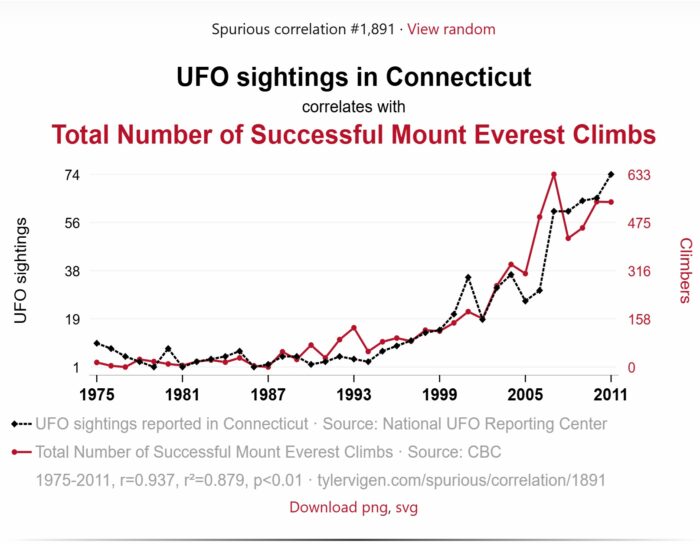 Did you know that the number of Google searches for cat memes correlates tightly (P-value < 0.01) with England’s performance in cricket World Cups? What’s going on here? Is interest in funny cat videos driven by the excitement created by cricket victories. Perhaps cat memes are especially inspiring to English cricket players. Or more likely, this is just a spurious correlation, despite the impressive P-value.
 I love to follow kerfuffles between different experts and deep thinkers. It’s great for revealing the subtleties of logic, science, and evidence. Recently there has been an interesting online exchange between a physicists science communicator (
 Amid much controversy, the Alabama State Supreme Court ruled that
  Have you ever been in a discussion where the person with whom you disagree dismisses your position because you got some tiny detail wrong or didn’t know the tiny detail? This is a common debating technique. For example, opponents of gun safety regulations will often use the relative ignorance of proponents regarding gun culture and technical details about guns to argue that they therefore don’t know what they are talking about and their position is invalid. But, at the same time, GMO opponents will often base their arguments on a misunderstanding of the science of genetics and genetic engineering.
 Homer: Not a bear in sight. The Bear Patrol must be working like a charm.
 Categorization is critical in science, but it is also very tricky, often deceptively so. We need to categorize things to help us organize our knowledge, to understand how things work and relate to each other, and to communicate efficiently and precisely. But categorization can also be a hindrance – if we get it wrong, it can bias or constrain our thinking. The problem is that nature rarely cleaves in straight clean lines. Nature is messy and complicated, almost as if it is trying to defy our arrogant attempts at labeling it. Let’s talk a bit about how we categorize things, how it can go wrong, and why it matters.
 I like to think deeply about
  I have been writing blog posts and engaging in science communication long enough that I have a pretty good sense how much engagement I am going to get from a particular topic. Some topics are simply more divisive than others (although there is an unpredictable element from social media networks). I wish I could say that the more scientifically interesting topics garnered more attention and comments, but that is not the case. The overall pattern is that topics which have an ideological angle or affect people’s world-view inspire more passionate criticism or defense. Timed drug release is an important topic, with implications for potentially anyone who has to take medication at some point in their lives. But it doesn’t challenge anyone’s world view. ESP, on the other hand, is a fringe topic likely to directly affect no one, but apparently is 70 times more interesting to my readers (using comments as a measure).
 I first wrote about the