Apr
06
2026
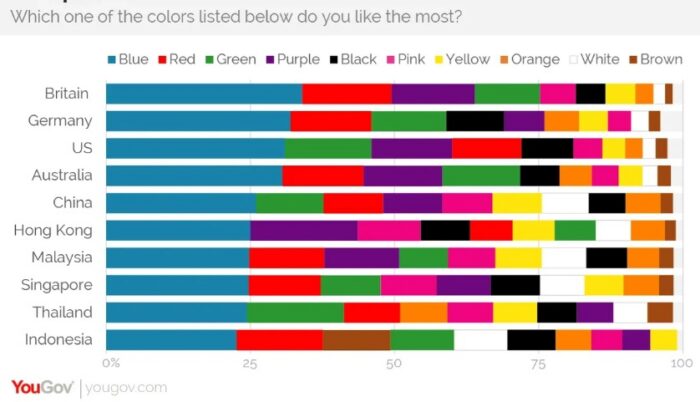 Many people might find this to be an easy question and simple concept – what is your favorite color? In fact it was used as the quintessential easy question by the bridge guardian in Monty Python and the Holy Grail. But it is a good rule of thumb that everything is much more complicated than you think or than it may at first appear, and this is no exception. We recently had a casual discussion about this topic on the SGU, and it left me unsatisfied, so I thought I would do a deeper dive. Perhaps there is a neuroscientific answer to this question.
The panel differed in their reactions to the question of favorite color (we were just giving our subjective feelings, not discussing research or evidence). Cara felt that “favorite color” is largely arbitrary. Kids are asked to pick a favorite color, which they do (under pressure) and then often just stick with that answer as they get older. She also felt the question was meaningless without context – are you referring to clothes, cars, house color, or something else? Jay was at the other end of the spectrum – he has a strong affiliation for the color orange which gives him a pleasant feeling. The rest were somewhere in between these two extremes.
I knew there had to be a science of “favorite color”, which I thought might be interesting. Indeed there is – and it is interesting.
First, what is the distribution of favorite color, across the world and demographically? Blue is, far and away, the most favorite color, in most countries across the world, so it seems to be very cross-cultural. It is also the favorite across age groups and gender. The second-most favorite color is either green, red, or purple. Brown is almost universally the least favorite color. Gender has an effect on favorite color, with more women favoring pink, and reds in general (but still preferring blue overall). Republicans still prefer blue over red, but more Republicans prefer red than Democrats. There are country-specific differences as well. Red is a higher preference in China than many other countries, for example.
Continue Reading »
Apr
02
2026
 I have a love-hate relationship with TikTok, as I do social media in general. It is a great communication tool and allows scientists and science communicators to get their content out to a larger audience cheaply and easily. If you know how to use the internet and social media as a resource, you can find a video about almost any topic. I particularly love the “how to” videos. And yet these applications are also used (mostly used) to spread nonsense and misinformation, or at least inaccurate, misleading, or overly generalized information. The low bar of entry cuts both ways.
As a result I spend part of my time as a communicator with my finger in the dike of social media pseudoscience and science denial. For example, this individual feels his insights into the workings of the human brain need to be shared with the world. His musings are based entirely on a false premise, his apparent misunderstanding of what neuroscientists understand about brain function. He begins with the nicely vague statement, “scientists have discovered”, followed by a completely incorrect statement – that thoughts come to our brain from outside the brain.
Before I get into this old “brain as receiver” claim, I want to point out that this format is extremely common on TikTok in particular and social media in general. This is more worrying than any individual claim – the culture is to present some random nonsense in the format of “isn’t this crazy”, or with with a cynical tone implying something nefarious is going on. Such authors may or may not believe what they say, they may just be trying to amplify their engagement with a total disregard toward whether what they are saying is true or not. They may even be a full Poe – knowing that what they say is nonsense. Either way, they feel it is appropriate to spend the time to record and upload a video without spending the few minutes that would be needed to check to see if what they are saying is even true. The very platform they are using to spread their nonsense often has all the information they need to answer their alleged questions. The culture is profoundly incurious, intellectually vacuous, lacking all scholarship or quality control, and seems to value only engagement. Thrown into the mix are true believers, grifters, and those who display classic symptoms of some form of thought disorder. This is “infotainment” taken to its ultimate expression.
Continue Reading »