Jun 04 2026
Planets Around Black Holes
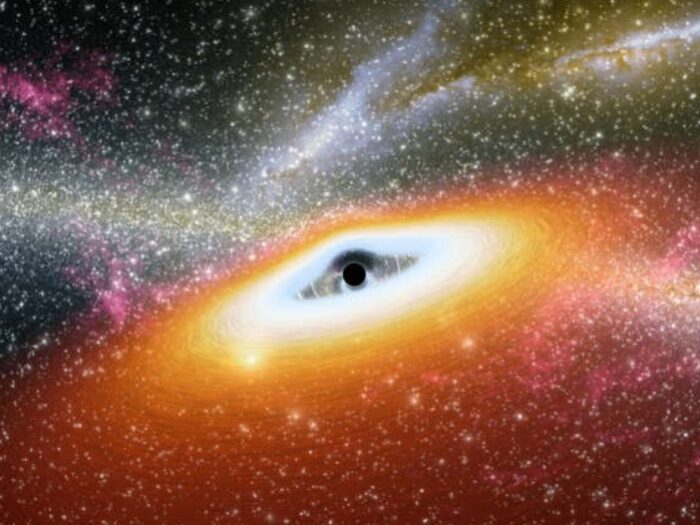 My mental map of the universe has evolved over my life, partly due to new scientific discoveries and partly due to my own education. As if often the case, as you learn more, things get more complicated. The simplistic picture I had as a child was that the universe consisted of many galaxies in which there are many stars and around which there are planets, likely something similar to our own solar system. I have had to modify this model dozens of times, and perhaps I need to make another little tweak. This has to do with where planets exist.
First, galaxies are not randomly distributed throughout the universe. They are bound together in local groups, those groups are gravitationally bound into galaxy clusters, which in turn are part of superclusters which are finally organized into giant filaments, the largest gravitationally bound structures in the universe. So our universal address is – the Sol system within the Milky Galaxy, part of the Local Group within the Virgo Cluster which is part of the Laniakea Supercluster.
At some point I also learned that not all stars (and therefore, not all planets) exist within galaxies. Estimates of the number of stars within and between galaxies just overlap, so they may be equal, but the average estimates indicate that likely 1-10% of all stars are not in galaxies. They are wandering between galaxies, mostly within galaxy clusters. The first intergalactic star was discovered in 1997. It is likely that most such stars were formed within galaxies (you need clouds of gas and gravitational disturbances for stars to form) but then were flung out because of gravitational interactions with other objects, such as a black hole. Two galaxies colliding can also spray their stars throughout the cluster. It is also very likely that such stars would retain their planets.
In fact, intergalactic stars would be a great place for life. They would not be at risk from nearby supernova or gamma ray bursts. There is also a much lower density of cosmic rays outside of galaxies (they are largely produced within galaxies and are trapped by magnetic fields within galaxies). So space travel would also be much easier within an extragalactic solar system. They are also likely to be extremely isolated from other systems, and their nighttime sky would be much darker. Some would have only some distant smudges of other galaxies. But many would have spectacular views of nearby galaxies dominating their sky.
At some point I also learned that within the Milky Way there are more rogue planets wandering between stars than there are planets gravitationally bound to stars. There are likely about a trillion planets orbiting stars, and 4-5 trillion rogue planets. These are less likely to host life as we know it, without the warmth of a nearby star. But it is possible for such planets to host chemosynthetic life within subsurface oceans. Moons of rogue gas giants may also be warmed by tidal forces. It’s even possible for some worlds to have thick hydrogen atmospheres which could keep the surface of the planet warm enough to have liquid water for billions of years.
A recent study, theoretically at least, may add another location where there are a surprising number of planets – around supermassive black holes at the centers of galaxies (including the Milky Way). Quick caveat – this is an ArXiv preprint publication, so not yet peer-reviewed. It is based on modeling and simulations without any confirmation from observational data.
Some supermassive black holes are called active galactic nuclei (AGN) if they are actively “feeding” on a disc of matter swirling around them. These astronomers were interested in whether or not this disc of material could form into planets. It is generally considered that such swirling discs of material are too hot to allow matter to clump together and form planets, but they considered the conditions as you get further and further from the AGN. Their simulations found a sweet spot where the temperature and radiation are low enough to allow for planet formation while still having enough matter to clump into planets. Essentially you end up with a distance gradient of “doubling time” – the amount of time on average for any clump of rock and dust to double its mass. Some regions would have only slow growth and produce only pebbles. Others would have rapid growth, enough to exceed the mass necessary for stars to ignite. And in between – lots of planets.
They estimate there could be tens of millions of planets around a single AGN. They also hypothesize that there may be many exotic objects in these regions. For example, you could have a rapid enough doubling time and a sufficient supply of dust that an object could form entirely of dust (no significant hydrogen or other gas) and yet exceed the mass of star formation. What would happen to such an object? We have no known examples. Some actual stars may also form in this region.
Any planets forming around an AGN would likely be a terrible place for life, this being a generally hostile environment. This also is a tiny number of potential planets compared to the number of star-bound and rogue planets in the galaxy. If this turns out to hold up under peer review, and if observations confirm their predictions, then this would be an interesting small tweak to our models of where everything is in the universe. It would be most interesting for the potential for exotic objects to exist in these regions. Microlensing would be capable of detecting such objects around AGNs, so this is a testable hypothesis.