May
09
2022
 Human behavior is complex and can be very difficult to predict. This is one of the challenges of safe driving – what to do when right of way, for example, is ambiguous, or there are multiple players all interacting with each other? When people learn to drive they first master the rules, and learn their driving skills in controlled situations. As they progress they gain confidence driving in more and more complicated environments. Even still there are about 17,000 car accidents per day in the US.
It should not have been surprising, therefore, that autonomous or self-driving car technology would also find the task incredibly challenging. Self-driving algorithms not only have to learn the rules, and master the basic technology of sensing the environment with sufficient accuracy and in real time, but also to master increasingly complex and inherently unpredictable environments. A decade ago, when the technology was rapidly advancing, enthusiasts predicted that the technology would be essentially ready for the mass market by the early 2020s – so, now. But they realized that the last 5% or so of performance ability was perhaps more challenging than the first 95%. Some problems become exponentially more difficult to solve when new variables are added (we still haven’t solved the three-body problem). We have seen this with other technologies, like fusion, general AI, speech recognition, and some applications of stem cells, where early predictions were overly optimistic.
This is the challenge that AI specialists are working on now – how to get self-driving car AI systems to perform well-enough to handle the challenging situations that crop up with regularity while driving? The further complicate the issue, these systems have to function in real time, so the solution cannot involve a dramatic increase in computing that would slow down the whole system.
Continue Reading »
May
03
2022
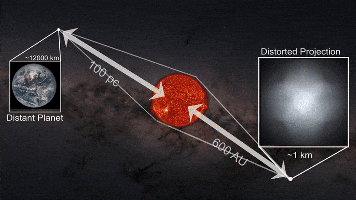 Is it even theoretically possible to image in any detail the surface of an exoplanet light years away? An optical telescope would need to be many times the diameter of the Earth to produce such images. This “brute force” method of just building a giant telescope is probably never going to happen. Instead we need to find a more clever way, a method of exploiting the laws of physics to magnify distant images orders of magnitude beyond current technology. One idea gaining attention is using the sun as a giant gravitational lens.
In 1916 Einstein published his theory of General Relativity, which conceptualized gravity as a distortion of spacetime. He predicted that an object with a large gravitational field would even bend light. His predictions were validated with the 1919 total solar eclipse. During totality stars could be seen around the edge of the sun, and their apparent positions indicated that light from those stars had been bent as they passed near the sun. That validation gave a huge boost to acceptance of Einstein’s theory and made him a scientific superstar. Building on this idea he later predicted that a distant massive object with a light source directly behind it from the perspective of Earth would be surrounded by a ring of light from that more distant object – called an Einstein ring. Although relatively rare because they require a precise alignment, Hubble has found many examples.
In 1979 Von R. Eshleman wrote a paper in which he proposed that Einstein’s gravitational lens effect could be leveraged to image objects at interstellar distances. He wrote:
“The gravitational field of the sun acts as a spherical lens to magnify the intensity of radiation from a distant source along a semi-infinite focal line. A spacecraft anywhere on that line in principle could observe, eavesdrop, and communicate over interstellar distances, using equipment comparable in size and power with what is now used for interplanetary distances.”
Continue Reading »
May
02
2022
According to the WHO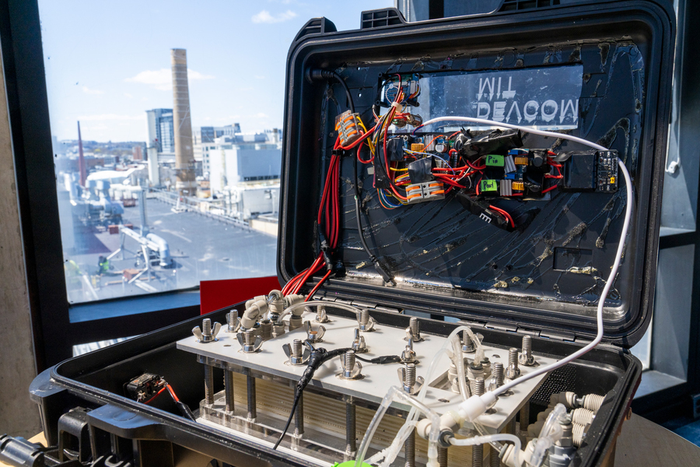 , one third of the people in the world lack access to safe drinking water. They report that, “Globally, at least 2 billion people use a drinking water source contaminated with faeces.” Some locations (like the island of Bermuda) lack any supply of fresh water, and depend largely on rainwater. While a lot of progress has been made over the last few decades, this remains a huge problem. It is also likely to be exacerbated by global warming and an increasing population. A proper sanitation infrastructure is the ideal solution, but in the meantime anything that can supplement supplies of drinkable water will help.
One technology that has been around for decades and is often pointed to as a potential solution is desalination, taking the salt out of salt water. If we can economically do this, then we could just get our fresh water supply from the ocean or from brackish sources. There are plenty of commercial options available, like this one, that uses reverse osmosis and filtration to desalinate and purify water. Even in developed nations desalination plants are becoming more common, as demand increases, and also to create a reliable local source even during times of drought. California has 11 such plants, like this one north of San Diego that produces 50 million gallons of fresh water per day.
There is also a use for small portable desalination options in poor or remote regions that lack access to centralized sources of clean water. Portable options can also be useful during disasters, or when demand spikes due to heat waves or droughts. Portable “suitcase” sized desalination devices already exist and can be purchased commercially. The SeaWater Pro, for example, costs about $6,000 and comes in a portable hard case. It comes in two options, a plug-in and one run by a lithium-ion battery. The battery option could also be paired with a portable solar panel, which range from a couple of hundred to a few thousand dollars depending on how much power you need. This device produces 10 gallons of fresh water per hour, or 240 gallons per day (if plugged in). That is enough to serve a few families or even a small village.
A recent study examines a new approach to portable desalination, using “multistage electromembrane processes, composed of two-stage ion concentration polarization and one-stage electrodialysis.” The study demonstrates that the technology works, producing drinkable water up to the WHO standard starting with either brackish water or sea water. The advantage of this system is that it does not require filters, so nothing that needs to be regularly replaced. It is therefore a more independent system. A battery-based system has been field tested, and the authors report that: “The demonstrated portable desalination system is unprecedented in size, efficiency, and operational flexibility.” Continue Reading »
Apr
28
2022
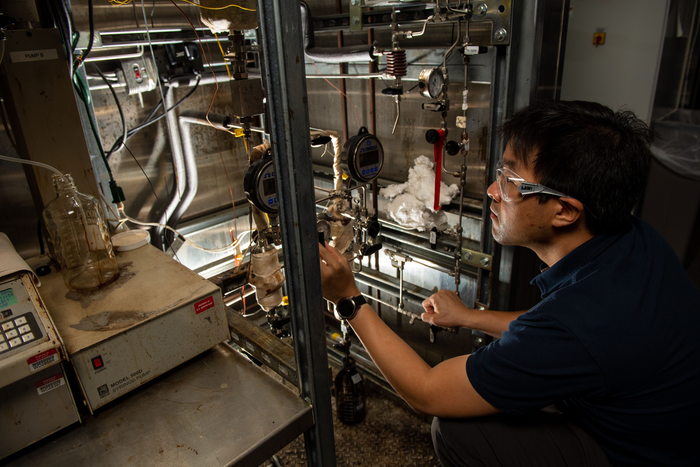 As we try to transition as much as possible away from fossil fuels, jet fuel remains a tricky problem to solve. Jets, like rockets, require a fuel with a high energy density (energy per volume) and specific energy (energy per mass). For rockets the specific energy is far more important – mass is everything, due to the rocket equation – and so perhaps the ideal fuel for rockets is hydrogen, because it is so light. For jets, however, energy density is also very important because there is only so much volume in the fuel tanks, and making them bigger can be counterproductive.
Jet fuel has another requirement. O-rings are used to seal metal-on-metal joints in the fuel tank and engine. In order for these O-rings to work optimally they have to swell during engine operation, a property known as seal-swell. Currently aromatics are added to jet fuel because they cause the seals to swell. In fact, this has been a huge hindrance to the use of replacement and more sustainable jet fuels, because they lack adequate seal-swell properties.
A new innovation, however, may have solved this problem. The researchers developed a lignin-based jet fuel additive (LJF) with several desirable properties. Here’s the highlight: “A new LJF is reported primarily composed of C6-C18 mono-, di-, and tri-cycloalkanes.” They tested a 10% blend of their new LJF with conventional jet fuel and it increased the fuels energy density and specific energy, both highly desirable effects. But perhaps more importantly, the LJF additive had great seal-swell properties. It could therefore replace the aromatics in the jet fuel.
This is important for the project of creating sustainable jet fuels because the aromatics have a significant negative impact on the environment. They produce a lot of soot when burned and contribute to contrails. Contrails contribute to global warming, perhaps even more than the CO2 released by burning jet fuel. Reducing or eliminating soot from aromatics and the resulting contrails could significantly reduce the contribution to AGW from jet travel. As a blend the LJF, which is a biofuel, displaces fossil fuel, and by making the fuel more energy dense reducing overall fuel use.
Continue Reading »
Apr
26
2022
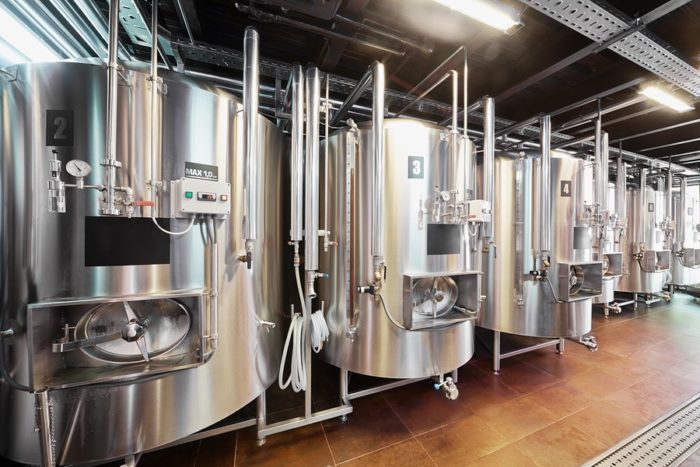 Are we headed for a world in which most of the meat we consume was grown in a vat rather than in an animal? This is a fairly high-stakes question (pun intended). We have a growing population, we are already using most of the arable land available, and we are pushing the efficiency of agriculture. There is still some technological head room, mostly with GMO technology, to improve yields further. But we are already use more land than is optimal to feed ourselves, as well as a lot of water, and consuming a lot of energy, which has a carbon footprint. Anywhere we can achieve efficiency can have a huge impact, therefore.
The animal product industry is the focus of a lot of attention by environmentalists because of its inherent inefficiency. There are different ways to look at this. Cattle consume about 25 calories for each one they produce, pork is about 15, chicken 6, and fish is close to 1:1. But we can also look at calories produced per acre of land, in which case the comparison is not as clear.
One way to look at the issue is calories produced per acre of land. Here beef has the worst ratio, with 1.1 million calories produced per acre (I assume this is per year, although it is not explicitly stated in the linked reference). Potatoes are very efficient at 17.8 million calories per acre. But soybeans are also pretty inefficient at 2.1, while pork is more efficient than soybeans at 3.5. The ratio of efficiency between potatoes and soybeans is about the same as the ratio between wheat (6.4) and beef.
Some types of meat are more land-efficient than some plants, but yes, overall, plants are more efficient. The picture is also complicated because animals can produce high-quality nutrition and can use land not suitable for growing plant-based food. Simplistic comparison therefore breakdown when you look at a more complete picture. But I think it is scientifically non-controversial to say that the typical Western diet includes too much meat, and if we cut down it would improve the overall efficiency of our food production in terms of land, water, and carbon. This is a low-tech solution that is likely optimal for health and the environment.
Continue Reading »
Apr
25
2022
 Because I host a popular podcast, I often get solicitations to offer people to be interviewed on the show. They are mostly scientists and science-communicators with a new book to promote. This is actually a helpful resource, although I end up booking very few. One of the reasons for the low hit rate is that the promoters are surprisingly undiscriminating, sometimes laughably so. Recently I received an e-mail regarding “scientist” Tom Paladino:
“He’d appreciate the opportunity to come on your show, The Skeptics Guide to the Universe, to explain what Scalar Light is and how it can be used to help heal the human body naturally.”
After taking a look at his website I questioned whether Paladino knows what scalar light is, although it may be different than Scalar Light. Apparently scalar light was something researched by Nikola Tesla – in my opinion invoking his name is an extremely reliable marker for pseudoscience and chicanery, up there with Galileo.
Let’s start with the actual science – what is “scalar light” or more generally, a scalar energy field? In physics the word “scalar” just means a physical property that has a specific magnitude value at each point in space, and that value is independent of perspective or frame of reference. Temperature is scalar because you can give a magnitude value at every point, but direction is irrelevant. Scalar properties are distinguished from vector properties, which have both magnitude and direction. Earth’s gravitational field is a vector energy field, because each point in space has a specific magnitude and direction.
Is light a scalar or vector phenomenon? Well, the speed of light (c) is always the same regardless of the observer, so it is a scalar phenomenon (the speed of light only refers to its magnitude). The velocity of light refers to its magnitude and direction, so it is a vector quality. From the perspective of physics, then, “scalar light” refers to the speed of light. Or it’s redundant – it’s just light, which has a scalar property (speed).
Continue Reading »
Apr
24
2022
Since many of my regular commenters are intent on talking about their Wordle scores in the comments, you can now use this thread rather than my Topic Suggestions. Please put the following phrase at the top of every comment to avoid spoilers (fresh comments appear on the homepage, so people can see them even if they are not reading this post).
“To all WORDLE fans
We are discussing today’s WORDLE puzzle.
If you do not want to see the answer,
then please avert your eyes.
——————————”
For those who may not know, Wordle is a popular word puzzle created by Welsh software engineer Josh Wardle in 2013. After it became popular it was purchased by the New York Times, who now hosts the game. The game has become popular partly because people like publishing their solutions on social media. The game has also provoked a lot of questions. There is no evidence to suggest that playing Wordle makes you smarter, and we now have a lot of research that shows that puzzle games like this make you better at the specific game, but does not boost general intelligence. However, the game may make people feel smart. That’s because it is easy to underestimate how quickly word options can be eliminated, and therefore how quickly we can whittle down the options to the correct answer, so we feel really smart when we get it.
Math nerds have also used the game as an opportunity to teach about entropy and information theory. How much information do you get out of each guess? What is the optimal starter word? If you played a statistically perfect game, what would your score distribution be?
Which country has the best Wordle players? Well, if Twitter is a fair indication then it’s Sweden. What’s the best state? North Dakota.
Enjoy.
Apr
21
2022
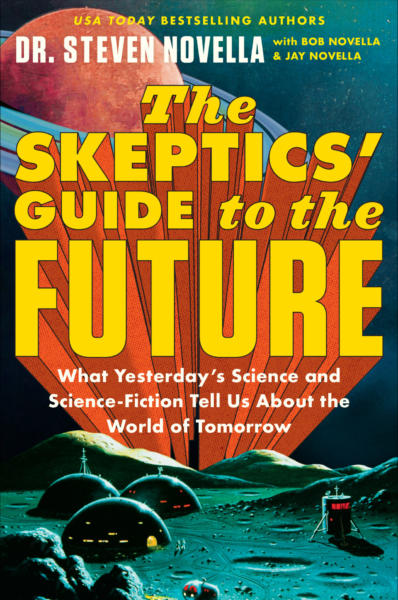
 I am happy to announce that pre-orders are open for my upcoming book, The Skeptics’ Guide to the Future, which will be released by Grand Central Publishing on September, 27th. You can preorder your book here.
This was a particularly fun book to write, with my two brothers, Bob and Jay (who also co-host the SGU podcast with me). This is our second book, with Evan and Cara also contributing to the first one (The Skeptics’ Guide to the Universe). In this new book we explore futurism itself – what have we learned from past attempts at predicting the future and how can we use those lessons to perhaps do a little better? We explore, for example, what I call “futurism fallacies”, common errors in trying to extrapolate our world into a vision of the future. One common fallacy is to extrapolate current trends indefinitely into the future, even though this is generally not the path that history has taken. Disruptive technologies, changing priorities, the interaction among various types of technology, and evolving culture all introduce zigs and zags into the course of history, and therefore the future.
Is futurism, therefore, doomed to failure? This is actually a matter of scholarly debate, with critics and advocates. Overall I think predicting the future is similar to predicting the weather – while it is impossible to predict the details beyond a very short window, we can make broad predictions about the climate. Similarly we can say that technology will not only continue to advance but the pace of that advance is accelerating. We explore those individual technologies that are just emerging and most likely to have a profound impact on our future, such as genetic engineering, additive manufacturing, artificial intelligence, and metamaterials. There are also some established technologies that will continue to advance, expanding into new niches, such as robotics.
We also discuss technologies that are just in the conceptual stage, and give our opinion as to whether or not they are likely to ever come to fruition. We will likely have fusion power someday, but I doubt we will ever have a space elevator (at least not on Earth).
Continue Reading »
Apr
19
2022
 Sound can be a powerful form of energy, and is often underappreciated. Remember the weirding modules in Dune, that focused and amplified sound as a weapon? That is not an unrealistic technology. If you are near a powerful explosion, even without being exposed to heat or shrapnel, you can be killed by the pressure wave alone, which can cause significant internal damage.
Sound has also been used for years as a medical tool. You are probably most familiar with ultrasound technology, a non-invasive and safe way to image living tissue in real time. Many parents are familiar with this technology, as it is safe enough to image a growing fetus. But sound can also be used medically to destroy, and this application has many potential advantages.
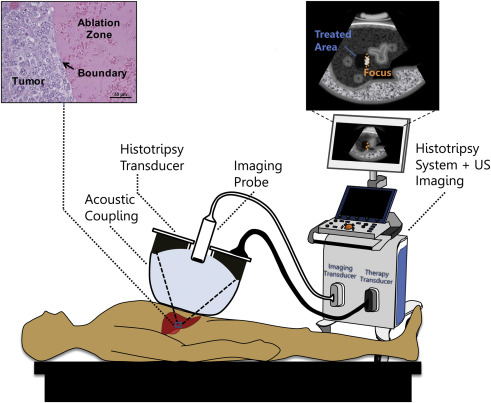
One such technique is called High-Intensity Focused Ultrasound, or histotripsy. This is the latest approach to using sound to destroy unwanted tissue inside the body. There are older techniques that would use sound wave to heat up tissue and cause thermal damage. Histrotripsy uses a different method, and early research suggests this is a potentially significant step forward. The basics of the technology is the use of two highly focused beams of very short (<50 microseconds) bursts of high intensity sound. Where the beams cross, I am assuming through constructive interference, the intensity is great enough to cause cavitation within the tissue.
Cavitation is negative pressure that will cause a bubble of gases to expand inside the cells. These bubbles then collapse, resulting in significant mechanical stress on the cells that destroy them. Repeated applications of the histotripsy over the same area causes these areas of cavitation to coalesce into one large area filled with “liquified homogenate” – i.e. goo. This process can be targeted by simultaneous ultrasound imaging (the cavities appear bright on ultrasound), which makes the entire setup fairly portable and convenient.
Continue Reading »
Apr
18
2022
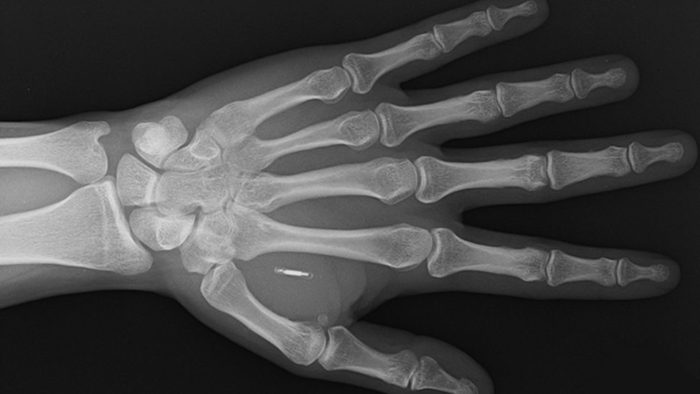 Would you get a readable chip implanted in your hand? In a 2021 European survey 51% of people said that they would. What are the risks and potential benefits of the technology as it currently stands?
There are currently two main technologies for implantable chips that can be read at close range through the skin. The more familiar technology is RFID – radio frequency identification. There is also Near Field Communication (NFC) which is a type of device that uses short range connections, less than 4cm. Both NFC and RFID use radio frequency wireless communication. They are activated by coupling with an external antenna that allows one-way or two-way data communication. The devices are therefore passive, they do not require their own power, which is a huge advantage for something implantable.
This is the same technology used in wireless card readers or similar non-implantable technology. The real difference is that these chips are designed to be implanted, so that are small (slightly larger than a grain of rice) and are encased in a bioplastic that is tissue compatible. The first such chip was implanted in a person in 1998. They have been used routinely for implantation in pets. They are FDA approved for implantation in humans, and the data shows that they are medically safe. They are also MRI safe, meaning that (despite rumors) they won’t explode, overheat, or move if a person with a chip implant goes through an MRI scan. However, some brands may not be MRI compatible, meaning that the data on them may be wiped or destroyed by the MRI scan. This is likely a solvable problem, however. Chip designs could be made MRI resistant. It’s also theoretically possible to put on a glove that would shield the chip to reduce or avoid damage.
Continue Reading »