Mar 06 2026
Scientists Grow Chickpeas In Lunar(ish) Soil
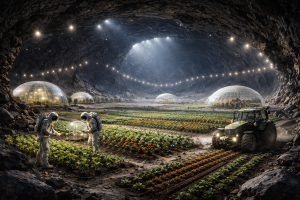 If we are going to have an enduring presence on either the Moon or Mars, or anyplace off of Earth, we will need to grow food there. It is simply too expensive, inconvenient, and fragile to be dependent on food entirely from Earth. In fact, any off-Earth habitat will need to be able to recycle most if not all of its resources. You basically need a reliable source of energy, sufficient food, water, and oxygen (consumables) to sustain all inhabitants, and the ability to endlessly recycle that food, water, and oxygen.
The ISS has achieved 98% recycling of water, which is what NASA claims is the threshold for sustainability of long space missions. The ISS also recycles about 40% of its oxygen. However, the ISS grows none of its food. It is all delivered from Earth, with a 6 month supply aboard the ISS. There are experiments to grow plants on the ISS, and these have been successful, but this is not a significant source of nutrition for the astronauts.
Doing the same on the Moon is not practical for long missions, although we will certainly be doing this for a time. But the goal, if we are to have a lunar base as NASA hopes (NASA plans a lunar base at the Moon’s south pole by 2030) is to grow food on the Moon (and eventually on Mars). On the ISS the big limiting factor is microgravity. The Moon has lower gravity than Earth, but it has some gravity and so that will likely not be a major problem, especially since we can grow plants on the ISS. We can also grow plants hydroponically pretty much anywhere, and I suspect this will happen on any lunar base. But a fully hydroponic system has its limits as well.
Hydroponics on the Moon would be challenging for several reasons. First, it is energy intensive, and energy may be a premium on a lunar base, especially early on. Second, it requires a precise balance of nutrients in the water, and those nutrients would have to be sourced from Earth. So it doesn’t really solve the problem of dependence on Earth. And third, hydroponics requires a lot of equipment which would have to be shipped from Earth. We could theoretically leach nutrients from lunar regolith, and this might help a bit, but is also energy intensive and would not be a source of nitrogen.
Therefore – NASA and others are looking into the possibility of growing plants in lunar regolith. This could have multiple advantages. It requires much less equipment, energy, and water than hydroponics. Many of the nutrients would come from the regolith itself. This would reduce dependence on supplies from Earth. A soil-based system can also more easily recycle nutrients from food waste and human waste. Likely, a lunar base would have a hybrid hydroponic and soil-based system. As a side benefit, if such a base grew enough food to feed its human inhabitants, this would also recycle CO2 and produce more than enough oxygen for them to breath. In fact, they would have to figure out something to do with the extra oxygen to keep it from building up (likely not a problem – oxygen has many uses).
The major hurdle to growing food in lunar regolith is that – well, you can’t. Plants do not grow well in lunar regolith. It lacks nitrogen and other nutrients, it lacks organic matter, and it contains toxic compounds. Experimentally, plants will not grow sufficiently in simulated lunar regolith. But, we can treat the regolith to turn it into soil that can grow plants, and that is the focus of the current study mentioned in the headline. Scientists have used simulated regolith, modified by adding organic matter (vermicompost) created by red wiggler earthworms composting organic waste, and were able to grow chickpeas in the resulting soil. They tried various mixtures, and found that 75% regolith to 25% soil was the limit – more than 75% regolith and the plants would not survive. They also coated the chickpeas with arbuscular mycorrhizae before planting. The fungus is symbiotic, increasing the uptake of some nutrients while decreasing the uptake of some toxins like heavy metals.
The experiment was considered a success – the chickpea plants grew, survived, and produced chickpeas. However, they have not yet tested the chickpeas to see if they are safe and edible. They need to be tested for any toxic compounds. This is also not the first such study, there have been dozens of others. They generally show that crops will grow in modified simulated Martian and Lunar regolith. But questions remain about how good the simulated regoliths are.
There has also been one study using actual unmodified lunar regolith (brought back by the Apollo missions). In this study the plants grew, but showed signs of severe stress and were morphologically altered. That they grew at all, however, is amazing and encouraging.
What does all this mean for the future of lunar and Martian bases? They will very likely include some growing of food in modified regolith. The implication of the research is that we can likely develop a self-sustaining system in which plants are grown in modified soil using mostly native regolith. These plants produce food and oxygen while using CO2. The soil can then be fertilized using compost from any organic waste generated by the base, including humanure. You can even recycle urine in order to source nitrogen. In short, we can envision a system in which everything is recycled to locally produce food and air. We can also recycle 98% of the water in the system, perhaps eventually even more. You just need to kickstart the system with initial resources, and maybe need to top them off from time to time, but otherwise the system is self-sustaining.
It is also likely that the more the lunar or Martian regolith is used to grow food, the more it will look like Earth soil. The percentage of organic matter will increase, it will develop an ecosystem of microorganisms, and any toxins will be leached out over time. This high quality soil can then be used to expand the farm, and generate more modified soil from regolith.
It is also likely that such a lunar farm would exist underground, probably within a lava tube. This means that all the light with be artificial, but that’s not a big problem – we can do grow lights. Having a farm under a dome on the surface is likely not worth it. This would provide free sunlight, but only half the time, and not in a typical circadian cycle, but roughly 14 days of sunlight followed by 14 days of darkness. It would also be susceptible to radiation and micrometeors. Better to be in the safety of a lava tube, deep under ground, and just use grow lights.
Finally, one factor I have not mentioned yet is the potential to alter the plants themselves to adapt them to growing on the Moon, or on Mars or on a space station. Through some combination of cultivation and genetic engineering, we may be able to adapt crops to the lower gravity and the modified lunar soil. This could optimize productivity, safety, and nutrition.
While there is a lot of work to be done, the research so far shows that farming the Moon or Mars is feasible, which is good if we plan to have long term bases on either.