Apr 06 2026
What Is Your Favorite Color?
 Many people might find this to be an easy question and simple concept – what is your favorite color? In fact it was used as the quintessential easy question by the bridge guardian in Monty Python and the Holy Grail. But it is a good rule of thumb that everything is much more complicated than you think or than it may at first appear, and this is no exception. We recently had a casual discussion about this topic on the SGU, and it left me unsatisfied, so I thought I would do a deeper dive. Perhaps there is a neuroscientific answer to this question.
The panel differed in their reactions to the question of favorite color (we were just giving our subjective feelings, not discussing research or evidence). Cara felt that “favorite color” is largely arbitrary. Kids are asked to pick a favorite color, which they do (under pressure) and then often just stick with that answer as they get older. She also felt the question was meaningless without context – are you referring to clothes, cars, house color, or something else? Jay was at the other end of the spectrum – he has a strong affiliation for the color orange which gives him a pleasant feeling. The rest were somewhere in between these two extremes.
I knew there had to be a science of “favorite color”, which I thought might be interesting. Indeed there is – and it is interesting.
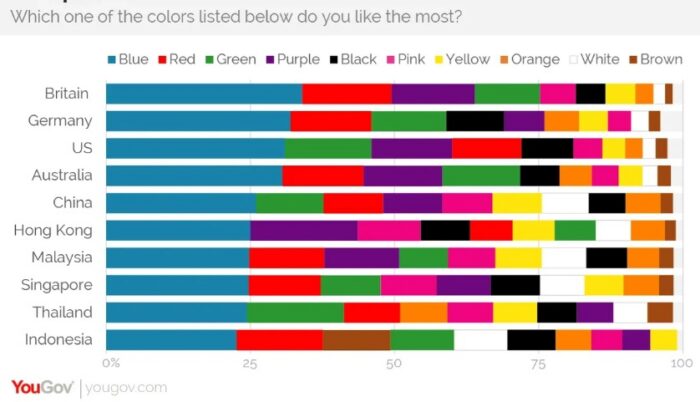
First, what is the distribution of favorite color, across the world and demographically? Blue is, far and away, the most favorite color, in most countries across the world, so it seems to be very cross-cultural. It is also the favorite across age groups and gender. The second-most favorite color is either green, red, or purple. Brown is almost universally the least favorite color. Gender has an effect on favorite color, with more women favoring pink, and reds in general (but still preferring blue overall). Republicans still prefer blue over red, but more Republicans prefer red than Democrats. There are country-specific differences as well. Red is a higher preference in China than many other countries, for example.
The demographics of favorite color are clues as to potential underlying causes. Is favorite color purely a cultural phenomenon? It does not seem to be, but there are some minor cultural influences. Is it a neuro-biological phenomenon? It could be, but not purely. If it is partly neurological, what does it track with? How about personality. The evidence is, in short, mixed, and reveals the hidden complexity of seemingly straightforward questions.
Most people think of color preference as referring to hue, but saturation and brightness have just as much of an influence on color choice. When you consider all aspects of color, the picture becomes more complex. Extroverts, for example, prefer bright colors. Adults tend to prefer more saturated colors. The results of studies, therefore, depend on how the questions were asked. But an overall summary is – you can make some statistical predictions about the big five personality types (extroversion, openness, agreeableness, neuroticism, and conscientiousness) from color choice. But this is one factor among many, and depend on multiple factors (the context, the object, and all three color traits). There does seem to be an actual phenomenon here – an influence of personality on color choice – but it’s mixed and complicated.
So far we have mostly just been describing who has which color preferences, but not why or how. We have some clues from the demographics of color choice, but no answers. Given everything above, it is still possible that color choice is entirely learned, or partly learned but mostly an inherited trait. What does the evidence say about this question? Well, there is no current answer, but there is a strong theory that is a good fit to the evidence – the ecological valence theory.
According to this theory color preferences emerge from the totality of our life experience mainly through emotional association. We have a partly associatative memory, in that we tend to remember things partly by associating them with other things that occur together. This includes color. If green things tend to be associated with good experiences, then we will begin to associate the color green with good feelings. According to EVT blue is the most common favorite color because we associate with blue clear skies and clean water, which tend to be associated with happy experiences. We tend to associate brown with feces or rotten food, so that is consistently the least favorite color.
The strength of EVT is that it allows for biological, cultural, experiential, and personality factors all at once. They all can affect our associations with colors, and contribute to how they make us feel. Some associations may be natural, like blue skies, green vegetation, and putrid yellow and brown. Others can be purely cultural, like pink for girls or purple with royalty. Different personalities would be drawn to different colors that tend to be associated with congruent moods, like vibrant reds for extroverts, or calming blues for introverts. And then there are likely to be some quirky individual factors as well – extreme individual experiences, or social group sorting (which color wedge do you typically play in Trivial Pursuit).
Does neuroscience add anything to this picture? So far, neuroscientific studies have elucidated some of the underlying brain regions that relate to color preference and processing, but don’t really provide any insight into why color preferences exist. Here is the most relevant study I could find:
These results demonstrate that brain activity is modulated by color preference, even when such preferences are irrelevant to the ongoing task the participants are engaged. They also suggest that color preferences automatically influence our processing of the visual world. Interestingly, the effect in the PMC overlaps with regions identified in neuroimaging studies of preference and value judgements of other types of stimuli.
Sure – color preferences and experiences happen in the brain, and involve a brain region generally involved in value judgement. This is a piece to the puzzle, but itself does not really address the cause of color preferences, just some of the neurological mechanisms.
There is still a lot to learn about color preferences. The evidence does not support the notion that color preference is a purely arbitrary phenomenon, but rather that it has a psychological, cultural, and neurological basis. But there is still a lot of research to be done in terms of the nature and causes of color preferences.