Jan 19 2026
Moon Landing Hoax In School
 Last week a child of one of my cohosts on the SGU, who is in fifth grade (the child, not the cohost), came home from school and declared, rather dramatically, “Mom, Dad – did you know that we never went to the Moon? It was all fake.” They found this to be a surprising revelation, but were convinced this was a proven scientific fact. Of course, we live in the age of the internet, and our children are going to be exposed to all sorts of information that may be misleading or age-inappropriate. This is one more thing parents have to deal with. What was disturbing about this incident was where they learned this “scientific fact” – from their science teacher.
Any parent should be concerned about this, but in a family of skeptical science communicators, this raised the alarm bells. But the first thing they did was send a polite e-mail to the teacher (cc’ing the principal) and simply ask what happened. This is good practice – always go to the primary source. It’s easy for anyone to get the wrong idea, and this wouldn’t be the first time a fifth grader misinterpreted a lesson in class. The teacher essentially said that while he did not explicitly tell the students we did not go to the Moon (the student reports he said “it’s possible we did not go to the Moon”), he personally believes we did not, and that it is a “proven scientific fact” that it would have been impossible, then and now, to send people to the Moon (somebody should tell the Artemis astronauts).
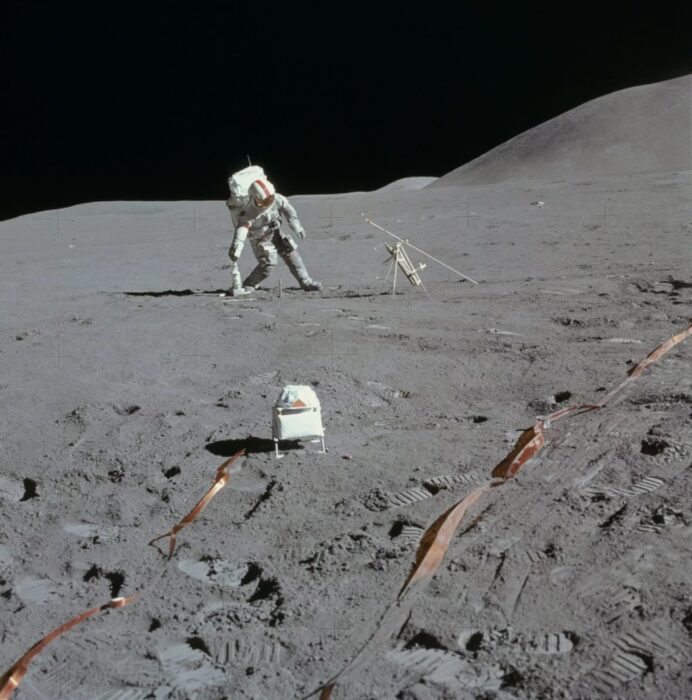
Apparently he raised at least two points in class – that there were (impossibly) no stars in the background of the photographs taken from the Moon, and the astronauts could not have survived passage through the radiation belts around the Earth. These are both old and long-debunked claims of the Moon-hoax conspiracy theorists. While it is easy to find sources online, let me briefly summarize why these claims are wrong.
The first claim, about no stars in the photographs from the Moon, is trivially solved with some basic photography knowledge. Cameras have to be set for different light levels. There are three basic settings – the ISO of the film or sensor (a measure of how sensitive it is to light), the aperture and the shutter speed. The sky on the Moon is black because there is no atmosphere to diffuse the light, but the surface during the day can still be very bright, and reflect off every surface. This means, to avoid over exposure, they would have used a small aperture and fast shutter speed, which would not have allowed for exposing the tiny amount of light coming from stars, which are only a point of light. Even from Earth, if you want to get a visible picture of stars at night you need to take a long exposure – long enough that you need to use a tripod. Regular cameras (including the ones used during Apollo) have a low dynamic range – the range of light levels they can capture simultaneously. So they would not have been able to capture the bright lunar surface and stars in the background at the same time. Modern digital cameras have techniques for capturing high dynamic range, but this does not apply to the Apollo-era cameras.
The second point refers to the Van Allen belts, which are belts of increased radiation intensity around the Earth. These are tori of ionic radiation trapped by the Earth’s magnetic field. They can vary in shape and intensity, and are not symmetrical. The inner belt is mainly protons and the outer belt is mainly electrons. They do pose an issue for satellites, which have to have proper shielding to protect any sensitive electronics. Crucially – we knew about the Van Allen belts since 1958, so NASA had this information when planning the Apollo missions.
This is a bit more complicated to debunk than the silly photography claim, but still, this information is widely publicly available. The effects of radiation exposure are determined by three variables – the intensity of the radiation, the type and energy of the particles, and the time of exposure. The Apollo capsules were specifically shielded with an aluminum alloy hull and insulation to reduce the intensity of the radiation. Also, NASA specifically calculated a launch trajectory to minimize the time they would spend traversing the Van Allen belts. They ended up spending just a few minutes in the higher energy lower belt, and about 90 minutes in the outer belt. The total radiation exposure was the equivalent of a typical CT scan – so not much. Because there are so few astronauts it is difficult to get statistically powerful data on their subsequent risk of death from cancer or cardiovascular disease, but what evidence we have shows no significant increase in risk.
So these two points, which this science teacher apparently believes “proves” it is impossible to send humans to the Moon, are easily debunked with some basic science knowledge. This gets me to the real point of this post – anyone who believes such a conspiracy is likely not qualified to teach science. I firmly believe that science teachers, even at the fifth grade level, need to have a working basic knowledge of science and critical thinking. Believing a conspiracy theory like this is evidence for lack of both. In addition to these points, we can ask – what would have to be true in order for the Moon hoax conspiracy to be true. The size of the conspiracy would have to be massive? Why didn’t the Soviet Union call us out on the hoax, which they could easily have detected and demonstrated? How has it been maintained for six decades? Why hasn’t the scientific community called NASA out on the hoax? If it were truly impossible to go to the Moon, there are generations of scientists, from all over the world, who could easily demonstrate this.
The lack of curiosity and critical thinking on display here is shocking and profound. What a horrible lesson to teach a class of fifth-graders. This also raises another point – expressing such beliefs to fifth graders (apparently without any proper context) shows an incredible lack of judgement. This was not part of any lesson plan or approved material, and he has to know it is (to say the least) controversial (bat-shit crazy is more like it). Even if it were presented in a “teach the controversy” format to encourage critical thinking, I would question whether this is age-appropriate.
Of course, we will turn this into a teaching moment, and use it as an opportunity to teach critical thinking, why grand conspiracy theories are suspect, and some of the relevant science. We will also do what we can to make sure the entire class gets this lesson. We also will try to drive home that teaching such nonsense as “proven scientific fact” to school children is, to say the least, not appropriate.