Feb 03 2026
Forgetting History
 Engaging on social media to discuss pseudoscience can be exhausting, and make one weep for humanity. I have to keep reminding myself that what I am seeing is not necessarily representative. The loudest and most extreme voices tend to get amplified, and people don’t generally make videos just to say they agree with the mainstream view on something. There is massive selection bias. But still, to some extent social media does both reflect the culture and also influence it. So I like to not only address specific pieces of nonsense I find but also to look for patterns, patterns of claims and also of thought or narratives.
Especially on TikTok but also on YouTube and other platforms, one very common narrative that I have seen amounts to denying history, often replacing it with a different story entirely. At the extreme the narrative is – “everything you think you know about history if wrong.” Often this is framed as – “every you have been told about history is a lie.” Why are so many people, especially young people, apparently susceptible to this narrative? That’s a hard question to research, but we have some clues. I wrote recently about the Moon Landing hoax. Belief in this conspiracy in the US has increased over the last 20 years. This may be simply due to social media, but also correlates with the fact that people who were alive during Apollo are dying off.
Another factor driving this phenomenon is pseudoexperts, who also can use social media to get their message out. Among them are people like Graham Hancock, who presents himself as an expert in ancient history but actually is just a crank. He has plenty of factoids in his head, but has no formal training in archaeology and is the epitome of a crank – usually a smart person but with outlandish ideas and never checks his ideas with actual experts, so they slowly drift off into fantasy land. The chief feature of such cranks is a lack of proper humility, even overwhelming hubris. They casually believe that they are smarter that the world’s experts in a field, and based on nothing but their smarts can dismiss decades or even centuries of scholarship.
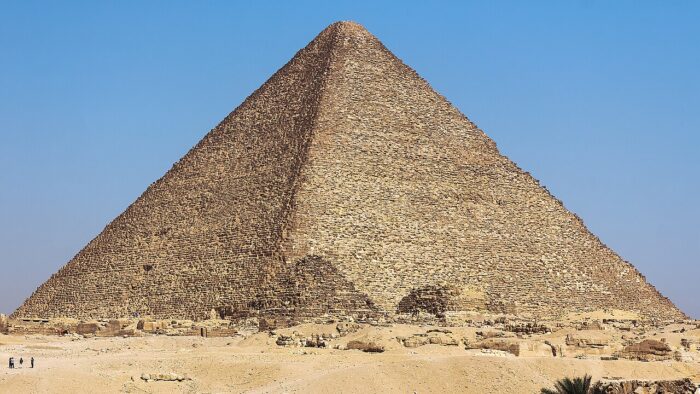
Followers of Hancock believe that the pyramids and other ancient artifacts were not built by the Egyptians but an older and more advanced civilization. There is zero evidence for this, however – no artifacts, no archaeological sites, no writings, no references in other texts, nothing. How does Hancock deal with this utter lack of evidence? He claims that an asteroid strike 12,000 years ago completely wiped out all evidence of their existence. How convenient. There are, of course, problems with this claim. First, the asteroid strike at the end of the last glacial period was in North America, not Africa. Second, even an asteroid strike would not scrub all evidence of an advanced civilization. He must think this civilization lived in North America, perhaps in a single city right where the asteroid struck. But they also traveled to Egypt, built the pyramids, and then came home, without leaving a single tool behind. Even a single iron or steel tool would be something, but he has nothing.
Of course, there is also a logical problem, arguing from a lack of evidence. This emerges from the logical fallacy of special pleading – making up a specific (and usually implausible) explanation to explain away inconvenient evidence or lack thereof.
Core to the alternative history narrative is also that those ancient people could not possibly have built these fantastic artifacts. This is partly a common modern bias – we grossly underestimate what was possible with older technology, and how smart ancient people could be. Even thousands of years ago, in any culture, people were still human. Sure, there has been some genetic change over the last few thousand years, but not dramatically, and this is also in how common alleles were, not their existence. In other words – every culture could have had their Einstein. Ancient Egypt had genius architects, and is some cases we even know who they were.
People also underestimate the willingness of ancient people to engage in long periods of harsh work in order to accomplish things. Perhaps this is a “modern laziness bias” (I think I just coined that term). We are so used to modern conveniences, that the idea of polishing stone for 12 hours a day for a year in order to create one vase seems inconceivable. The pyramids, it is estimated, were constructed with 20-30,000 workers over 20 years. This included skilled masons, who likely became very skilled during the project. Egypt had an infrastructure of such skilled workers, supported by many long term projects over centuries.
Which brings up another point – we underestimate how much time these ancient civilizations existed. My favorite stat is that Cleopatra lived closer in time to the Space Shuttle than the building of the pyramids. Wrap your head around that. These ancient people were clever, they included highly skilled crafters, and they had centuries, at least, to advance their techniques.
What amazes me is that this narrative of denying history extends to recent events. Again, the Moon landing is an example. But there is also a narrative circulating on TikTok that buildings from the 18th, 19th, and even 20th century were not built by the people who historians said built them. They were found in place, and were built by an older and more advanced civilization – called Tartaria. Never heard of it? That’s because it does not exist. This civilization was wiped out by a world-wide mud flood in the 19th century. According to this particular nuts conspiracy theory, modern governments just occupied the buildings they left behind then conspired together to wipe the history of the mud flood and Tartaria from all records.
What is even more amazing to me is that, in far less time than it took to create a TikTik video spreading this nonsense, someone with even white-belt level Google-fu could have found convincing evidence that this is wrong. You can find pictures of the buildings being built, or of the city before they were built, or documentation of them being built, or experts who have already gathered all this information for you. You can also find that “Tartaria” was a medieval label used to denote the “land of the Tartars”, which simple refers to Mongols. It was a nonspecific geographic label, not an actual place or nation.
But of course, none of this matters in a social media world in which narrative is truth, everything “they” say is a lie, and in fact truth or lie is not even really a thing. It’s all narrative, it’s all performance and clicks.
And this is why scholars and scientists need to engage with the world, much more than they currently do. We cannot simply ignore the nonsense with the idea that it will shrivel and die if we don’t give it light. That is such a pre-social media idea (if it were ever true). We have to fight for scholarship, or logic, facts, and evidence. We have to fight for history.