Aug 25 2025
Brightest Fast Radio Burst Discovered
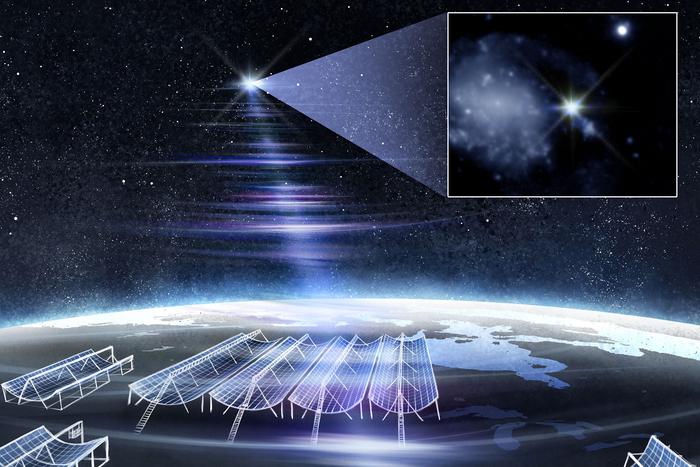 The universe is a big place, and it is full of mysteries. Really bright objects, that can be seen from millions or even billions of light years away, can therefore be found, even if they are extremely rare. This is true of fast radio bursts (FRBs), which are extremely bright and very brief flashes of light in the radio frequency. They typically last about one thousandth of a second (one millisecond). Even though this is very brief, they still represent a massive energy output, and their origins have yet to be confirmed.
Recently astronomers have detected the brightest FRB so far seen, and it was relatively close, only 130 million light years away. That may seem far, but most FRBs are billions of light years away (again, indicating that they are relatively rare, because we need a huge volume of space to see them). Because this FRB was bright and close, it gives us an opportunity to examine it in more detail than most. But – this is also made possible by recent upgrades to the equipment we use to detect FRBs.
The primary instrument we use is CHIME (Canadian Hydrogen Intensity Mapping Experiment). As the name implies, this was developed to map hydrogen in the universe, but it is also well-suited to detect FRBs. So far, since 2018, it has detected about 4,000 FRBs. But because they are so brief, it is difficult to localize them precisely. We can see what direction they are coming from, and if that intersects with a galaxy we can say it probably came from that galaxy. But astronomers want to know where within that galaxy the FRB is coming from, because that may provide clues to confirm their origin. So they built “outriggers” – small versions of CHIME spread around North America to effectively increase the size of the CHIME detection area and significantly increase its precision. It was this new setup that detected the recent FRB. What did they find?
They were able to localize the FRB to its location within its host galaxy – the outer edge of what appears to be a star-forming region. At the middle of a star-forming region, the stars are very young, and as you go farther from the middle they get older. So that means any stellar source here is likely moderately old – not newly minted, but not ancient (as stars go). What does this tell us?
Let’s back up a bit and talk more about the current theories about FRB formation. The first FRB was detected in 2007. Since then we have detected over 4000, mostly by CHIME. The vast majority of FRBs are one-offs, meaning they happen once and never repeat. A small subset, however, are repeaters – they occur more than once from the same location. Most of this repeat at irregular intervals, and then eventually stop. However, a still smaller subset are regular repeaters. The most recent bright FRB is not a repeater (at least not within the last 6 years of observation).
Astronomers debate as to whether repeaters and non-repeaters have the same or similar source of if they are likely to be entirely different. But they acknowledge that they simply do not know.
In 2020 NASA also detected another important piece to this FRB puzzle – the first FRB from within our own galaxy. Because it was so close, we could see the object that it appeared to come from – a magnetar. Magnetars are rare and awesome objects as well. So far we only know of 40 magnetars (with a few more candidates being examined). They are essentially neutron stars, the remnants of large suns and the second densest objects in the universe after black holes. Rare neutron stars have powerful magnetic fields, a trillion times more powerful than Earth’s. If you were within 1,000 km of a magnetar you would die just from the magnetic field.
Magnetars themselves are a bit mysterious. We have theories as to what causes their powerful magnetic field, with the most prominent being that it is a magnetohydrodynamic dynamo – the rapid spinning of dense charge material in the neutron star. Magnetars pump out a tremendous amount of energy, including powerful gamma and X-ray radiation. For this reason they only last thousands to millions of years, then their magnetic field fades away and they essentially become normal neutron stars. It is their short lifespan that makes them rare in the universe.
So – the FRB from within our own galaxy was found to be coming from a magnetar. This is likely not a coincidence (statistically speaking), since magnetars are so rare. Therefore astronomers belief that magnetars are the likely source of at least some, if not all, FRBs. Again, the repeating and non-repeating ones may have different sources. This makes sense in that magnetars are very powerful objects, and FRBs are very powerful bursts of energy, so they are a plausible source.
At this point astronomers plan to continue to use the enhanced CHIME detector with the outriggers to monitor the skies for more FRBs, and try to locate them precisely within their galaxies. From this data we may see patterns that tell us something about their likely origin. We should see several hundred FRBs each year, so they will have lots of data.