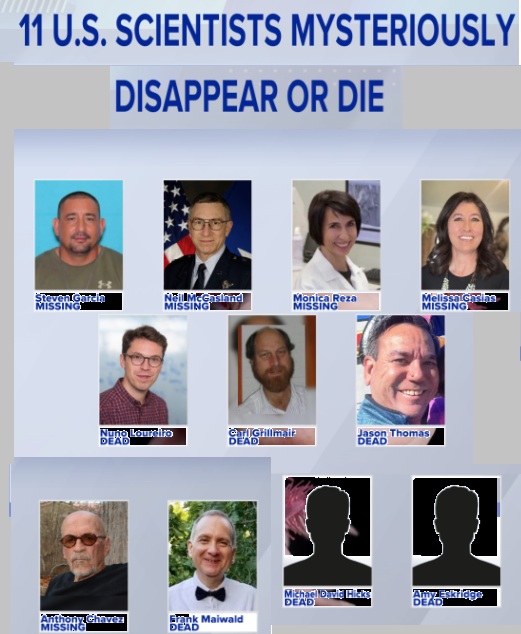
 The latest social media buzz involves a list of scientists who have either died or gone missing over the last three years, with the implication that there must be something nefarious going on. The FBI is now investigating these cases to see if there is any connection, and the White House appears to be taking the case seriously. James Comer of the House Oversight Committee said: “It does appear that there’s a high possibility that something sinister is taking place here. It’s very unlikely that this is a coincidence. Congress is very concerned about this. Our committee is making this one of our priorities now because we view this as a national security threat.”
My initial reaction to stories like this is – these kinds of things crop up all the time and they always turn out to be just coincidences, or not even that. Sometimes they are just stories fabricated out of increasingly distorted information, almost always to serve some conspiracy narrative. So my reaction is the same as if someone claims to have seen Bigfoot or an alien spacecraft – initial skepticism is fully warranted, but sure, I am happy to take an objective look. This may be a rare case when there is a genuine phenomenon going on, and in any case this is what activist skeptic do – take a deep dive when these stories emerge.
Let’s first review the basic facts as presented. Here are the 11 scientists currently on the list:
Amy Eskridge—Scientist reportedly researching anti-gravity technology. Died: 2022
Michael David Hicks—Research scientist at NASA’s Jet Propulsion Laboratory; worked on the DART Project and Deep Space 1 mission. Died: July 2023.
Frank Maiwald—Principal researcher at NASA’s Jet Propulsion Laboratory. Died: July 2024.
Anthony Chavez—Former employee at Los Alamos National Laboratory. Missing since: May 2025.
Monica Reza—Director of Materials Processing at NASA’s Jet Propulsion Laboratory. Missing since: June 2025.
Melissa Casias—Administrative worker at Los Alamos National Laboratory. Missing since: June 2025.
Steven Garcia—Government contractor at a New Mexico facility for the Kansas City National Security Campus. Missing since: August 2025.
Nuno Loureiro—Director of MIT’s Plasma Science and Fusion Center. Died: December 2025.
Carl Grillmair—Caltech astrophysicist who worked on NASA’s NEOWISE and NEO Surveyor missions. Died: February 2026.
William “Neil” McCasland—Retired U.S. Air Force major general. Missing since: February 27, 2026.
Jason Thomas—Pharmaceutical researcher. Found dead: March 2026.
From a scientific (specifically epidemiological) perspective what we have here is called an apparent cluster. We encounter these in medicine all the time. I remember when I was a neurology resident in the 1990s there was an apparent cluster of cases of CJD (mad cow disease) in New England where I was working (more specifically the Naugatuck Valley of Connecticut). I had a few cases myself, and it definitely seemed to be more than we would expect by chance. It is the job of the CDC to investigate all such apparent clusters and first determine if they are real. This is mostly a statistical analysis – is this just the random clumping that we expect in data, or are these cases truly outside the statistical noise? It was determined that the CJD cluster was not real – just statistical noise.
With a case like the dead or missing scientists, we can do a similar type of analysis. Is this really beyond what we would expect by chance? Remember that people are really good at pattern recognition, to the point that we see patterns that are not really there (a recognized phenomenon known as apophenia). We also feed these illusory patterns with other cognitive biases, such as confirmation bias, subjective validation, anomaly hunting, and post-hoc reasoning. In the case of apparent clusters like this, what that means is that people might decide after they see a potential data point that it is significant, rather than determining ahead of time what constitutes a “hit”. They also may stretch any definitions they are using to cast a deceptively wide net. Once an apparent cluster is noticed then confirmation bias kicks in. In today’s world this means that an army of social media “sleuths” can go hunting for any apparent cases that fit the cluster – again, casting a very wide net.
Without getting into the individual cases yet, the numbers do not seem impressive. Just eleven missing or dead over four years – but what’s the baseline? Well, there are about 2 million researchers in the US. There are about 25 deaths per million people per day in the US, that’s 50 scientists dying each day, or 73,000 scientists over a four year period. Finding 11 that have some vague connection does not seem unusual to me. I would be amazed if you couldn’t find far more convincing clusters than this one. When we look at the list this base-rate problem gets even worse. On the list is a retired US Air Force major general – not a scientist. There is also a government contractor, and an “employee” – the net widens. Also, we are including both deaths and people who have gone missing.
I should point out I am using numbers for the general population, which may not match the rate for scientists. However, since the list included non-scientists and people who have retired, the numbers are reasonable, at least to get a general idea of probability. But I also looked at CDC data – about 800,000 people in the US between 25 and 65 die each year, or 3,200,000 over a four year period. About 6% of the population work in the science field, which would be 192,000, or half that if you use a narrow definition of 3%, so close to the 73,000 figure I calculated the other way.
We can also look at the institutions – JPL has 4,500 employees. If we crunch the numbers, then we would expect about 41 JPL deaths each year, or 164 over four years. At the Los Alamos National Laboratory, the figure is 18,000 employees, or 164 people per year, 657 over four years. Even if you want to be super conservative – even one tenth of these deaths at JPL and LANL would still be 82 deaths over four years – so again, the five on that list are not impressive. Given these numbers I think it is reasonable to conclude this is not a real cluster. This is far less than random noise, by at least two orders of magnitude.
The other approach to questions like this is to investigate the individual cases. The CDC, for example, would not only look at the numbers in a potential disease cluster, but would also review individual cases. If individuals with a foodborne illness all ate at the same restaurant, that would be significant, even if the overall numbers were not that impressive. So I don’t have a problem with the FBI doing some basic investigation so see if there is anything suspicious going on, but I would be really surprised if there were. It is not inherently implausible that one or more of these people were targeted because of their work or high security clearance, but looking through the list there doesn’t appear to be a real connection there.
Eskridge, for example, doesn’t seem to have anything connecting her to anyone else on the list, except her work was vaguely “sciencey”. I say this because she is on the list because she supported research into antigravity technology. I don’t think it’s fair to say she was an antigravity researcher. She had a bachelor’s degree in biology and chemistry, no masters or PhD. She has no published papers. She started the Institute for Exotic Science and had an interest in antigravity. This makes her more of a crank than anything else – give that it is extremely likely that antigravity is impossible (this goes way beyond this blog post, and perhaps I can do a deep dive on this later, but if you are interested just look it up). Until we have a theory of quantum gravity we have to keep the door slightly cracked open that maybe it’s not strictly impossible, but that is extremely unlikely. In any case, we don’t even have the beginning of a basic science to work from, and what we do have says it’s not possible. So unless you are a world-class theoretical physicist working specifically on uniting quantum mechanics and general relativity, your not worth killing if the goal is to prevent the emergence of antigravity technology.
Hicks worked on the DART project, the goal of which is to develop technology to deflect asteroids that might strike the Earth. Why is that connected to antigravity research? Why is that a threat to anyone? What is the connection to a pharmaceutical worker, a fusion researcher, or a materials scientist? Grillmair worked on the NEO telescope, which is a near Earth object scope, so there is a potential connection to DART, but not anyone else. The rest are mostly just administrators, workers, and employees, and one major general thrown in.
At first blush this seems to be a list of people put together by searching for anyone who has died or gone missing over the last few years with any vague connection to anything space related. I would be surprised if this turns into anything. I suspect that the FBI will do a preliminary investigation, find nothing, and the whole story will fade away. However, it will likely live on in the conspiracy subculture, morphing over time to make the details seem more impressive until there is a mostly false mythology about the dead scientists.