Mar 12 2026
Creationists Don’t Understand Nested Hierarchies
 Creationism, in all its various manifestations, is sophisticated pseudoscience. This makes it a great teaching tool to demonstrate the difference between legitimate science and science denial dressing up as a cheap imitation of science. Creationist arguments are a great example of motivated reasoning, providing copious examples of all the ways logic and argumentation can go awry. It has also been interesting to see creationist arguments (at the leading edge) “adapt” and “evolve” into more complex forms, while maintaining their core feature of denying evolution at all costs.
I am going to focus in this article on young Earth creationists, specifically Answers in Genesis, and something that is a persistent element of their position. Essentially they do not understand the concept of nested hierarchies. I have a strong sense that this is because they are highly motivated not to understand it, because if they did the entire structure of their YEC arguments would collapse.
This AiG article is a great example – Speciation is Not Evolution. The article is more than a bit galling, given that the author seeks to lecture scientists about the use of precise definitions. It begins by patronizingly explaining the humor in the famous “Who’s on First” skit (gee, thanks for that), then accuses scientists of not being precise with their definitions. This is, of course, the opposite of the truth. Good science endeavors to be maximally precise in terminology (hence the jargon of science), and it is creationists who habitually use vague and shifting definitions – such as their abuse of the word “information” and for that matter “evolution”.
We see this right in the title of the paper – speciation is not evolution – well, speciation is part of evolution. No one claims that by itself it encompasses evolution, but it’s a pretty critical part. They play this game frequently, by claiming, for example, that natural selection does not increase “information”. Correct, it non-randomly selects information. But mutations, duplications, and recombinations demonstrably increase information. They then argue that mutations only “degrade” information, and duplications only copy what is already there. Mutations change information in ways that can be neutral, positive, or negative, as judged by the context of the individual organism. Duplications absolutely increase the amount of information (again, what definition of information are they even using), allowing for one copy to maintain its original function while the new copy can mutate into new functions.
But let’s get to the core argument of this article, that speciation can occur within “kinds” but cannot turn one kind into another. In other words, dogs can evolve into new species of dogs, but a dog can never evolve into a cat. “Evolutionists”, they argue, don’t understand this difference, and so confuse speciation within a kind to “macroevolution” from one kind to another. Meanwhile, they do not have an operational precise definition of what a “kind” is. The word comes from the Bible (God created creatures each according to their own kind) and is not a scientific concept. The author states that a kind roughly correlates to a family level taxonomically. But that doesn’t help. A taxonomical “family” is also not a precise thing. It is simply a categorization convention, and varies tremendously across the tree of life. The same is true of macroevolution – this is not a scientific concept and has no operational definition.
The problem with both of these concepts – kind and macroevolution – is that they suffer from a fatal demarcation problem. There are lots of demarcation problems in science, anytime we are trying to categorize a messy continuum of nature. What’s a planet, or species, or continent? The difference is, the YEC argument is contingent on there being a sharp demarcation – evolution can proceed to this amount, but no further. Evolution can account for this degree of change, but no further. The problem is, they never state any reason, based on any valid principles, as to why. They simply assert that kinds are inviolate.
But at the core of their claims is a complete misunderstanding of what evolutionary science actually claims. Ironically, when they say that dogs can only evolve into more dogs, and never into cats – they are correct. Evolutionary scientists agree with this statement, especially if you take a cladistic approach to taxonomy. By definition a clade is one species and all of its descendants. This is why it is cladistically correct to say that people are fish. Once the eukaryotic clade evolved, everything that descends from it are still eukaryotes. So humans are eukaryotes, and animals, vertebrates, fish, lobe-finned fish, reptiles, mammals, and primates. It is correct, for example, to say that all descendants of fish are still fish, but you have to count humans as fish. What you cannot ever do is go back up the cladistic tree. You cannot undo evolution. You also cannot make a lateral move to another unrelated clade. So an animal cannot evolve into a plant.
The YEC misunderstanding of this concept renders all of their arguments as to why evolutionary scientists are wrong into strawman arguments. No one ever said a dog can evolve into a cat – in fact scientists say this is impossible. It is not part of evolutionary thinking.
What creationist do is grossly underestimate how much change can occur within a clade, because they are stuck on the concept of “kinds”. Functionally what is a kind? It’s one of those things that you vaguely sense. You know it when you see it. Everyone knows what dinosaurs look like – they have a dinosaurish vibe. This is why they falsely argue that birds could not have evolved from dinosaurs. Actually, it is more correct to simply say that birds are dinosaurs – they are a subclade within the dinosaur clade. Birds are also reptiles, because dinosaurs are a subclade within reptiles, which are a subclade within fish, etc. It’s nested hierarchies all the way down. But birds look like a different kind than dinosaurs, so this violates their vague sense of what a kind is. They then mock this idea by analogizing it to a dog evolving into a cat – this this is a false analogy. Dogs and cats are different subclades of mammals, and you cannot evolve from one clade into another, only into subclades within your existing clade.
Stephen J. Gould also discussed this idea and zoomed in on an important concept that is highly misunderstood. Over evolutionary time we expect that disparity (not diversity, the amount of differences, but disparity, the degree of difference) decreases. This seems counterintuitive, but it makes sense once you fully internalize the concept of nested hierarchies. Multicellular life achieved maximal morphological disparity soon after the Cambrian explosion, and from that point forward we only see variations of the various body plan themes. Over evolutionary time the nested hierarchy structure of the tree of life means that we see variations on progressively constrained themes. Evolution is constrained by its history, so the more evolutionary history a lineage has, the more constrained its future evolution. If we look at the entire history of evolution, we see this increasing constraint play out as decreasing disparity. At most disparity can stay the same, but extinction is like a ratchet slowly decreasing disparity.
To take an extreme example used by Gould to illustrate this, imagine a mass extinction where the only surviving land vertebrates are dogs. Eventually those dogs will adapt and fill all the empty niches – you will have herbivore dogs, grazing dogs, dogs living in trees, predator dogs, and more. But they will all be variations on dogs. A dog will not evolve into a giraffe, but it may evolve into a giraffe-like dog, while still retaining dog features. This is also why using modern extant examples (a dog evolving into a cat) also makes no sense. The dog clade is evolutionarily constrained to forever be dogs, even though that can include a lot of diversity. But if you go back in time a few hundred million years, you can have a mammal that is less evolutionarily constrained that evolved into both cats and dogs.
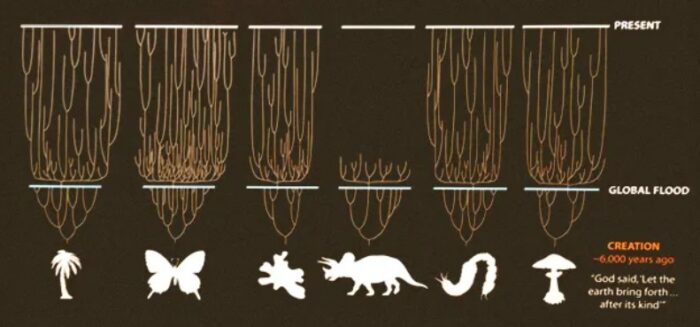
We can also ask the question – what does the evidence show? Above is the picture that AiG uses to illustrate its speciation within clades. The depiction of each clade is conceptually not bad (I don’t think it was meant to be literally accurate), but it artificially stops at an arbitrary line of “kinds”. Does the evidence support this view? What would we expect to see if each kind were created unto itself and separate from all other kinds? What would we expect to see if these nested hierarchies go all the way back to the beginning of life? You can fill a book reviewing the actual evidence, but let me give a quick summary.
If the YEC schematic is correct, then we would expect to see discrete clades that can be cleanly separated – morphologically, genetically, physiologically and biochemically. If the evolution schematic is correct then we would not expect any clean separation, but a continuum along all these features leading back as far as the evidence goes. The bottom line is that the evidence is a home run for the evolutionary prediction. Creationists deal with this devastating fact in a couple of ways. First, they often simply deny the evidence, saying things like “there are no transitional fossils”. They support this claim by mischaracterizing the evidence, ignoring evidence, and also by playing loose with the definition of “transitional”.
They also make the claim that any similarities between kinds is due to each kind having the same creator. Why would the creator reinvent the wheel with each kind, of course he just used the same solutions over and over again. But this argument only goes so far. There are numerous connections between clades that go far beyond utility, such as viral inclusions. The genetic material from a virus can get stuck in the genome of a creature, and then persist down throughout its clade. These are non-functional bits of viral residue in the genome, and they provide a map of nested hierarchies which obey clades, but violate any notion of kinds.
We also can look at the fossil record temporally. In the YEC model, we should see all clades appearing at the same time (creation), then going through a simultaneous bottleneck (the flood) followed by speciation into our current extant species. That is not what we see – not even close. Some will say – what about the Cambrian, that is the sudden appearance of all kinds. Um, no. There are no birds, dogs, triceratops, horses, or humans in the Cambrian. All the family-levelish kinds they say exist were not in the Cambrian fauna. The Cambrian explosion resulted mainly in the multicellular phyla (basic body plans), including some that are now extinct. If they claimed that kinds were phyla and that they were created 500 million years ago, they would have a stronger case. But that is not what they say. Over time we then see increasing diversity within clades, with new subclades evolving and appearing over evolutionary time. We basically see exactly what we would predict if all life has a common ancestor, and not what we would expect to see if life were divided into family level kinds created all at the same time.
Creationists cannot engage with what evolutionary scientists actually claim, so they have to invent ridiculous straw men to attack. They use loose and shifting definitions, and then have the gall to falsely accuse scientists of doing that. They can’t explain the evidence, so that have to ignore and distort it beyond all recognition.
And to clarify my position, in case you are new to this blog, I am not against belief in God and essentially don’t care what anyone believes when it comes to metaphysical questions. But science follows methodological naturalism, and if you follow the methods of science there is only one logical, evidence-based, and scientific answer to the question of the origin of species. The evidence overwhelmingly shows that all life is descended from a common ancestor in a nested hierarchy of relationships.