Mar 13 2023
New Asteroid Probably Won’t Hit Earth
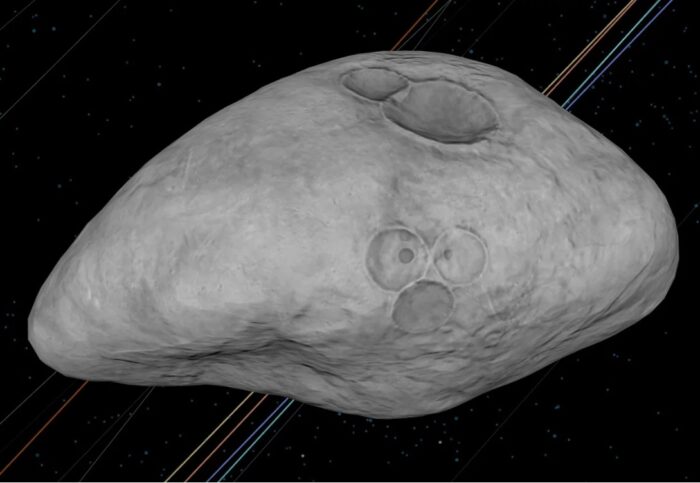 NASA recently discovered a 50 meter wide asteroid whose orbit will come close to Earth. They estimate a close approach in 2046, which will likely bring the asteroid within 1.1 million miles of the Earth, about four times the distance of the moon. However, there is always uncertainty in calculating orbits, and the farther into the future you try to project their path, the more uncertainty there is. At this point in time NASA estimates a one in 560 chance that the asteroid, dubbed 2023 DW, will hit the Earth in 2046.
Orbits are calculated through multiple observations of the object along its orbit. We have to see how it is moving, and the longer the observation the greater the precision. For recently discovered objects, like this asteroid, there is more uncertainty in the orbital calculations, which is why NASA cannot completely rule out an impact. Because it is a near-Earth object, however, they will continue to make observations, refining their calculated orbit, and reducing the uncertainty.
Interestingly, the current scale for designating the risk of an object hitting the Earth, the Palermo scale, is not based on a simple percentage probability, but on the probability relative to the background rate of impacts. A Palermo scale of 0 means that the chance of a particular object hitting the Earth is no different than the background rate of impacts. The scale is also logarithmic, so a Palermo rating of 1 means a chance of impact 10 times the background rate, 2 is 100 times. 2023 DW has a Palermo rating of -2.17.

 Psychiatry, psychology, and all aspects of mental health are a challenging area because the clinical entities we are dealing with are complex and mostly subjective. Diagnoses are perhaps best understood as clinical constructs – a way of identifying and understanding a mental health issue, but not necessary a core neurological phenomenon. In other words, things like bipolar disorder are identified, categorized, and diagnosed based upon a list of clinical signs and symptoms. But this is a descriptive approach, and may not correlate to specific circuitry in the brain. Researchers are making progress finding the “neuroanatomical correlates” of known clinical entities, but such correlates are mostly partial and statistical. Further, there is culture, personality, and environment to deal with, which significantly influences how underlying brain circuitry manifests clinically. Also, not all mental health diagnoses are equal – some are likely to be a lot closer to discrete brain circuitry than others.