Sep
24
2026
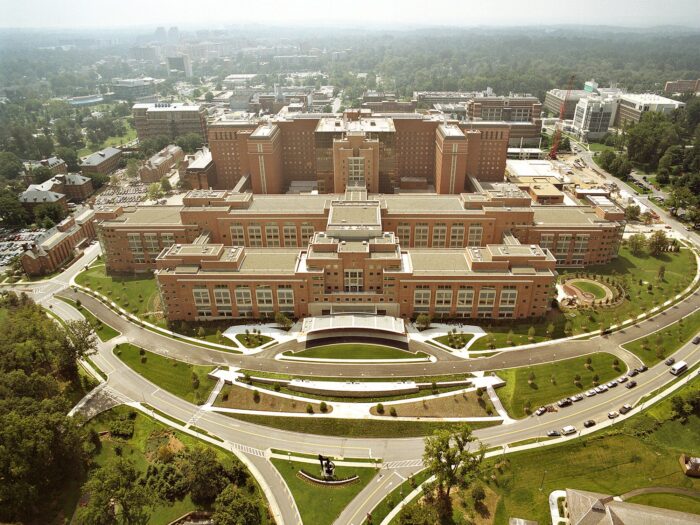 This is a tiny bit of good news it what has been a horrific story for American science over the last almost two years. Trump has backtracked on his attempts to politicize science funding at the NIH, and throughout the federal government. He did this apparently in reaction to bipartisan pushback from Congress. This, however, does not mean that there hasn’t already been profound damage and that further meddling will not happen.
To put all this into context, it is important to understand the infrastructure of scientific research that has been developed in the US, largely since WWII. The federal government created a number of institutions, the biggest of which is the NIH with an annual budget of $48 billion, to fund scientific research. This money largely went to universities through specific grants. This grant money is the life-blood of many research institutions – it pays for the research itself but also the infrastructure that allows the research to happen. Grants are awarded by merit, determined by panels of relevant experts. In exchange the funding organizations can impose many quality control rules on grant receiving institutions, labs, and researchers. You have to maintain a suite of certifications, and the results of your research have to serve some definable purpose and be accessible to the taxpayers who ultimately fund the research.
The NIH and other granting institutions are creatures of Congress – they were created by Congress, who determines their mission and provide their funding. Generally Congress determines their general goals, and then allows appointed experts to execute those goals by determining things like which grants get funded. This system has worked fabulously well over the last 70 years or so, allowing America to lead the world in scientific development. It is arguably one of the main reasons the US today is the superpower that it is. Here is a good discussion by Neil deGrasse Tyson on the power of this research infrastructure and the damage that has resulted from tampering with it.
As a general rule this arrangement, of politicians and funders determining broad goals and experts determining how to best execute those goals, works well. Historically whenever politicians try to meddle in those details, to “micromanage” what experts should be doing, the results range from bad to catastrophic. The classic historical example is Lynsenkoism in the former Soviet Union. Briefly (read the linked Wikipedia entry for more info) Trofim Lysenko did not believe in Mendelian genetics or natural selection, but favored what is now called a more Lamarkian approach. His science was favored by Stalin because it aligned better with Soviet ideology, and so he was elevated in power and those scientists who disagreed with him vanished. The result was mass starvation and a hollowing out of the science of genetics in Russia, something that they have still not fully recovered from. For this reason, whenever political ideology inappropriately meddles in the conduction of science, it is referred to as Lysenkoism. Arguably, that is exactly what the Trump administration is doing. Continue Reading »
Sep
21
2026
 A recent article in the New York Times is, unfortunately, terrible journalism that ends up shilling for a fraudulent and exploitative industry. The author, Sarah Wildman, tells of her previous encounter with a medium through her unnamed cousin. Part of the subject was Wildman’s 14 year-old daughter who had died the year before. This is a massive conflict that compromises her objectivity. No editor should have let this article go through. Wildman herself admits. “Also, I did not really want to debunk it.” She wanted to believe – that makes her a vulnerable target, not an objective journalist.
The essence of the article is that it really doesn’t matter if mediums are genuine or not. They allow people to feel a connection to their deceased loved-ones, and there is research evidence that such a feeling of connection can be emotionally useful. But the research she cites is about people remembering their loved-ones, thinking about them, looking at pictures and videos, etc. It is not about receiving messages from them through mediums. There is some research looking specifically at mediums, but it is all non-controlled and retrospective (this is exploratory preliminary research). What this research also shows is that feeling comfort from a medium is largely dependent on believing that the communication is real – you have to believe that the mediums are genuinely psychic. And that is a huge problem.
I would therefore challenge Wildman’s core conclusion, that mediums are necessarily or uniquely helpful. People can be assisted in their bereavement through other means that do not involve giving money to an industry built on grift and exploitation. There are also methods that do not require people to believe in things that are not real. In fact, people who seek mediums often feel shame for doing so, and hide what they have done for fear of being dismissed. Wildman blames scientists and skeptics for this. She wrote:
“The study of these occurrences and their impact on grief has long been prejudiced by exactly what you’d expect: the surety of scientists and skeptics that all of it — mediums, sensations, signs — might be about as real as a dime-store Ouija board, a 19th-century séance or, worse, a momentary psychotic episode.”
Continue Reading »
Sep
14
2026
When you hear the phrase, “Science is socially constructed,” what does that mean to you? If you are a philosopher of science, you likely have a deep and nuanced understanding of exactly what that means. Unfortunately, in my experience, many scientists and science communicators do not fully appreciate what it means, and may even have severe misconceptions about it. I am not a philosopher, but I have studied a lot of philosophy and always try to align my understanding with the experts. I also have an interest in many different sciences, which I think is extremely helpful in understanding the socially constructed nature of science.
Let me first say what is not meant by that phrase – it does not mean that science is not real, that the findings of science are not true in some meaningful way, or that all methods of understanding the universe are equivalent. This is not relativism or post-modernism.
What it does mean is that science is something that people do. That may seem obvious, even trivial, but often people speak of “science” as if it is an entity unto itself. I know that we often use shorthand for convenience, but it is good to occasionally think about how that shorthand may bias how we think about things, and reflect those biases. When people say things like, “listen to the science” it makes it seem as if “science” is something that can speak with its own voice. It isn’t. Similarly someone might say, “look at the facts” as if the facts can interpret themselves. They can’t. People are always in the loop. People actively construct science out of observations and hypotheses and theories. There are institutions of science, different cultures within science, and different perspectives.
Continue Reading »
Sep
10
2026
 For many science fiction fans the computer voice on the Enterprise is iconic, and is, in fact, “the” voice of any computer. Majel Barrett deliberately gave the computer a stilted, monotone, mechanical voice to reflect the fact that it was a non-sentient machine. But also, it reflected the technology at the time. Voice synthesizers had been around since the VODER, first debuted at the 1939 World’s Fair. They produce an electronic-sounding definitely artificial voice. Many people are also familiar with this electronic voice through Stephen Hawking’s voice synthesizer.
But now we have the technology to create artificial speech that sounds convincingly human – the voice sounds natural and not electronic and contains all the inflection and nuance of natural speech. Sesame is one example, and you can try the demo for yourself. The app adds pauses, breaths, “ums”, and other fillers to sound more natural. Essentially it is now simply not possible to tell an AI generated voice from a human generated voice. I recently rewatched Star Trek TOS and paid close attention to the futurism in the series and was struck by how dated all concepts of AI were in the show. We can already produce natural-sounding human speech, so why is the Enterprise’s computer so mechanical 200 years in the future?
However – there is another explanation (this is obviously a retcon having nothing to do with the original intent of the creators). More recently it occurred to me that we might consider the mechanical nature of the computer voice a deliberate feature, not a bug of technological limitations. In the episode Tomorrow is Yesterday the ship’s computer had recently been overhauled on Cygnet XIV and was given a female personality with a more natural sounding (albeit humorously annoying) voice. We can therefore say that the technology existed and the mechanical voice was at least partly a deliberate choice. At this point you are probably thinking, “So what?”
Well, one of the features of LLM-based chatbots is that they are getting increasingly good at imitating human interactions through language, whether with text or speech. This creates the powerful illusion that they are sentient and feeling, when they clearly are not. I know this point can be debated – how can we be sure they are not sentient? I maintain they are simply not built to be sentient. As an example, the same technology can be used to make pictures, but no one argues that Midjourney is sentient. So for the sake of discussion let’s stipulate LLMs are not sentient. Continue Reading »
Sep
01
2026
 Solar power as a source of electricity has been on a meteoric rise, and has crossed some encouraging milestone recently. Every way you look at it, solar is booming. This is driven primarily by the decrease in the cost of adding solar power, so let’s start there.
The Berkley Lab has been tracking the cost of solar power in the US for years, so they are a reliable source of information. They get direct data from the actual price paid by consumers, and break down the cost of panels, the cost of installation, and all the “soft” costs that are part of the industry. In 2009 the total cost of installing solar between $7 – 8.70 per watt. An average US residential home installs a 6-8 kW system, with the average increasing over the years. In 2025 the average size was 7.7 kW. Let’s use a 7 kW system, at $8 per watt, that’s $56,000 total installation cost. Today the average price of installed residential solar in the US is $3.6 per watt (but it is $3.0 if you pay upfront, $4.50 if you finance). So that same 7 kW system now costs $25,200. (If you pay for it outright, the cost drops to $21,000.) So over the last two decades the total const of installed residential solar has dropped by about 60%. This is without considering any tax breaks or incentives.
The reason for the decrease is partly that solar panels themselves are cheaper, and they are more efficient, so a 7kW system requires fewer panels. Installation costs have decreased by about 50% over this time, largely due to economies of scale. However, the US still has higher soft costs for solar than many other industrialized nations, and this is mostly a matter of the regulatory system. So there is some regulatory efficiency to be gained. Solar companies themselves also have some possible efficiency gains. Fortunately, the net price for solar continues to go down, with another 50-60% decrease in total price possible even without further technology gains. Commercial and grid scale solar is even cheaper – with large non-residential installations down to $2.4 per watt.
Continue Reading »
Aug
31
2026
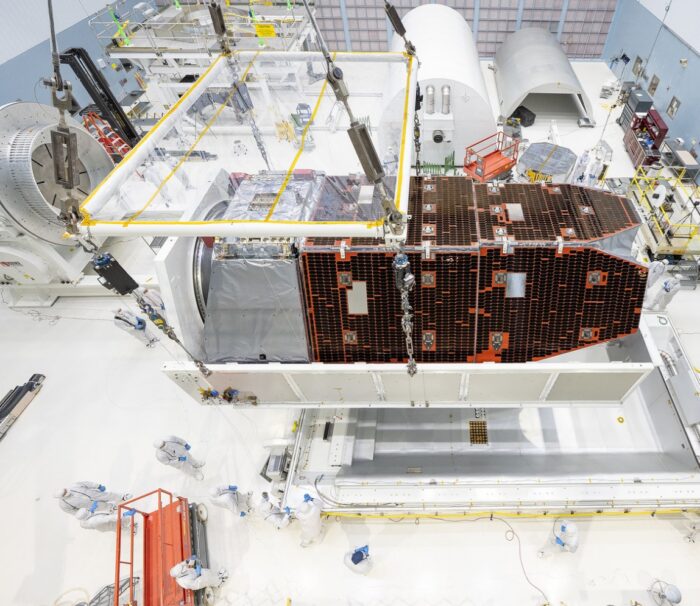 On Sunday August 30, 2026, NASA successfully launched the Nancy Grace Roman space telescope aboard a Space X Falcon Heavy. This telescope has amazing capabilities and will add to our ability to study and understand the universe, with a special focus on dark energy, black holes, and exoplanets. However, the best way to look at such telescopes is as part of a system of instruments, each with complementary trade-offs in abilities. But there are also some genuine technological advancements in this instrument.
The telescope is named after Nancy Grace Roman, who was NASAs first Chief Astronomer and NASA’s first female executive. She is also consider the “Mother of the Hubble” telescope for her critical role in planning and securing funding for the Hubble telescope.
Let’s start with the technical details. The Roman telescope was launched on a journey 1 million miles to the L2 Lagrange point between the Earth and Sun. Lagrange points are locations within overlapping gravitational fields, like the gravitational fields of the Earth and Sun, where there is a balance between the pull of both fields and the centrifugal force of orbiting itself. . The result is net zero forces on an object at a Lagrange point (of which there are 5 between Earth and the Sun). It does functionally act like a gravitational well itself. Roman will be orbiting the L2 point in what’s called a quasi-halo orbit, a large loop that ranges from about 117,000 to 500,000 miles away. The James Webb telescope is in a similar orbit around the same L2 point, but their orbits will keep them safely separated from each other. It will take Roman three months to arrive in its orbit around L2.
The primary mirror of Roman is a wide field infrared camera, with a 2.4 meter lens (the same size as Hubble’s). However, one of Roman’s primary features is that this lens is wide field – it can see 100 times as much of the sky in clear focus at the same time as the Hubble. It has a 300 megapixel camera with which to capture this information. This means it can gather a ton of data quickly, surveying the sky 1000 times faster than the Hubble. It will gather 50 times more data in 5 years than Hubble has in the last 30 years.
Continue Reading »
Aug
27
2026
 There is a lot of legitimate concern over the net effects of students using AI to do their school work. If you let AI do your writing, then you will not learn how to write, for example. Or worse – if you let AI think for you, then you will not learn how to think. I have spoken with many teachers at many levels about this and they range from those who take diligent steps to minimize AI “cheating”, to the other end where some throw up their arms and essentially say, “if students us AI to cheat, they are just cheating themselves out of an education.” For me the bigger question is – what happens to society if we raise a generation intellectually crippled by their dependence on AI?
Certainly, the educational system at every level needs to deal with the reality of AI, and needs to protect the legitimacy of their methods for evaluating students. But also, schools need to face the reality of a world with AI and prepare their students for that world, which may require leveraging AI itself as a teaching tool. In fact, using AI as part of the teaching itself may secondarily solve (or at least mitigate) the AI-cheating problem. For example, if you develop a workflow that includes human and AI elements, then use of AI is already baked in and accounted for. Ideally, the outcome will be optimal when the human adds value to the process and uses AI effectively. The outcome should be better than AI alone, or human alone, could generate. And if you have to show your work throughout the workflow, it becomes hard to fake your contribution to the process.
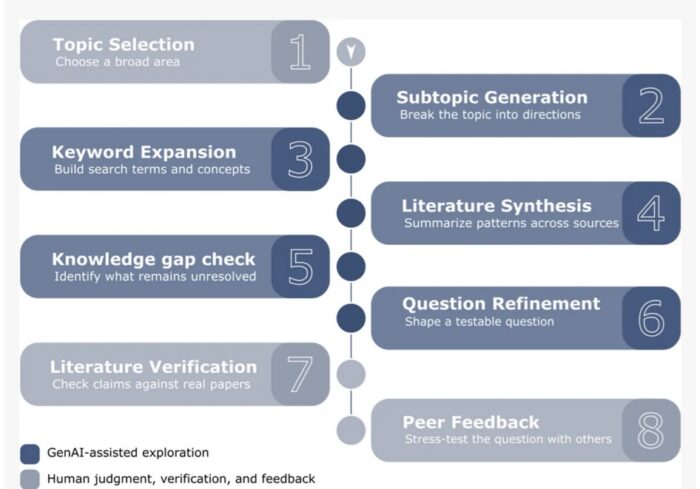
I don’t think researchers were even thinking of the AI-cheating problem when they developed this AI assisted workflow to teach undergraduates how to develop proper research questions. They were trying to more effectively teach students how to develop research questions. But their model may provide a useful template in many other educational contexts, and also help the AI-cheating problem.
Here is the problem they were trying to address – undergraduate students often have a difficult time developing useful research questions. It’s a lot harder than you might think – “Students can usually name a topic they care about, but often lack strategies for turning that interest into a question that is grounded in evidence, scoped to what is feasible, and aligned with available methodologies.” This has long been identified as a bottleneck in undergraduate research education. Developing a solid research question is often the most critical step in any research, and is often the most challenging thing to do. Continue Reading »
Aug
24
2026
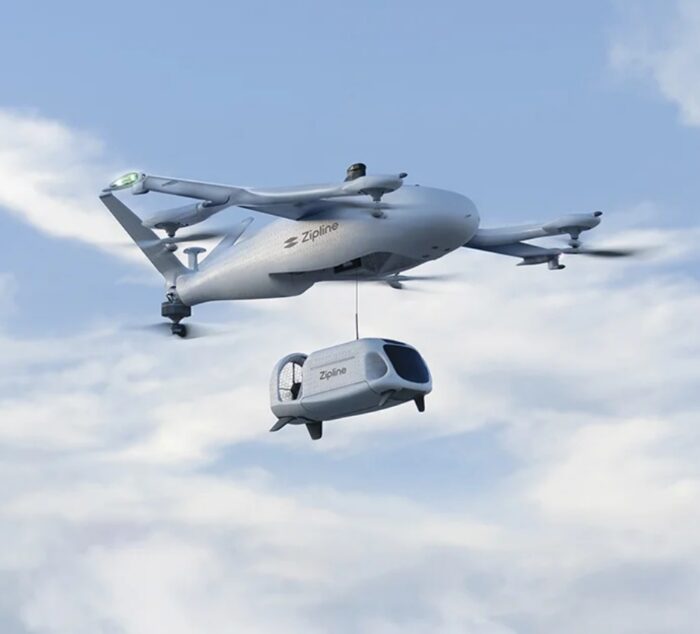 It should be clear by now that drone technology has crossed a technological threshold where they are cheap and efficient enough to have widespread use. They have transformed modern warfare. They are commonly used in surveillance. Over 75% of recent action films use drone footage, which has reduced the cost of aerial footage by about 90%. And now it seems that drone delivery services are poised to expand considerably.
What has caused this advance in technology? Part of it is advances in battery tech, which allows for greater range with lighter batteries, but that is not the whole picture. AI control systems are also critical. Sensor technology has also improved, both in miniaturization and Beyond Visual Line of Sight (BVLOS) technology. This is the ability to communicate with and control drones beyond line of sight using cellular, satellite, and mesh radio networks.
So are we about to see the future as depicted in Ready Player One, with drones constantly buzzing around the sky delivering everything from pizza to VR equipment? Probably not, but we will be seeing more drones. Several companies have been developing their drone delivery technology, and have already made millions of deliveries world wide. Amazon already has drone delivery available in 11 cities with more on the way. Wing is another company with current but limited drone delivery available. Zipline has perhaps the most advance system. They have been using and testing their system is Rwanda to deliver medications and other vital supplies to villages without an adequate road system. They have also now apparently made a deal with Uber Eats to deliver one million meals per day.
Continue Reading »
Aug
20
2026

In the last few decades our understanding of human evolution has expanded considerably. We have identified numerous new species, fleshing out a complex branching bush of relationships among early humans. But these discoveries have also caused a problem – our taxonomical naming convention for all these species is basically broken. That is the argument made by paleontologist Ian Towle in a provocative paper – Clades, Grades, and the Genus Problem: A Case for Revising Hominin Taxonomy. Let me lay out the problem before I discuss his proposed solution.
There are basically two layers to the problem – the first is a tension between a cladistic approach to taxonomy and a traditional Linnaean approach (or what Towle refers to as clades vs grades). Cladistics is a classification system that is strictly determined by evolutionary branching points. A clade includes a common ancestor and all descendants (any taxonomic group with this feature is called monophyletic). Clades are nested within larger clades. Traditional taxonomy then maps ranks such as family, tribe, genus and species onto some of those branching levels, although there is no biologically fixed amount of evolutionary divergence corresponding to any particular rank, and not all branching points are ranked. This approach is potentially clean and reflects our understanding of evolutionary relationships. The primary challenge of the cladistic approach, especially when we drill down to the genus and species level, is that we do not always know exactly what the evolutionary branching points are. Further, those branching points may not be clean and different species can still exchange genetic material often for millions of years.
The traditional Linnaean approach uses a variety of criteria for its classification, including evolutionary relationship but also morphology and behavior. A distinct group living in a particular place and time can be defined by specific morphological characteristics. The advantage here is that you don’t have to know the precise evolutionary branching points, you can identify species by features you can see. Perhaps the classic example of the difference between cladistics and the Linnaean approach is birds. Under a cladistic system, birds are dinosaurs. Under the Linnaean system, they could be a distinct group identified by their common derived features. Continue Reading »
Aug
17
2026
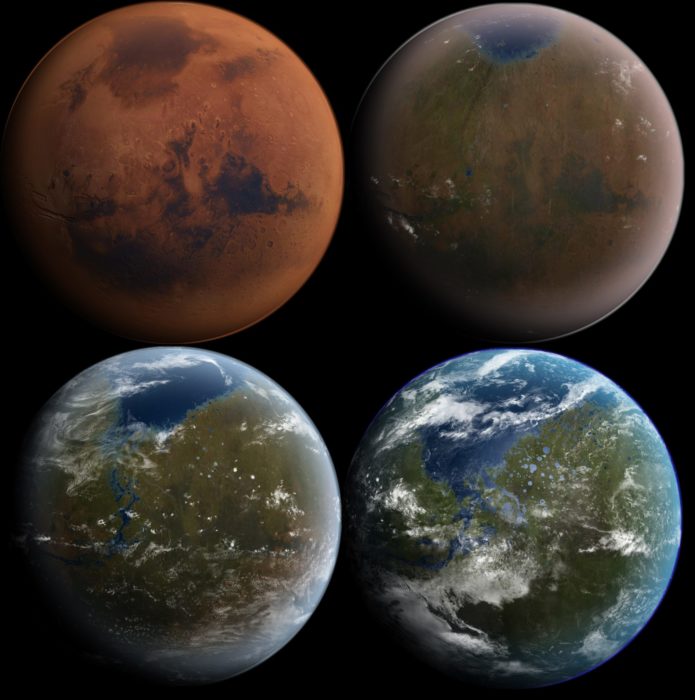 Terraforming, altering a planet’s atmosphere and surface to make it more Earth-like, has become a staple of science fiction. The benefit of successfully terraforming a planet are huge in that we now have an entire planet we can settle without the need for spacesuits and air-tight stations. We could also farm the surface for food, and would have access to liquid water. But how feasible is it? Is this something we could theoretically do with existing technology, and how long would it take?
The answer to these questions depends upon the planet in question. Right now the only planet for which it is even a discussion is Mars. Terraforming Venus is theoretically possible, at least on paper, but would likely be much more difficult, so let’s focus on Mars. What would it take to terraform Mars?
Mars is dry and cold with a wispy atmosphere – less than 1% the density of Earth’s atmosphere at sea level. We would therefore need to increase the thickness of the atmosphere, including greenhouse gases to help warm up Mars to a livable temperature. Average surface temperature is around -75 F / -65 C, but it can get quite balmy at the equator during the say, 70-80 F. But even there the temperature plummets to -100 F at night, because the lack of atmosphere cannot retain the heat.
Would the “Total Recall” approach work, simply melt the polar ice caps, which are mostly CO2 and water ice, to release a thick atmosphere? No. Melting the Martian icecaps would increase the atmosphere from 0.6% to 1.2% of an Earth atmosphere, which is negligible and would not result in runaway heating. But there is also CO2 and ice in the Martian regolith around the planet. What is we could melt all of the ice? https://www.nasa.gov/news-release/mars-terraforming-not-possible-using-present-day-technology/According to a NASA study, if we could release all that ice we would still only get up to 6.9% of an atmosphere. At that pressure the water in your body would boil and oxygen would leave your lungs. Humans require 20-25% atmosphere to survive without a pressure suit – not that it would be comfortable, but you would not quickly die.
Continue Reading »