 Facts matter. While that should be obvious, and skeptics have been pushing that world view for decades, it seems that the central importance of objective facts to both democracy and any intellectual pursuit might be more apparent recently. You tend to notice the importance of something more when you lose it, and the recently popular political tactics of “fake news,” “alternative facts,” and “truth isn’t truth,” have certainly focused attention.
But attacking objective reality in order to promote an ideology or preferred belief system is nothing new, even if it has become more obvious and odorous. Sure, everyone has their narrative and philosophy by which they organize their understanding of reality. This narrative influences how we perceive reality, which facts we accept and remember, and which ones we find reasons to dismiss. The question is a matter of degree – how much do we allow facts to influence our beliefs vs our beliefs to influence the perception of facts?
The main virtue of science is that it systematically puts facts above beliefs, and constantly hits beliefs over the head with facts. Other contexts, not so much. And there are times when ideology becomes so dominant that facts become irrelevant. Belief in creationism is one of those contexts – the creationist culture traffics almost entirely in “alternative facts.” People consuming the creationist literature and culture are effectively being gaslighted – presented with an alternate reality as if it is true. There are countless examples of this, but one of my favorites is the creationist claim that there are no transitional fossils. For example:
Contrary to the impression given by evolutionary books and magazines, evidence of transition is rare and limited to variation within kinds. Sensationalistic claims of ‘evolutionary ancestors’ make it into the newspapers; retractions and more sober evaluations of new fossils do not.
Add some outdated or out-of-context quotes, and a complete misinterpretation of evolutionary theory and the fossil record, and you create an alternate reality. The real reality, as I have discussed many times before, is that there are tons of transitional fossils, supporting the fact that life on earth has changed over time through a pattern of common descent. Here is one more to throw onto the pile – the evolution of the turtle.
Turtles are reptiles, but they have some unique features as a group. They have a beaky mouth with no teeth, a top shell made from fused ribs and vertebra, and a bottom shell. They also lack holes above their eyes used for the insertion of jaw muscles. So – common descent predicts that turtles must be related to other reptiles, which means we should find fossils of turtle ancestors that have some turtle features but not all – a transitional turtle.
But keep in mind, evolution is not a ladder but a bush. There will not be a straight line from the last common ancestor between turtles and other reptiles and modern turtles. There will be a bush of diversity, with different features appearing at different times, and even disappearing, and individual groups with relatively primitive features surviving late in the fossil record. As scientists discover a puzzle piece here and there, a confusing picture will emerge in terms of the specific details of evolutionary history. But the big picture will be clear – a transition over evolutionary time from the common ancestor to modern turtles.
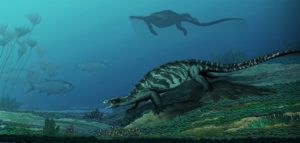
So – in 2008 scientists discovered several turtle fossils 220 million years old that only have a shell on the bottom, not the top, and a beaky mouth. They had some but not all of the turtle unique features. Then, in 2015, they discovered a 240 million year old turtle (Pappochelys rosinae) with just the beginnings of a bottom shell. And now, in 2018, scientists report the finding of an older turtle ancestor, 230 million years old (Eorhynchochelys sinensis), that has no shell but still has the beaky mouth. The ribs are starting to expand into the upper shell or carapace, but only partly. These latter two specimens also still have the skull holes of other reptiles, showing their relationship to other modern reptiles.
The presence of the beaky jaw is early for the turtle line, showing that some later turtle species may have lost the beak. We are looking at a diverse group, only one line of which lead to modern turtles.
These fossils do not represent a straight line, as I said, but they show the existence of turtle relatives over evolutionary time progressively acquiring the classic turtle features. These are stunning transitional fossils that absolutely confirm the predictions of the common descent part of evolutionary theory. The fiction that there are few or no transitional fossils is demonstrable nonsense, but that will not stop creationists in their alternative universe from continuing to make this false claim.

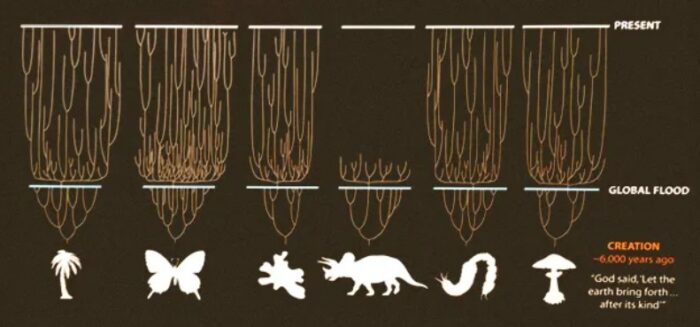 Creationism, in all its various manifestations, is sophisticated pseudoscience. This makes it a great teaching tool to demonstrate the difference between legitimate science and science denial dressing up as a cheap imitation of science. Creationist arguments are a great example of motivated reasoning, providing copious examples of all the ways logic and argumentation can go awry. It has also been interesting to see creationist arguments (at the leading edge) “adapt” and “evolve” into more complex forms, while maintaining their core feature of denying evolution at all costs.
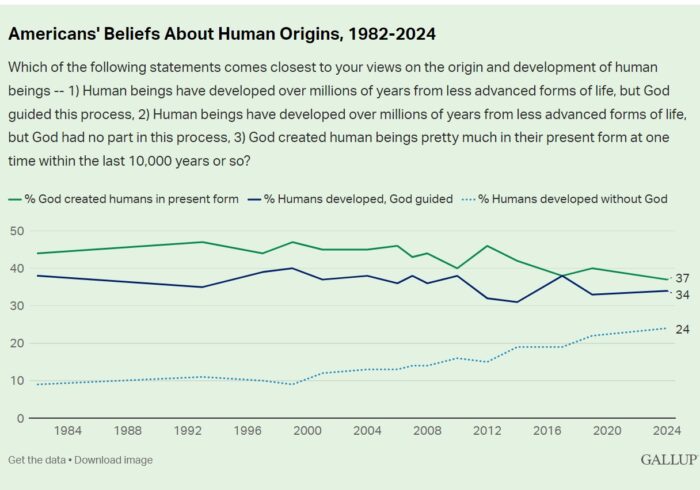 Surveys are always tricky because how you ask a question can have a dramatic impact on how people answer. But it is useful to ask the exact same question over a long period of time, because that can indicate how public attitudes are changing. This is one of the benefits of
  Evolution deniers (I know there is a spectrum, but generally speaking) are terrible scientists and logicians. The obvious reason is because they are committing the primary mortal sin of pseudoscience – working backwards from a desired conclusion rather than following evidence and logic wherever it leads. They therefore clasp onto arguments that are fatally flawed because they feel they can use them to support their position. One could literally write a book using bad creationist arguments to demonstrate every type of poor reasoning and pseudoscience (
 There are a few interesting stories lurking
  In 1985 Michael Denton, arguing against the fact of evolution,
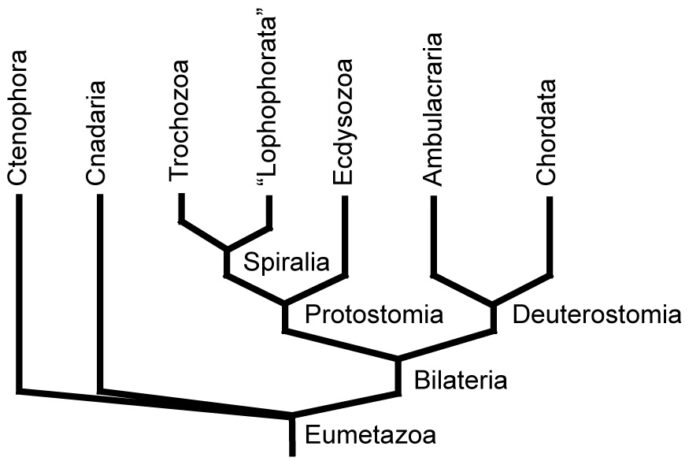
  The idea that all life on Earth is related through a nested hierarchy of branching evolution, occurring over billions of years through entirely natural processes, is one of the biggest ideas ever to emerge from human science. It did not just emerge whole cloth from the brain of Charles Darwin, it had been percolating in the scientific community for decades. Darwin, however, put it all together in one long compelling argument. Alfred Wallace independently came up with essentially the same conclusion, although did not develop it as far as Darwin.
 As an American it’s very easy to look at issues from a narrow American-centric view (we have a well-earned reputation for this). I am often reminded of this by my many international SGU listeners, and I have had to discipline myself to keep this in mind.
 A recent paper in Progress in Biophysics and Molecular Biology,
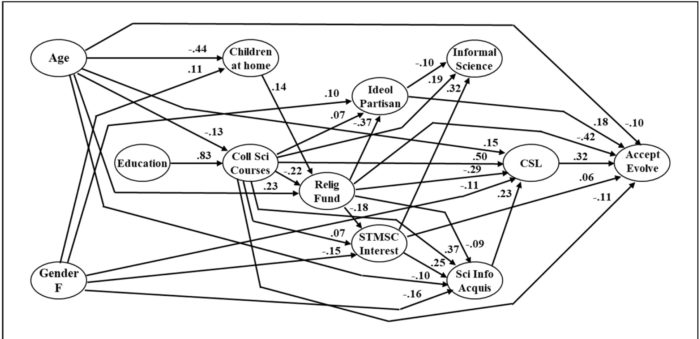
  A recent survey