Dec 15 2025
Animals Adapting to Humans
 As human civilization spreads into every corner of the world, human and animal territories are butting up against each other more intensely. This often doesn’t end well for the animals. This is also causing evolutionary pressures that are adapting some species to living in close proximity to humans.
Humans cause significant changes to the environment – we may, for example, clear forests in order to plant crops. We also convert a lot of land to human living spaces. We alter the ecosystem with lots of light pollution. We are also now warming the planet.
Humans also produce a lot of food and along with it a lot of food waste. One of the common rules of evolution is that if a resource exists, something will adapt to exploit it. Perhaps the most versatile species in terms of adapting to human sources of food is rats. They follow humans everywhere we go, and prosper in our shadow. New York city experiencing this phenomenon first hand – there is basically no effective way to deal with the rat problem in the city as long as they have a waste problem. They will need to significantly reduce the availability of food waste if they want to make any dent in the rat population.
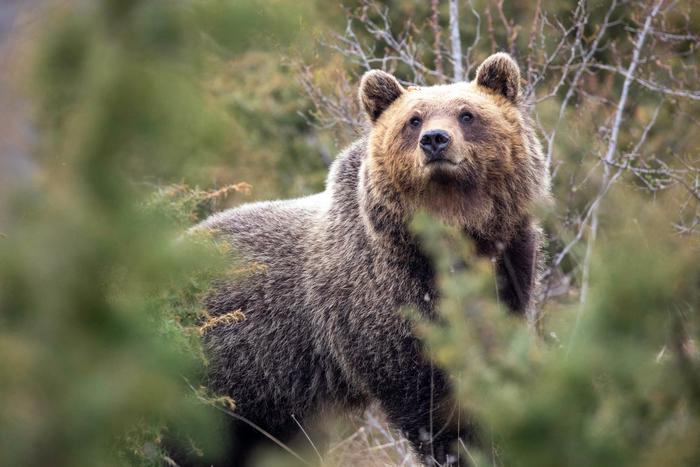
There is another way that humans provide a selective pressure on the animals that live close to us – we kill aggressive animals. A recent study shows this effect in a population of brown bears that live in Italy, close to humans. This isolated population has become its own genetic subpopulation of brown bears with distinctive features, including a genetic profile associated with less aggressiveness. Make no mistake, these are still wild animals, and brown bears are a dangerous animal. But they are less aggressive than other brown bears.
Another example are the golden jackals of Israel. They too have been living in close proximity to humans for year, resulting in “partial self-domestication”. This is likely very similar to the process of domestication of wolves into dogs. There are likely several selective pressures involved, not just humans having a higher tendency to kill very aggressive animals. Humans are also, as I said above, a source of food. Those animals that are less afraid of humans and willing to get a little closer to them have access to lots of calories, which is a massive survival advantage. At first human waste may simply be a calorie supplement, providing an advantage for calmer and less threatening-looking animals. Then, as they come to depend more and more on humans for food, the need to hunt decreases. Evolutionary pressures then favor a shift away from hunting, from being large, muscular, aggressive, and even away from camouflage. Selective pressure favor a friendlier demeaner, and cuter physical characteristics.
The end-stage of this process is full domestication, as happened with dogs, but this is a continuum. It is likely that most mammal species have the potential to be domesticated. There is the now famous experiments with laboratory domestication of silver foxes. By selecting individuals with a calmer demeanor, researchers were able to produce a semi-domesticated fox breed in a matter of decades. Interestingly, by selecting for behavior a suite of other features came along for the ride, including floppy ears, spotted coat, and a generally cuter appearance.
There is even a hypothesis that humans self-domesticated. This process may have begun with our split from Neanderthals 600,000 years or so ago, and continued into modern times. The idea is that we collectively will punish, in some way, members of our society that are very aggressive. Violent criminals may be punished in a way (execution, for example) that provides a negative selective pressure, so that over time genes for violence and aggression become less common in the population. In an intensely social setting, selective pressures may favor the ability to cooperate and get along. So the first species we domesticated may have been ourselves.
But to be clear, humans are not the sole agent of domestication. As I outlined above, the process starts with the species itself. Dogs likely self-domesticated much of the way, before humans took over and started breeding them. The trigger for this self-domestication was the availability of human waste food, but humans were not the direct agents of the process.
It is likely that nature will continue to adapt to the overwhelming presence of humans on the planet. For animals there is mostly one choice – if you want to live to have to live with humans. There are still plenty of wild refuges in the world, but they are mostly hemmed in by civilization, and they are mostly managed parks. Eventually contact with humans may be sufficient to provide selective pressures on more and more species.
The brown bear example is extremely interesting, and makes me wonder about other bear populations. There is a large and growing black bear population in Connecticut where I live. I have had black bears many times in my yard and even on my deck. They have come to associate humans with food, and are very adept at accessing human waste food or other sources (like bird feeders). It may be likely that the more contact these bears have with humans the less aggressive they will become. They will learn to live on the edges of human space without without getting killed.
Cars are another source of selective pressure. Many species may evolve behaviors to minimize their chance of being struck by a vehicle.
Human are also learning to adapt to the animals they live near. This is more cultural than evolutionary, but people who live close to wildlife generally learn the rules, just as people in CT are learning to live with black bears. This means you cannot store your bird seed outside, you cannot leave your garbage outside over night, and you need to learn to stay out of the bear’s way. People in the western part of the US have similarly learned to live in proximity to mountain lions. These animals are also moving east (filling a niche left by the killing off of most wolves in the east), and so within a few decades easterners will have to learn to live with mountain lions as well.
Make no mistake – bears and lions are still dangerous wild animals. One risk is that as these species become a little less aggressive people will act as if they are not threatening, and will put themselves unnecessarily at risk. It may be a good thing that they are less aggressive, so that the risk of dangerous human-animal interactions is reduced, but that means we need to have high awareness that these are wild animals and we need to respect their space as well. Reducing the friction between humans and animals works both ways.