Nov
13
2015
 The British National Health Service (NHS) is considering blacklisting homeopathy prescriptions from general practitioners. While this would have an overall small effect on the homeopathy market, it is politically potentially very significant.
The NHS currently spends about £4m on homeopathy each year, of which only £110,000 is from GP prescriptions. The rest is from homeopathic hospitals (yes, hospitals). The real market, however, is in over the counter homeopathic products.
In the UK, Europe and the US homeopathy has ballooned into a multi-billion dollar industry. It is now potentially, it seems, the victim of its own success. When it was smaller it essentially flew under the radar – regulators and politicians didn’t think it was worth spending political capital to reign in a fringe treatment that people either wanted or did not know or care about.
In the US the FDA specifically decided to let the homeopathic industry regulate itself, because it was simply too small for them to spend their resources on. That has now changed.
Continue Reading »
Aug
27
2015
 The FDA (Food and Drug Administration) recently asked for public comment on its regulatory policies regarding homeopathy. They probably didn’t figure that a fellow federal agency, the FTC (Federal Trade Commission) would respond.
The FTC also recently asked for public comment on how it can better regulate homeopathic product advertising. While the FDA regulates food and drugs (including supplements), the FTC regulates claims that sellers can make about those foods and drugs. The FTC is now complaining to the FDA that their policies are in inherent conflict. They write:
The staff comment notes that the FDA’s regulatory framework for homeopathic drugs, set forth in a 1988 Compliance Policy Guide, does not require that over-the-counter (OTC) homeopathic drugs be approved by FDA as safe and effective if they satisfy certain conditions, including that the product’s label contains an indication for use. Yet the policy guide does not require sellers to have competent and reliable scientific evidence to support the indication for use.
The comment states that given the FTC’s long-standing advertising substantiation policy that health claims must be substantiated by such evidence the FDA’s current regulatory framework may harm consumers and confuse advertisers.
Continue Reading »
Jun
19
2015
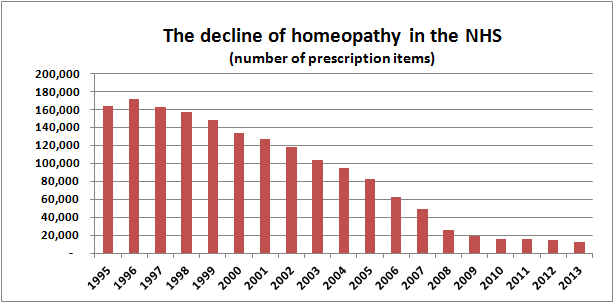
Several years ago, during a lecture on Science-Based Medicine, I noted that if there were one medical pseudoscience that was vulnerable to extinction it was homeopathy. Homeopathy is perhaps the most obviously absurd medical pseudoscience. It is also widely studied, and has been clearly shown to not work. Further, there is a huge gap in the public understanding of what homeopathy is; it therefore seems plausible that the popularity of homeopathy can take a huge hit just by telling the public what it actually is.
Further, homeopathy is in a precarious regulatory position. Homeopathic products are presented and regulated as drugs, but clearly they are not, and they are also not supplements, herbal drugs, nutrition-based, or natural products. They are simply fraudulent drugs riding a wave of ignorance.
In the last few years homeopathy has had a rough time. While the industry is still growing, there are signs of clear trouble on the horizon. Let’s review:
Some Background
Homeopathy is a 200 year old pre-scientific system of medicine based upon magical thinking. It is mostly based on two notions, the first of which is that like cures like. In other words, a substance that causes a symptom can cure that symptom in extremely low doses. There is no scientific basis for this, despite the desperate attempts by homeopaths to invoke vaccine-like analogies, or their new favorite, hormesis.
Continue Reading »
Apr
14
2015
The skeptical community is abuzz with the announcement by the FDA’s announcement that they are reviewing the “regulatory framework” of homeopathic products and are open to public input. We have written about this at Science-Based Medicine, and as you can imagine, this is a serious topic of discussion among the editors.
Background
The FDA regulates food, drugs, medical devices, supplements, and cosmetics for the purpose of protecting the public health and safety. Congress created the FDA and determines its powers. In the 1938 FDA act, one Senator, Royal Copeland, who was a physician and homeopath, included in the bill that the provision that the Homeopathic Pharmacopeia of the United States (HPUS) would be included in the list of official drugs.
What this means exactly is that homeopathic products are automatically considered drugs by the FDA. Further, any new homeopathic product added to the HPUS in a supplement also counts. All homeopaths have to do, therefore, to get a homeopathic product listed as a drug by the FDA is write it down in one of their supplements to the HPUS. That’s it. No research is necessary, no assurance of safety or efficacy.
Continue Reading »
Mar
19
2015
I was recently pointed to an excellent article by an Irish journalist, Jonathan McCrea, about homeopathy. He discussed the topic on his radio show, and was highly critical of the practice. In response a homeopath wrote in a letter complaining that the shows was too negative, and McCrea wrote a nice reply pointing out the scientific evidence. He quoted science-based medicine extensively, as well as systematic reviews.
It’s wonderful to see a science journalist who is not a scientist themselves do such a great job. As he explained himself in the reply, a good journalist will reflect the consensus of expert opinion. He also pointed out the dangers in medical nonsense and clearly understands his duty as a journalist when reporting on such issues – so good for him.
Here is the money quote from the homeopath:
What I would like to point out to your presenters is that never, in all their dismissal of homeopathy, do they seem to take into consideration the homeopaths who practice this particular brand of ‘heresy’ (heresy according to their own particular view of the world that is). If it is nonsense as they claim, then we are all either stupid, deluded or charlatans who take people’s money for something which we know does nothing. I may be many things but I am neither stupid, deluded nor a charlatan as anyone who knows me will verify. Neither are those thousands of doctors and vets who have changed from using conventional medicine to homeopathy. No homeopath or user of homeopathy comes to it from ‘belief’. We come to it from trying it, sometimes from curiosity, but often in desperation when other things haven’t worked. Then when we see it works we try it again. Then it works again and we try it more often, and it keeps working. Not every time, any more than antibiotics, or any other medicine works every time. But enough, more than enough to make us trust it.
This is a typical response – the appeal to anecdotal evidence. Clearly this homeopath does not understand the scientific position. She sets up an interesting forced choice straw man, that critics think homeopaths are either stupid, deluded, or charlatans. First, these are not mutually exclusive states. But then she equates these possibilities to using treatments which “we know does nothing.” That is a non-sequitur, however. If a homeopath is stupid or deluded then they don’t know that what they are using does nothing.
Continue Reading »
Jan
01
2015
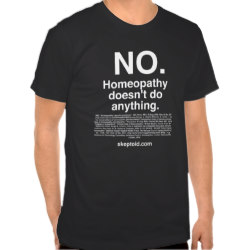 I have been saying for several years that if there is a pseudoscientific medical treatment that is especially vulnerable to critical analysis it’s homeopathy. There’s a lot of nonsense in the world of medicine, but homeopathy takes the prize. First, it is complete and utter nonsense.
There is no need to equivocate. Homeopathy violates basic scientific knowledge in physics, chemistry and biology. It is transparent witchcraft that cannot possibly work by any known or even semi-plausible mechanism. Further, clinical studies unsurprisingly show that it does not work, for anything.
And yet the public does not generally understand what homeopathy actually is. The most common belief is that homeopathy is natural or herbal medicine. Rather, homeopathy is based upon several dubious notions. The first is that like cures like, and idea based on sympathetic magic and not science or any knowledge of the real world. Further, the actual starting ingredients are based upon a fanciful and often absurd interpretation of this dubious notion, leading to things like using duck liver to treat the flu.
None of this actually matters, however, because most homeopathic remedies are diluted beyond the point that there is any chance of a single molecule of starting ingredient remaining. All of this is supposed to work, however, because the potion is “activated” by shaking it.
Continue Reading »
Oct
30
2014
New Zealand Green MP, Steffan Browning, stepped in it recently when he signed a petition asking the World Health Organization (WHO) to develop and distribute homeopathic remedies to end the Ebola epidemic. Unfortunately this is not an Onion article.
Browning later tried to do damage control by stating that his support of the petition was “unwise” and he blamed it partly on it being late at night when he signed it.
Asked whether he thought homeopathy could cure Ebola, Mr Browning said: “It’s not for me to go down that track at all. The World Health Organisation, world health authorities are doing that.”
This is a common political response. Ask a Republican eyeing national office what they think about global warming or evolution and you might get a similar answer. It is a disingenuous dodge to essentially say, “I’ll let the scientists decide.” when they have already decided. It’s simply a way to stake out a neutral position and not piss anyone off.
Continue Reading »
Jun
02
2014
 Dana Ullman is a notorious apologist for homeopathy. He has a reputation, at least among skeptics, for cherry picking data and making dubious arguments – whatever it takes in order to defend his beloved homeopathy. He then tops it off by accusing skeptics of being closed-minded for not accepting his drivel.
An article of his recently popped up on the Skeptic subreddit (posted by rzeczpospolita) with the challenge, “Countless scientific studies showing that homeopathy works. Or are you “skeptics” too closed minded to accept this fact?”
The article is too long to deconstruct in one blog post, so I will focus on the key claim – that clinical evidence demonstrates that homeopathy works. His primary piece of evidence is this:
Continue Reading »
Apr
24
2014
Edzard Ernst is one of my intellectual heroes. If you are a skeptic, you need to know who he is. He began his career amenable to the claims of alternative medicine. He became the world’s first professor of complementary and alternative medicine, and set about to do the one thing that no other CAM proponent (to my knowledge) has truly ever done – he wanted to use rigorous scientific research to find out if any specific CAM modality worked. Most proponents use research to prove that CAM does work, or simply to describe how it is used or how it can best be implemented.
Throughout the publication of his more than a thousand scientific articles, Edzard became increasingly convinced that most CAM methods simply do not work. Further, he learned what happens to people who point to the scientific truth about CAM, they are vilified by true believers.
I have to admire anyone who changes their world-view significantly in the face of scientific evidence. His intellectual honesty is refreshing.
Continue Reading »
Jun
17
2013
On two occasions I was invited to UCONN to debate the scientific legitimacy of homeopathy – in 2007, and again in March of this year. I often directly confront or debate those who hold an unscientific belief. Sometimes this is criticized as being pointless, but that claim is premised on the assumption that the only point to such a debate is convincing the person on the other side, but that is not the case.
I have several goals in direct confrontation: to better understand the claims and logic of those holding that view, to explore my own position and improve my ability to explain it, and to demonstrate scientific and critical thinking with respect to this issue to the audience.
The more recent homeopathy debate was between me an Andre Saine, a Canadian naturopath and homeopath. During the debate we barely scratched the surface of this complex topic, so we both agreed to continue our discussion in writing, moderated by Peter Gold who organized the debate.
Here is Andre’s first question to me, and my answer.
Continue Reading »