Aug 27 2012
Looking Back at TWA Flight 800
On July 17, 1996 TWA flight 800 took off from JFK airport on its way to Paris. Fifteen minutes into its flight, shortly after climbing to about 13,000 feet, the jet exploded in mid air. The nose of the jet fell off into the Atlantic while the rest continued to fly, erratically while on fire and spewing smoke, until 42 seconds later when there was a second explosion. The right wing and the rest of the fuselage separated and descended as two separate streams of burning debris until they hit the surface of the water 7 seconds later. All 230 people aboard lost their lives.
Sixteen years later there are still those who believe that TWA flight 800 was shot down by a missile. This is despite the fact that the largest and most expensive investigation in history into the crash of a commercial airliner came to a very different conclusion. I had the opportunity this past week to speak to six different eyewitnesses of this tragedy, some of whom firmly believe a missile took down the jet, while others are unsure. The incident remains a classic historical case demonstrating the fallibility of perception and eyewitness accounts.
The Official Version of Events
The NTSB, FBI, FAA, CIA, and even NASA were involved in the investigation of the explosion of flight 800. At first everyone assumed it was a bomb. Jets don’t just spontaneously explode in mid-air. Then eyewitness accounts of a missile strike starting coming in and that became a viable theory (and that is also when the CIA became involved). The FBI interviewed 270 different eyewitnesses, mostly people on Long Island, who had an excellent view of the entire episode from the beach or further inland. There were also eyewitnesses on boats, surfing, and even aboard other airplanes.
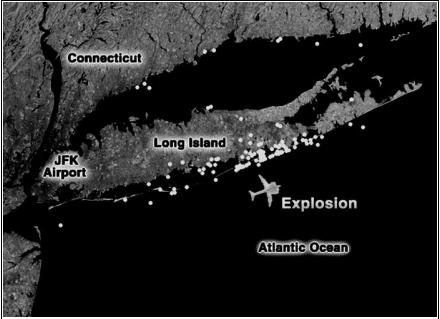
The CIA did an extensive analysis of this eyewitness evidence, together with the physical evidence (such as the location of the debris field) and radar evidence and put together a reconstruction of what happened. The scenario I described above is what they concluded – the jet exploded, flew erratically for 42 seconds, then exploded again losing the right wing, with the two sections falling for 7 more seconds until they hit the water. The total time of the incident from first explosion was therefore 49 seconds. In the graphic above, taken from the CIA report, the white dots represent the location of the eyewitnesses.
The NTSB managed to recover over 95% of the plane (and all of the bodies) – a herculean task. From the physical evidence it was clear that no missile struck flight 800. There was no impact zone, no pitting in the metal, no petaling like would be caused in a high-energy explosion. The NTSB ultimately concluded that the center wing tank (CWT) exploded due to mechanical failure. The tank was only 5% full at the time, which means the rest of the tank was full of fuel vapor. The plane had been sitting at JFK during the day with the air conditioners running – they sit right behind the CWT and would have heated up the tank. The climb to 13,000 feet would have caused more fuel vapor due to the lower pressure.
The NTSB concluded that the most likely scenario was that a spark in the fuel gauge of the CWT ignited the heated vapor in the tank. It was the perfect storm of conditions leading to the initial explosion. The jet, a Boeing 747 model 131, was 27 years old.
What the Eyewitnesses Saw
With the official reconstruction of events in mind, it is very interesting to read or hear eyewitness accounts of what they saw. The CIA commented on the fact that eyewitness accounts were remarkably consistent in certain details, and I found this also in the few witnesses I spoke to. Many witnesses had their attention drawn to the event by the sound of the initial explosion. Others were looking south over the water (a common event near sunset on the shore) and noticed the stream of smoke and fire.
Most witnesses at first assumed they were looking at a firework or a flare. This culminated in an explosion, with two streams of burning debris falling to the horizon. Thirty-eight of the eyewitnesses specifically reported that they saw this flare rise up vertically from the ocean, while many others report that it was traveling horizontally (they are divided as to which direction it was traveling).
In addition some (but not all – depending on their location) of the witnesses also heard one or both explosions. One witness I spoke to also heard a “zipping” sound right before the explosion, while another described it as a “pffft” sound. The timing of the audible explosions turns out to be a critical bit of evidence (often dismissed by conspiracy theorists). Flight 800 was 9 miles south of Long Island and almost 3 miles up when it exploded. The CIA calculated how long it would have taken for the sound of the explosion to reach the nearest witnesses on land – and that time is 42 seconds. Most witnesses were farther away and would have heard the explosion 50 seconds or longer after it occurred.
And yet, the witnesses who heard the sound report that it occurred either simultaneously with or shortly after the explosion that they saw. This made perfect sense to them at the time. Their brains constructed the incoming sensory information as a rocket ascending into the sky and culminating in an explosion that they both saw and heard.
It is notoriously difficult to judge distance, velocity, size, and also angles of objects and movement in the sky. There are no depth cues – the brain has insufficient evidence to accurately reconstruct what it is seeing, so it does the best it can, making likely assumptions. Unfortunately, we did not evolve with jets flying overhead. We evolved largely concerned with the narrow plain of our horizontal world, where there are usually foreground objects that help us judge relative distance, and we know the size of objects are can therefore judge their distance. This system fails when viewing objects against the sky.
One witness I spoke to had assumed the crash occurred on land, close to where he was. He had no idea he was viewing something happening a dozen miles away.
The laws of physics, however, are remarkably reliable. Witnesses saw a glowing trail of smoke. Many of them report that the trail zig-zagged, then exploded. Of the witnesses I spoke to, they also heard the explosion between 2 and 12 seconds later. Their 16 year-old memories may be a bit off, but this accords with their testimonies given right after the event. Their judgment of time may also be off, but I doubt they confused 50 seconds with 2 seconds.
It is clear, in my opinion, that the witnesses heard the first explosion shortly after they saw the second. The timing works out perfectly. The “flare” (that some people believe was a missile) was therefore flight 800 itself, after the first explosion, while it was flying erratically on fire and spewing smoke.
Some have therefore speculated that the sound they were hearing was the launch of the missile. It is impossible, however, that so many eyewitnesses covering a large distance would have all heard this launch. Some eyewitnesses felt the concussion of the explosion – a rocket launch would not have caused this to witnesses miles away. There are also no shoulder mounted surface to air missiles with the range to reach flight 800 from the shore. A missile launched from the water would have been farther away than the jet itself.
No eyewitness reports seeing a missile hit an intact jet, and then 42 or more seconds later hearing the first explosion.
The fact that 38 of the witnesses saw the “flare” climb vertically was confusing, even to the investigators. This led the CIA to assume that the jet itself flew vertically for a time after it exploded, but this is very unlikely, and that reconstruction was widely criticized as implausible. They later revised their reconstruction to take this criticism into account, give the jet a much gentler angle of ascent after the explosion.
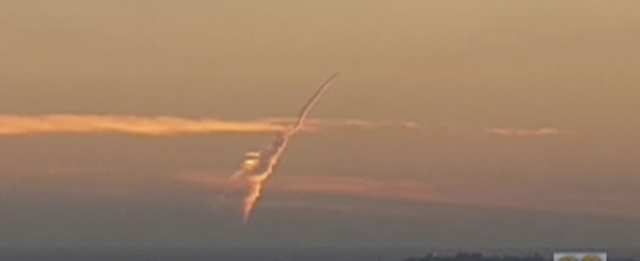
I don’t think the jet had to climb at all to explain why some of the witnesses interpreted what they saw as something climbing vertically. Remember the mystery missile that hundreds of eyewitnesses saw on the West Coast in November of 2010? It turned out to be only the contrail of a jet (the specific jet is a matter of debate, but it seems likely is was UPS902 from Honolulu flying through southern California). The nearly vertical path of the jet was nothing but an optical illusion.
Conclusion
Many people, including some of the witnesses I spoke to, are convinced to this day that a missile struck TWA flight 800. It is clear, however, that no one saw a missile strike that jet. The physics of the situation makes that impossible to square with what the witnesses saw and heard. There are witnesses who saw a rocket (or something like a rocket) climb vertically then explode, with the sound of the explosion coming at or within seconds of the explosion, and the two trails of debris falling to the horizon about 7 seconds later.
They could not have been viewing and hearing a missile strike an intact flight 800. The timing does not work, but it does fit with them viewing the second explosion at about the time they heard the first, and this also fits the subsequent two streams of debris taking about 7 seconds to fall into the Atlantic. The zig-zagging also fits better with a jet that has already exploded and lost its cockpit rather than a surface to air missile.
We therefore know with a high degree of confidence that people can believe they saw a missile when they didn’t. This fits with everything we know about the nature of optical illusions and the difficulties in constructing visual information against the sky. We also have other events, like the LAX “missile,” that demonstrate this optical illusion effect.
Yet some people are left with the unshakable belief that they saw a missile. They “know what they saw” and the word of the government is not enough to shake their confidence in their own senses and memory.