May
19
2017
Andrew Snelling is a young-earth creationist with a PhD in geology who wants to study the Grand Canyon. The National Park Service (NPS), which regulated who gets to do science in Grand Canyon National Park, turned down his application. You can probably guess what happened next.
Snelling is now suing the NPS and the Department of Interior for religious discrimination. He claims his application was turned down because of his religious views. That does not seem to be the case. The NPS had experts review his application. They determined that his science was not valid, and that the rocks he wanted to remove from the park could be found elsewhere. The NPS is particularly careful about any research that involves removing material from parks.
It seems clear to me that the NPS is on solid ground (heh). They already have a process in place to determine if scientific applications are for worthy science and if they justify the removal of material from a park. They did proper peer-review and abided by the recommendations of their experts. This does not appear to have anything to do with what Snelling believes, but the quality of his science. Snelling is now being a whiny b**ch. He also appears to be using this for propaganda purposes, which may have been the whole idea from the beginning.
Continue Reading »
May
12
2017
 I honestly don’t care what people choose to believe about unknowable speculations outside the realm of science and human knowledge. As long as they don’t use such belief as justification for public policy or to infringe on the rights of others, believe whatever you want.
However, once someone claims that they have scientific evidence for a supernatural belief, or can prove such a belief logically, then they have stepped into the arena of logic and science and their claims can be examined.
One such claim is that the existence of God can be proven through various logical arguments. I have never seen such an argument that I found even slightly compelling. They all have gaping holes in their logic. The latest incarnation comes from Robert Nelson, who appears to be promoting his 2015 book, “God? Very Probably.” He claims to have five rational arguments that lead to the conclusion that God very probably exists. Let’s take a look. Continue Reading »
Mar
27
2017
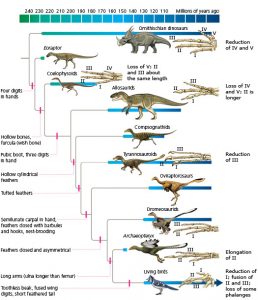 The fossil evidence for the evolution of birds is currently one of the greatest evolutionary stories we have to tell. It is also a home run for the predictive value of evolutionary theory and is a devastating blow to any denial of common descent.
Darwin published On the Origin of Species in 1859. At that time the fossil record was sparse, although it was enough to establish that the forms of living things was changing over geological time. One of the most dramatic gaps in the fossil record at the time was between birds and other vertebrates. It was believed that birds must have evolved from some type of reptile, but the most recent common ancestor was not known.
This was a great test for the new theory of evolution. If evolution were true then birds must have evolved from something else, and therefore the gap between birds and their closest non-avian relative should eventually be filled in by future fossil finds. If evolution is true, those creatures must have existed.
If, on the other hand, some version of creationism were true so that was created close to its current form, then there would not have to be any creatures filling in the morphological space between birds and their closest relatives. Birds would not have any relatives, they would be an isolated group unto themselves.
Continue Reading »
Jan
30
2017
 As we enter a new legislative session in many states we are also faced by a new wave of anti-evolution bills. Creationists have been trying to undermine the teaching of evolution in public schools since Scopes in the 1920s. They have essentially been unsuccessful legally but successful culturally. For the first half of the 20th century they made the “e” word too controversial for textbooks. Since then they have provided cover for teachers in the Bible Belt to teach creationism or falsely criticize evolution.
In a 2011 survey, only 28% of high school biology teachers reporting following National Research Council and National Academy of Sciences recommendations in teaching evolution, and 13% reported that they openly advocated creationism.
This, of course, refers only to public schools. Private schools can openly teach creationism, which is exactly why Trump’s pick for education secretary, Betsy DeVos, has spent so much effort and money promoting school vouchers and private schools.
Legally anti-evolution efforts have consistently run up against that pesky First Amendment, which guarantees religious freedom. The Supreme Court has interpreted this to mean that the government (Federal or State) cannot promote any specific religion or religious belief. Creationism is a religious belief, not science, no matter how creationists try to dress it up, therefore it doesn’t fly.
Continue Reading »
Dec
13
2016
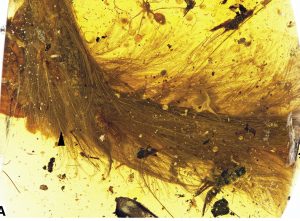 Lida Xing from the China University of Geosciences in Beijing was walking through an amber market in Myitkina, Myanmar when he discovered a rather interesting specimen. The seller believed that the large chunk of fossilized tree sap they were selling contained plant material. Xing recognized that it contained primitive feathers. Even more exciting, those feathers were not connected to a bird ancestor, but to the tail of a dinosaur.
A scientific analysis of that specimen has now been published in Current Biology.
This is a tremendous specimen for a number of reasons. Scientists interested in the evolution of feathers have been trying to piece together the developmental steps that occurred and in what order in order to transform scales into feathers. Developmental biology itself provides some clues – the path that feathers take when they develop in the embryo likely reflect their evolutionary history. It would be nice, however, to confirm this hypothesis with actual specimens.
Up until now paleontologists have had two kinds of fossil feathers. The first is feather impressions associated with fossil specimens. The advantage of this kind of evidence is that we know exactly what species the feathers belong to and so they can be placed in a phylogenetic tree of feathered dinosaurs, both avian and non-avian. The disadvantage is that the feather impression are compressed, so the three-dimensional information may be lost, and they often lack fine detail.
Continue Reading »
Dec
01
2016
 In September I wrote an article about a recent experiment at Harvard Medical School in which they created a very large agar plate in order to visualize bacterial colonies evolve drug resistance over time. I was primarily responding to Michael Behe’s argument that this experiment did not show evolution but “devolution.”
Recently Cornelius Hunter over at Evolution News and Reviews (a propaganda blog of the Discotute) wrote a response to my article. Hunter’s response is yet another example of how creationists engage in motivated reasoning and fail to either understand evolution or meaningfully engage with the scientific community. In fact, I found Hunter’s article to be largely incoherent, which is common because creationists are not trying to formulate a coherent scientific theory. They are just trying to provide cover for their ideological beliefs by creating doubt and confusion.
The first actual point I think I can extract from Hunter’s article is that the changes to the bacteria seen in the Harvard experiment were not actually evolution, just adaptation. He writes:
What Novella does not acknowledge, however, is that bacteria adaptation research, over several decades now, has clearly shown non-evolutionary change. For instance, bacterial adaptation has often been found to be rapid, and sensitive to the environmental challenge. In other words, when we look at the details, we do not find the evolutionary model of random variation slowly bringing about change, but rather environmentally directed or influenced variation.
That is not evolution. And indeed, the Harvard experiment demonstrated, again, very rapid adaptation. In just ten days the bacteria adapted to high doses of lethal antibiotic. As one of the researchers commented, “This is a stunning demonstration of how quickly microbes evolve.”
True, it is “stunning,” but “evolve” is not the correct term. The microbes adapted.
This is one common intellectual trick used by creationists – shift around your definitions as needed in order to manufacture apparent contradictions or at least confusion. Hunter is not working from a coherent operational definition of evolution. He gives no indication that he understands evolutionary theory, but that is hard to know through the fog of motivated reasoning.
Continue Reading »
Sep
19
2016
Researchers at Harvard did a clever thing. They created a giant plate on which to grow bacteria, and included in the plate increasing concentrations of an antibiotic as you moved toward the center. They then plated bacteria on the outer edges and made a time-lapse video of the bacteria growing.
The end result was a video showing the evolution of progressive antibiotic resistance in the bacteria. You can actually see adaptive radiation, as the bacteria push up against the boundary to the next higher concentration of antibiotics, then multiple locations start to spawn new colonies spreading in the next zone.
The researcher made some more nuanced observations as well. For example, the bacterial grow slowed with new mutations, meaning they sacrificed something with the resistance mutation, but then they sped up again as they further evolved. Further, the most resistant bacteria were often not at the leading edge but were stuck behind less resistant bacteria.
Continue Reading »
Aug
05
2016
 It is my universal experience, after more than thirty years of confronting various forms of evolution denial or creationism, that creationists simply do not understand evolution. If any do understand it, they pretend not to. I guess they have no choice – they are motivated to deny an established scientific theory. They need to pretend they know better than the world’s experts, or that the world’s experts are lying and deceitful.
Mike Pence is a run-of-the-mill creationist. His denial of evolution is unremarkable and unimaginative, but now he is running for Vice President so his views serve as a ripe target for criticism. In a speech before the House he decided, for some reason, to go on a rant against evolution. For those who are interested, it is a good opportunity to play “name that logical fallacy” and you may want to watch the video and count the errors before reading ahead.
Pretty much everything Mike Pence says in the speech is wrong or misleading, except for trivial facts. He starts by setting the stage with Darwin publishing On the Origin of Species and presenting the theory of evolution. That evolution is just a “theory” is a main theme of his speech, which I will get to in a moment, but first he follows up by saying that Darwin expected his theory to be proven correct by the fossil record. He concludes that Darwin did not live to see this happen, and neither have we.
Is Evolutionary Theory Proven? Continue Reading »
Apr
08
2016
 Pointing out how completely illogical and unscientific are creationists is something I need to do on a regular basis here. A creationist who regularly trolls the SGU Facebook page recently posted this video, which is a great opportunity to meet my creationist debunking quota.
Like all creationist propaganda, the video does not make any serious or legitimate scientific points. The purpose is just to provide a plausible screen for denying one of the most solid scientific facts every established – that life on Earth is the product of organic evolution.
The video is a collection of “gotcha” ambushes of students and scientists, asking them loaded questions that defy a simple answer (because first you would have to unpack all the false assumptions in the question itself). It’s natural to pause after such a question, while considering how best to approach it. The segments often cut out after the initial partial response followed by a “gotcha” follow up statement by the interviewer.
Continue Reading »
Feb
11
2016
 Ever since the theory of evolution won over the scientific community and became the established consensus scientific opinion, creationists have fought a cultural and legal war against it. They failed to win the scientific war, and they continue to do so.
This is not an uncommon tactic – if you lose in the arena of science, evidence, or facts, then fight in the arena of public opinion or regulation. Pseudoscientists are unfortunately savvy to this tactic.
In the case of evolution, creationists tried banning its teaching outright, which was eventually struck down as unconstitutional. So they demanded equal time, which was eventually struck down as unconstitutional (teaching religion as science in public schools). So they tried to disguise creationism as intelligent design, which didn’t fool anyone.
Continue Reading »